Fibermaxxing, Measured in Grams and Calories
Last updated: September 12, 2026
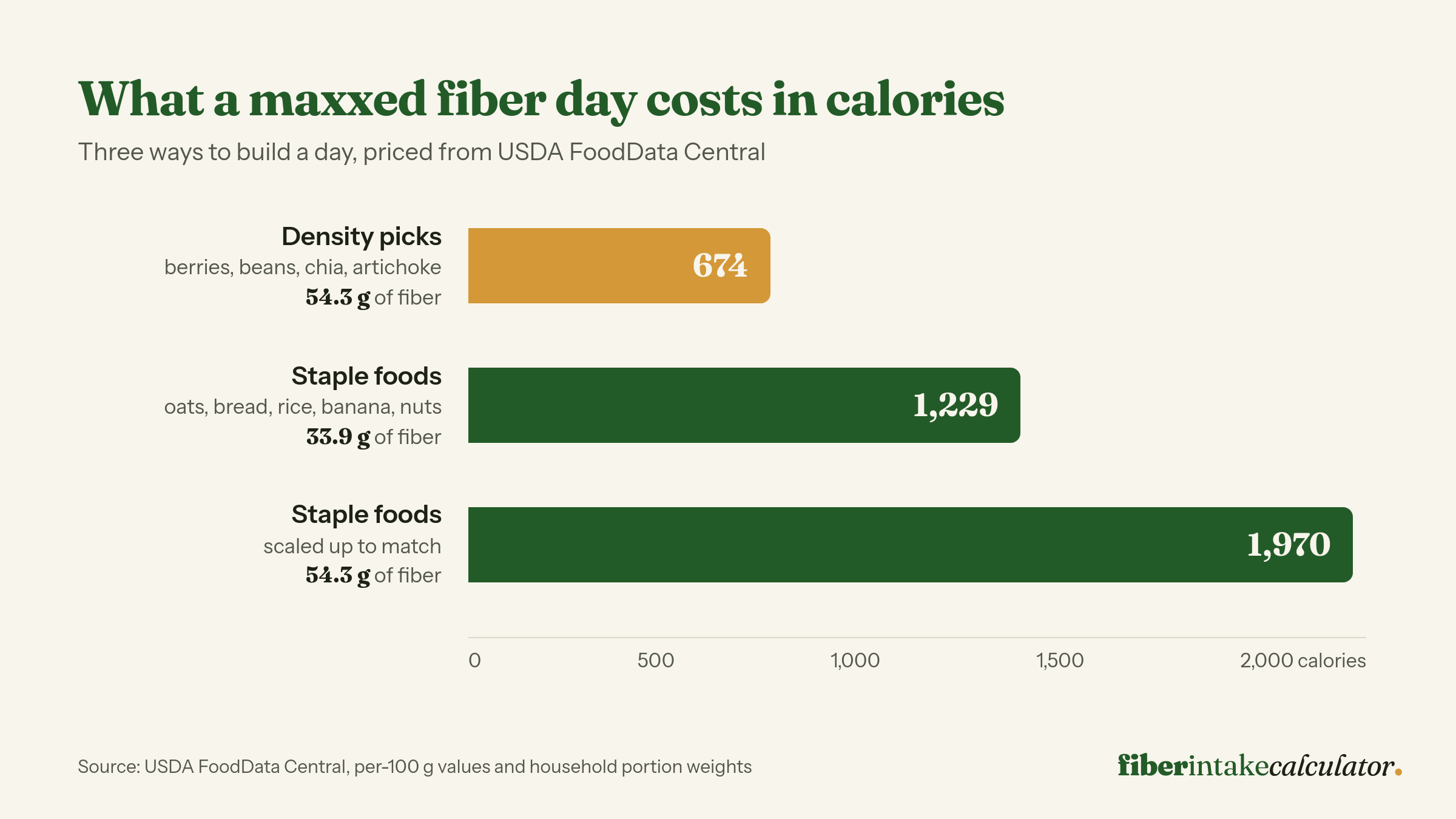
Fibermaxxing is the social media habit of pushing daily fiber well past the usual recommendation. Built from the densest foods, a 54.3 gram day costs 674 calories. Built from the staple foods most articles recommend, the same 54.3 grams costs about 1,970 calories, which is close to a whole day of eating.
That ratio is the part the trend leaves out. Fiber has no toxic dose and no official upper limit. What it has is a price in calories, and the price varies by a factor of three depending on which foods you reach for.
Every figure here comes from USDA FoodData Central, using each food’s per 100 gram values and USDA’s own household portion weights, read in September 2026. Work out your own target first with the fiber calculator, then read on for what hitting it actually costs.
Nobody agrees on what fibermaxxing means
Read the pages ranking for this term and you get seven different answers. Here is what each one actually says.
| Source | Daily target it states | Where it puts the ceiling | Ramp rate it gives |
|---|---|---|---|
| Institute of Medicine, 2005 | 25 g women, 38 g men, ages 19 to 50 | No upper limit set | Not addressed |
| UCLA Health | 25 g women, 38 g men | No upper limit, calls the term a misnomer | Slowly, no number |
| Brown University Health | At least 25 to 30 g | Not stated | 5 g every few days |
| Ohio State | 25 to 35 g typical range | 50 g raises risk, other sources say 70 g | Gradually over several weeks |
| University of Utah | 25 g women, 38 g men | No official upper limit | 5 g per day for 5 days, repeat |
| Mayo Clinic Press | 25 g women, 38 g men | Not stated | Over weeks, not days |
| Google AI Overview | 25 g women, 38 g men | 50 to 60 g overwhelms digestion | 3 to 5 g per week |
The targets cluster. The ramp rates do not: 3 grams per week at one end, 5 grams per day at the other, a sevenfold spread in advice about the one thing that decides whether your week goes well.
There is no upper limit to exceed. The Institute of Medicine set an Adequate Intake for fiber and no Tolerable Upper Intake Level, which is why every page above hedges differently on the ceiling. Full references are on our sources page.
The ceiling on fibermaxxing is calories
Fiber comes attached to food, and food comes with energy. Build the same 54.3 gram day two ways and the calorie bill splits.
The density day: 54.3 grams for 674 calories
| Food | Fiber | Calories |
|---|---|---|
| Navy beans, cooked, 1 cup (182 g) | 19.1 g | 255 |
| Chia seeds, 1 oz (28 g) | 9.8 g | 138 |
| Raspberries, 1 cup (123 g) | 8.0 g | 64 |
| Artichoke, 1 medium (120 g) | 6.8 g | 64 |
| Bran flakes, 3/4 cup (30 g) | 5.5 g | 98 |
| Broccoli, cooked, 1 cup (156 g) | 5.1 g | 55 |
| Total | 54.3 g | 674 |
Six items, 674 calories, and a third of a typical day’s energy still unspent. That works out to 12.4 calories per gram of fiber.
The staples day: 33.9 grams for 1,229 calories
These are the foods the ranking articles name first: oats, whole grain bread, brown rice, fruit, nuts.
| Food | Fiber | Calories |
|---|---|---|
| Pear, 1 medium (178 g) | 5.5 g | 101 |
| Apple with skin, 1 medium (182 g) | 4.4 g | 95 |
| Oats, dry, 1/2 cup (40 g) | 4.1 g | 153 |
| Whole wheat bread, 2 slices (64 g) | 3.8 g | 161 |
| Sweet potato, 1 medium (114 g) | 3.8 g | 103 |
| Almonds, 1 oz (28 g) | 3.5 g | 164 |
| Brown rice, cooked, 1 cup (202 g) | 3.2 g | 248 |
| Banana, 1 medium (118 g) | 3.1 g | 105 |
| Corn, 1 medium ear (103 g) | 2.5 g | 99 |
| Total | 33.9 g | 1,229 |
Nine items, 1,229 calories, and it still lands 4.1 grams short of the 38 gram target for men. That is 36.3 calories per gram of fiber, roughly three times the density day. Keep going at that rate to reach 54.3 grams and you spend about 1,970 calories, which for most adults is the whole day.
This is why the trend stalls. People who try to maxx on bread, rice and nuts run out of calories before they run out of target, then conclude that fiber is hard. The fiber is not the problem. The carrier is.
The cheapest grams in the shop
Sort the same foods by what each gram of fiber costs in calories and the shopping list writes itself. It is the same logic that orders our high-fiber food rankings, applied to a whole day rather than one aisle: see the vegetables ranking for the cooked-versus-raw effect and the fruits ranking for why berries sit at the top of every density list.
| Food | Fiber | Calories | Calories per gram of fiber |
|---|---|---|---|
| Raspberries, 1 cup (123 g) | 8.0 g | 64 | 8.0 |
| Blackberries, 1 cup (144 g) | 7.6 g | 62 | 8.2 |
| Artichoke, 1 medium (120 g) | 6.8 g | 64 | 9.4 |
| Broccoli, cooked, 1 cup (156 g) | 5.1 g | 55 | 10.8 |
| Navy beans, cooked, 1 cup (182 g) | 19.1 g | 255 | 13.4 |
| Chia seeds, 1 oz (28 g) | 9.8 g | 138 | 14.1 |
| Split peas, cooked, 1 cup (196 g) | 16.3 g | 231 | 14.2 |
| Lentils, cooked, 1 cup (198 g) | 15.6 g | 230 | 14.7 |
| Green peas, frozen, 1/2 cup (80 g) | 3.6 g | 62 | 17.2 |
| Bran flakes, 3/4 cup (30 g) | 5.5 g | 98 | 17.8 |
| Pear, 1 medium (178 g) | 5.5 g | 101 | 18.4 |
| Apple with skin, 1 medium (182 g) | 4.4 g | 95 | 21.6 |
| Sweet potato, 1 medium (114 g) | 3.8 g | 103 | 27.1 |
| Banana, 1 medium (118 g) | 3.1 g | 105 | 33.9 |
| Oats, dry, 1/2 cup (40 g) | 4.1 g | 153 | 37.3 |
| Corn, 1 medium ear (103 g) | 2.5 g | 99 | 39.6 |
| Whole wheat bread, 2 slices (64 g) | 3.8 g | 161 | 42.4 |
| Almonds, 1 oz (28 g) | 3.5 g | 164 | 46.9 |
| Brown rice, cooked, 1 cup (202 g) | 3.2 g | 248 | 77.5 |
Raspberries deliver a gram of fiber for 8 calories. Brown rice charges 77.5 for the same gram, nearly ten times as much. Both are whole foods and both are fine to eat. Only one of them is a tool for hitting a high number.
Note where the bran cereal lands: 17.8 calories per gram, mid-table, despite being the densest thing in most supermarkets by weight. Small servings do that. Our high-fiber cereal ranking shows why the serving weights on those boxes are not comparable.
A five-week ramp to your number
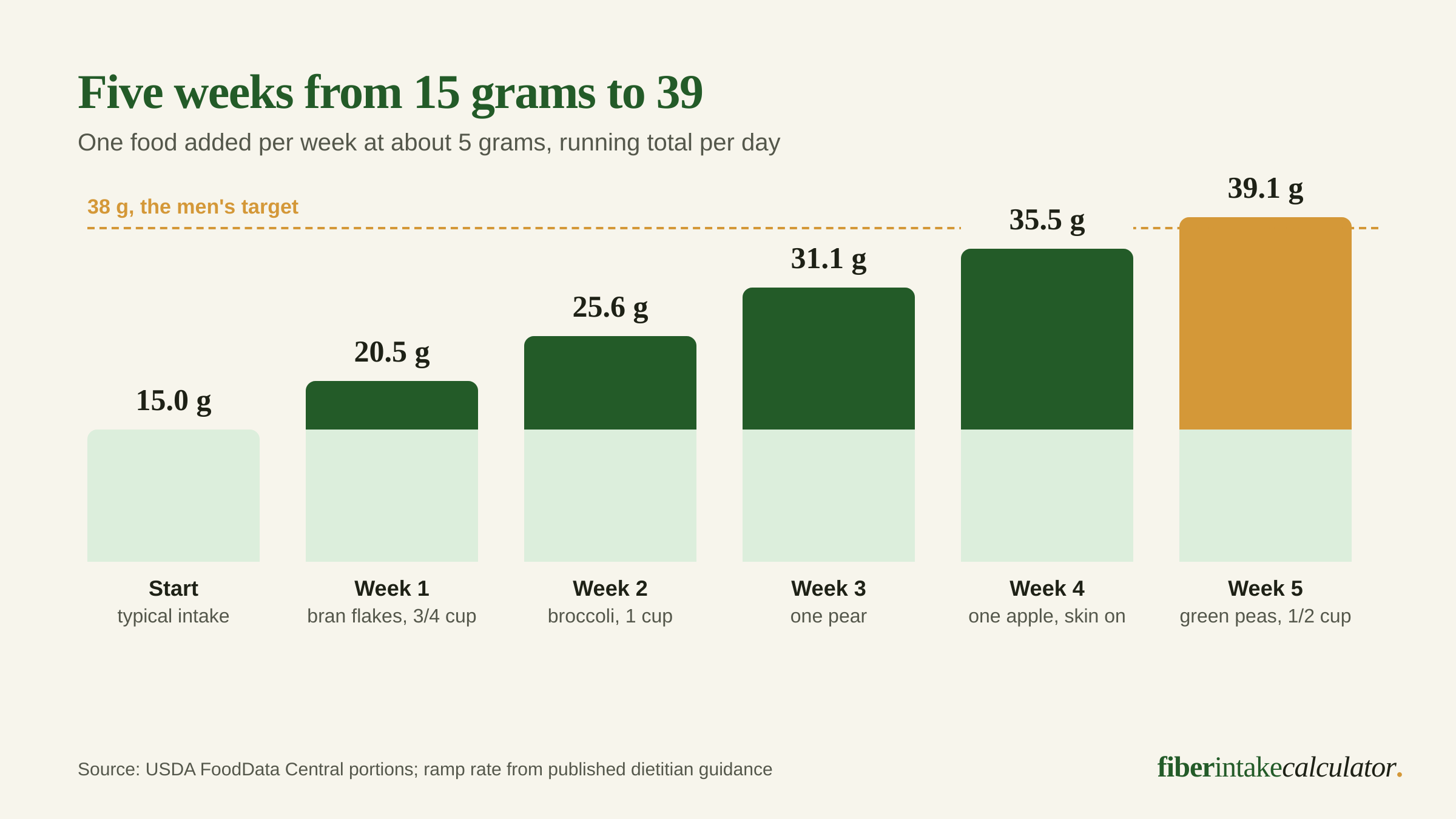
Typical intake sits near 15 grams a day, the figure UCLA Health’s dietitian gives. Adding about 5 grams a week and holding each step for a full week puts you past both Adequate Intake targets inside five weeks.
| Week | What you add, every day | Fiber added | Calories added | Daily total |
|---|---|---|---|---|
| Start | Nothing yet, this is the baseline | 0 g | 0 | 15.0 g |
| Week 1 | Bran flakes, 3/4 cup (30 g) | 5.5 g | 98 | 20.5 g |
| Week 2 | Broccoli, cooked, 1 cup (156 g) | 5.1 g | 55 | 25.6 g |
| Week 3 | One medium pear (178 g) | 5.5 g | 101 | 31.1 g |
| Week 4 | One medium apple, skin on (182 g) | 4.4 g | 95 | 35.5 g |
| Week 5 | Green peas, frozen, 1/2 cup (80 g) | 3.6 g | 62 | 39.1 g |
The 25 gram target for women is met in week two. The 38 gram target for men is met in week five. The whole ramp adds 411 calories a day and 24.1 grams of fiber, which is 17.1 calories per gram, better than the staples day and worse than the density day.
Two rules make it work. Add one item and change nothing else, so that if something goes wrong you know what did it. And hold each step a full week, because the gut bacteria that ferment the new fiber need days, not hours, to adjust.
If your target is not 25 or 38 grams, the calculator works it out from your calorie intake using the 14 grams per 1,000 calories basis, and our methodology page shows the arithmetic.
What going too fast actually does
The symptoms of overshooting are consistent across every source on the search results page: bloating, gas, abdominal cramping, and, unhelpfully, constipation. Ohio State also lists diarrhea, reduced absorption of iron, zinc and calcium, and phytobezoar, a rare intestinal blockage.
Two mechanisms explain most of it. Fermentable fiber feeds gut bacteria that produce gas, and a sudden increase produces more gas than your gut is used to clearing. The gas is the fermentation, so it is not a sign of doing it wrong, which is the point our page on high-fiber foods for gut health starts from. Gel-forming fiber holds water, so it needs water to move, which is where the constipation comes from.
That last one is the irony of the trend: the symptom people are often maxxing to fix is also the one overshooting can cause. If regularity is your actual goal, the trial evidence points at a much smaller and more specific dose, which we set out on our page about fiber for constipation.
The gas side depends on which fiber you added. A cup of beans and a bowl of wheat bran behave differently in the colon, which is the distinction our soluble and insoluble fiber page covers in detail.
Water, and the only number anyone actually prints
Every article says drink more water. None of them says how much, because for whole foods there is no established ratio.
There is one place a real number exists. Under 21 CFR 201.319, any product sold in dry form with psyllium, methylcellulose, guar gum, glucomannan or polycarbophil as its active ingredient must carry the direction to take it with at least 8 ounces, a full glass, of water or other fluid, alongside a choking warning. That rule exists because these fibers swell, and swelling in the esophagus is the risk it was written for.
So the only enforceable fiber and water number applies to supplements, not vegetables. It is a reasonable habit to borrow: a glass of water with each meaningful addition of fiber. Our fiber supplement comparison covers dosing for the products that rule governs.
Who should not be fibermaxxing
Some conditions call for less fiber, not more. Ohio State lists active Crohn’s disease or ulcerative colitis, bowel obstruction, diarrhea, diverticulitis, a new colostomy or ileostomy, recent intestinal surgery, and colonoscopy preparation. In most of those cases the restriction is temporary.
UCLA Health adds irritable bowel syndrome to the list of reasons to take it carefully, and Ohio State suggests older adults and anyone taking corticosteroids check first. If any of that applies to you, the target on this page is a conversation to have with your clinician, not a number to chase.
There is a psychological version of the same warning. Ohio State’s dietitians flag obsessive tracking, anxiety about missing a target, and constant worry about fiber quality as signs the trend has stopped helping, and argue for fiber-meeting rather than fiber-maxxing. Mayo Clinic Press makes the nutritional version of the point: a diet optimized for one number tends to lose calcium, protein and healthy fats along the way.
If your reason for maxxing is appetite control rather than digestion, the mechanism and the evidence are different again, and our fiber for weight loss page is the better starting point.
Frequently asked questions
How much fiber is fibermaxxing?
Nobody agrees, and that is the honest answer. Ohio State puts the maxxing range at 25 to 35 grams a day, Brown University Health at 25 to 30, and UCLA Health and University of Utah both use the Institute of Medicine figures of 25 grams for women and 38 grams for men. Google's own summary of the trend describes people pushing past 50 grams. Since the Institute of Medicine never set an upper limit for fiber, the number you land on is a choice, not a rule.
Is fibermaxxing good for you?
Getting from a typical 15 grams a day to your Adequate Intake is well supported and is what most of these pages are actually recommending. Pushing far past it is where the evidence thins out and the side effects start. Ohio State's dietitians make the sharper point that the goal should be meeting your fiber target rather than maximizing it, and they flag obsessive tracking as its own problem.
How fast can I increase fiber safely?
Published advice ranges from 3 grams per week to 5 grams per day, roughly a sevenfold spread. The slower end is the safer default: about 5 grams per week, held for a full week before the next step, which is the pace the five-week table on this page uses. Mayo Clinic Press puts it as increasing over weeks rather than days.
Can you eat too much fiber?
There is no Tolerable Upper Intake Level for fiber in the Institute of Medicine's 2005 reference intakes, so there is no official ceiling. Ohio State cites figures suggesting problems above roughly 50 grams a day and other sources putting that nearer 70 grams, and names reduced absorption of iron, zinc and calcium among the risks. The practical limit for most people arrives sooner than either number, as bloating and gas from moving too fast.
Do I need a supplement to fibermaxx?
No, and University of Utah's dietitians say supplements are unnecessary unless you are dealing with constipation. A supplement is a way to add a known dose quickly, which is also how people overshoot. If you do use one, the label direction requiring at least 8 ounces of liquid per dose is a federal rule, not a suggestion.
Built and maintained by the FiberIntake team, with data from USDA FoodData Central and peer-reviewed sources. Figures are checked against the cited source before publish. About this site →