High-Fiber Foods, Ranked
Last updated: September 6, 2026
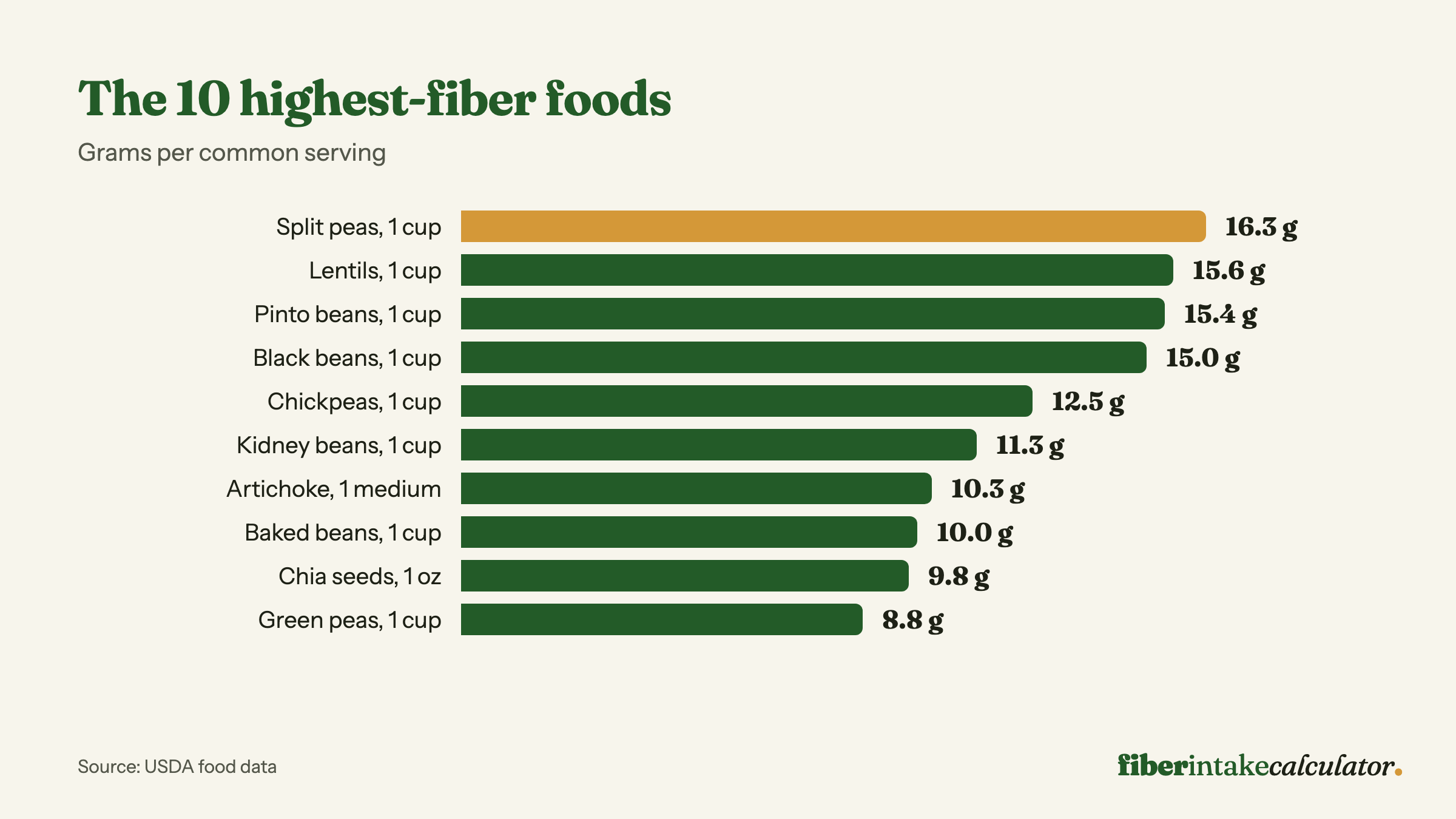
Sort the chart by any column. The % of your target column is personal: it uses the result you saved in the fiber calculator, or the FDA Daily Value of 28 g until you have one.
Six foods here reach double digits per serving, and all of them are legumes or seeds. That’s the practical shortcut this chart makes obvious: one daily serving of legumes does a third of the work, and no amount of salad substitutes for it.
It is also why food beats a jar. A cup of cooked lentils carries more fiber than any single dose in our comparison of the best fiber supplements, where a labeled serving ranges from 0.5 to 9 grams.
Picking from the top of this chart is also what makes a high daily total affordable. Six items from here reach 54.3 g of fiber for 674 calories, while the same total built from staple foods costs about 1,970, which is the trade-off at the center of the fibermaxxing trend.
Legumes do most of that work, and the group is deeper than this chart shows. Our ranking of legumes high in fiber computes 44 rows from USDA records and puts navy beans on top at 19.1 g per cooked cup, ahead of every bean the published lists start with. It also separates cooked, canned and dry, which is where most bean numbers in circulation go wrong.
Fruit is the group people ask about most, so it has its own page. The high-fiber fruits chart ranks 28 fruits by serving and by fiber per calorie, and puts numbers on what peeling and juicing cost you.
Berries are the corner of the fruit aisle people ask about by name, so they have a table of their own. The high-fiber berries ranking computes 23 rows and settles the two questions the published lists dodge: wild blueberries carry 6.2 g a cup against 3.6 g for farm-grown, and the eight-row lists in circulation stop before elderberries, loganberries and gooseberries.
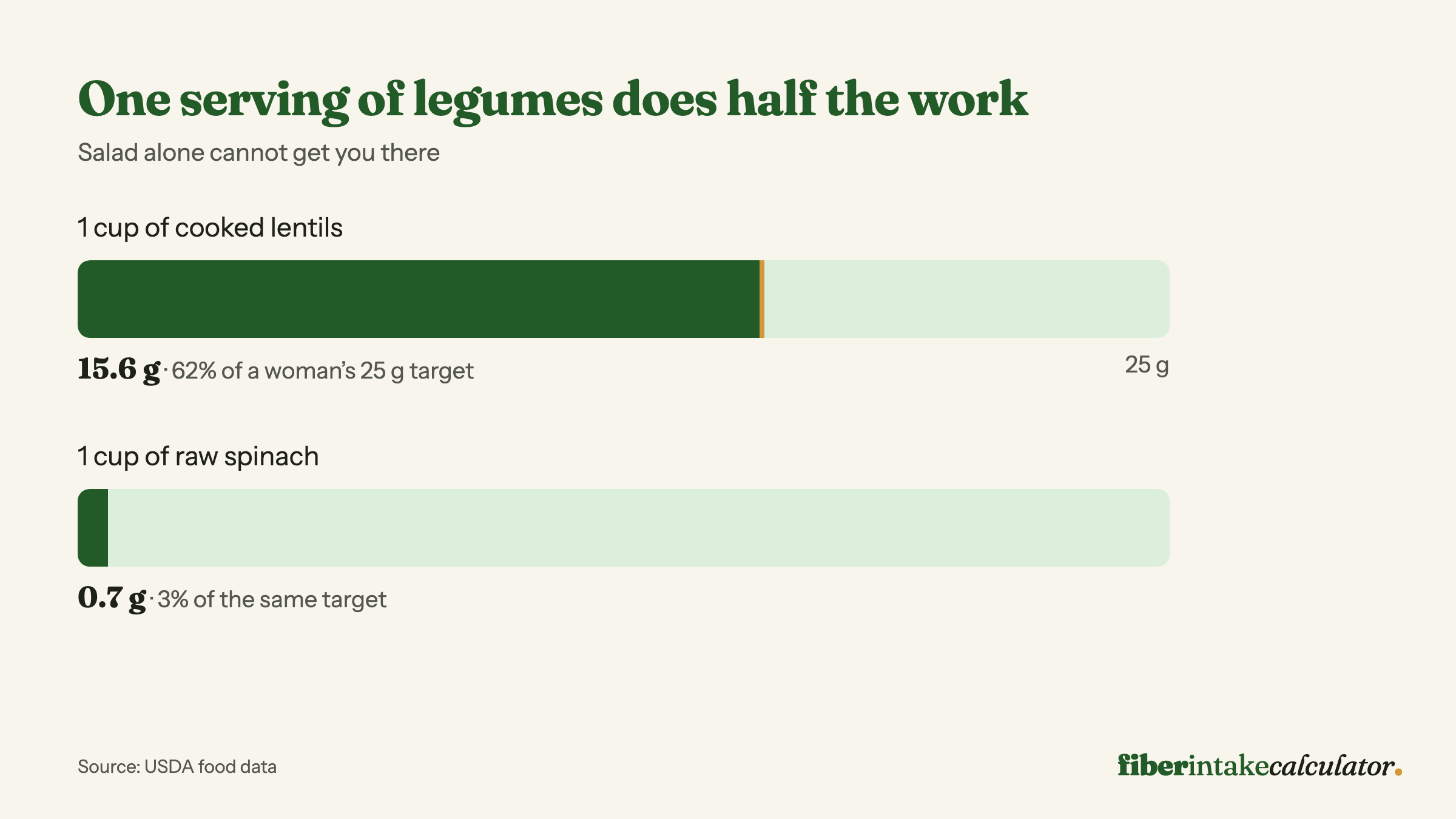
Vegetables have their own page too, because their numbers hinge on a detail most charts leave out. The high-fiber vegetables chart ranks 48 rows with the cooked or raw state on each one, which is the difference between 0.7 g and 4.3 g of fiber in the same cup of spinach.
Nuts and seeds are the group people overestimate, and they split in two. Our ranking of high-fiber nuts and seeds computes 32 rows and puts chia on top at 9.8 g an ounce, nearly three times the best nut, while nuts carry the lowest fiber per calorie of any group on this site. It also catches the swap behind the published pumpkin seed figure: the whole in-shell seed is 5.2 g an ounce and the hulled pepitas most people buy are 1.8 g.
Snacking is where most of the packaged fiber gets bought, and where the label matters more than the food. Our high-fiber snacks ranking reads the Nutrition Facts panel on 15 products against 13 whole foods, and finds only 4 of the 15 carry the 5.6 g per serving that FDA requires before a box may say “high fiber”.
Breakfast is the one meal where a single choice moves the daily total by 15 g or more. Our high-fiber cereal ranking reads the panel on 26 national boxes and prints the serving weight next to every figure, which is what shows that a level cup of All-Bran Buds carries 38.3 g of fiber and a level cup of Cheerios carries 2.7 g.
Away from the cereal aisle, our ranking of high-fiber breakfast foods does the same job for whole foods and rebuilds the breakfasts Google prints from USDA gram weights, which is how a widely published yogurt bowl claimed at 10 g turns out to carry 8.1 g.
Grains are the group where the published numbers go wrong most often, because a dry cup and a cooked cup of the same grain are not the same food. Our ranking of high-fiber whole grains computes 37 rows as they are actually served and puts bulgur on top at 8.2 g per cooked cup, well ahead of brown rice at 3.2 g. It also shows why a slice of whole-wheat bread is worth about 1.9 g whatever the bag says.
Readers working to a carbohydrate budget need this chart read sideways, because the groups at the top of it are the ones carbohydrate counting rules out. Our ranking of high-fiber low-carb foods puts a net carb column next to the fiber column on 44 rows, and shows that six of them reach 38.7 g of fiber for 12.1 g of net carbohydrate, against 99.7 g for the lentil and oatmeal route to a smaller total.
Some readers arrive needing the opposite of this chart, usually before a colonoscopy or during a flare. The low-fiber diet page reads the same USDA data from the bottom, ranks the foods those diets allow, and carries the gram ceiling the published food lists leave out.
| Food | Fiber per serving (g) | Serving | Group | % of your target |
|---|---|---|---|---|
| Split peas, cooked | 16.3 | 1 cup | Legumes | – |
| Lentils, cooked | 15.6 | 1 cup | Legumes | – |
| Pinto beans, cooked | 15.4 | 1 cup | Legumes | – |
| Black beans, cooked | 15 | 1 cup | Legumes | – |
| Chickpeas, cooked | 12.5 | 1 cup | Legumes | – |
| Kidney beans, cooked | 11.3 | 1 cup | Legumes | – |
| Artichoke, cooked | 10.3 | 1 medium | Vegetables | – |
| Baked beans, canned | 10 | 1 cup | Legumes | – |
| Chia seeds | 9.8 | 1 oz (2 tbsp) | Nuts & seeds | – |
| Green peas, cooked | 8.8 | 1 cup | Vegetables | – |
| Bulgur, cooked | 8.2 | 1 cup | Grains | – |
| Edamame, cooked | 8.1 | 1 cup | Legumes | – |
| Raspberries | 8 | 1 cup | Fruit | – |
| Blackberries | 7.6 | 1 cup | Fruit | – |
| Avocado | 6.7 | half (100 g) | Fruit | – |
| Whole-wheat spaghetti, cooked | 6.3 | 1 cup | Grains | – |
| Pearled barley, cooked | 6 | 1 cup | Grains | – |
| Pear, with skin | 5.5 | 1 medium | Fruit | – |
| Bran flakes cereal | 5.5 | 3/4 cup | Grains | – |
| Quinoa, cooked | 5.2 | 1 cup | Grains | – |
| Broccoli, cooked | 5.1 | 1 cup | Vegetables | – |
| Apple, with skin | 4.4 | 1 medium | Fruit | – |
| Brussels sprouts, cooked | 4.1 | 1 cup | Vegetables | – |
| Oatmeal, cooked | 4 | 1 cup | Grains | – |
| Sweet potato, baked with skin | 3.8 | 1 medium | Vegetables | – |
| Potato, baked with skin | 3.8 | 1 medium | Vegetables | – |
| Blueberries | 3.6 | 1 cup | Fruit | – |
| Sweet corn, cooked | 3.6 | 1 cup | Vegetables | – |
| Almonds | 3.5 | 1 oz (23 nuts) | Nuts & seeds | – |
| Popcorn, air-popped | 3.5 | 3 cups | Grains | – |
| Brown rice, cooked | 3.5 | 1 cup | Grains | – |
| Banana | 3.1 | 1 medium | Fruit | – |
| Orange | 3.1 | 1 medium | Fruit | – |
| Strawberries | 3 | 1 cup halves | Fruit | – |
| Pistachios | 3 | 1 oz (49 nuts) | Nuts & seeds | – |
| Flaxseed, ground | 2.8 | 1 tbsp | Nuts & seeds | – |
| Pecans | 2.7 | 1 oz (19 halves) | Nuts & seeds | – |
| Peach, with skin | 2.3 | 1 medium | Fruit | – |
| Kiwi | 2.1 | 1 fruit | Fruit | – |
| Cauliflower, cooked | 2 | 1 cup | Vegetables | – |
| Whole-wheat bread | 1.9 | 1 slice | Grains | – |
| Carrot, raw | 1.7 | 1 medium | Vegetables | – |
Serving values are USDA data as published in standard clinical fiber tables. See the methodology page for how figures are sourced and refreshed.
Frequently asked questions
What food is highest in fiber?
Per standard serving, cooked legumes lead. Navy beans top the full legume ranking at 19.1 g per cooked cup, ahead of split peas at 16.3 g, lentils at 15.6 g, and black beans at 15 g. Per bite, chia seeds are the densest common food at 9.8 g per ounce. No single food needs to do the work, though. Most people hit their target by combining legumes, whole grains, fruit, and vegetables across the day.
How do I use this chart to hit my daily target?
First get your personal number from the calculator (most adults need 21 to 38 g). Then pick foods until the '% of your target' column adds to 100. For example, a cup of lentils plus a cup of raspberries plus an apple covers most of a 25 g target.
Are these values per 100 grams or per serving?
Per common household serving (1 cup cooked, 1 medium fruit, 1 oz nuts), the way you actually eat. Serving-based numbers are more practical than per-100 g lab values, which overstate light foods like leafy greens.
Built and maintained by the FiberIntake team, with data from USDA FoodData Central and peer-reviewed sources. Figures are checked against the cited source before publish. About this site →