High-Fiber Berries, Ranked by Fiber per Serving
Last updated: September 25, 2026
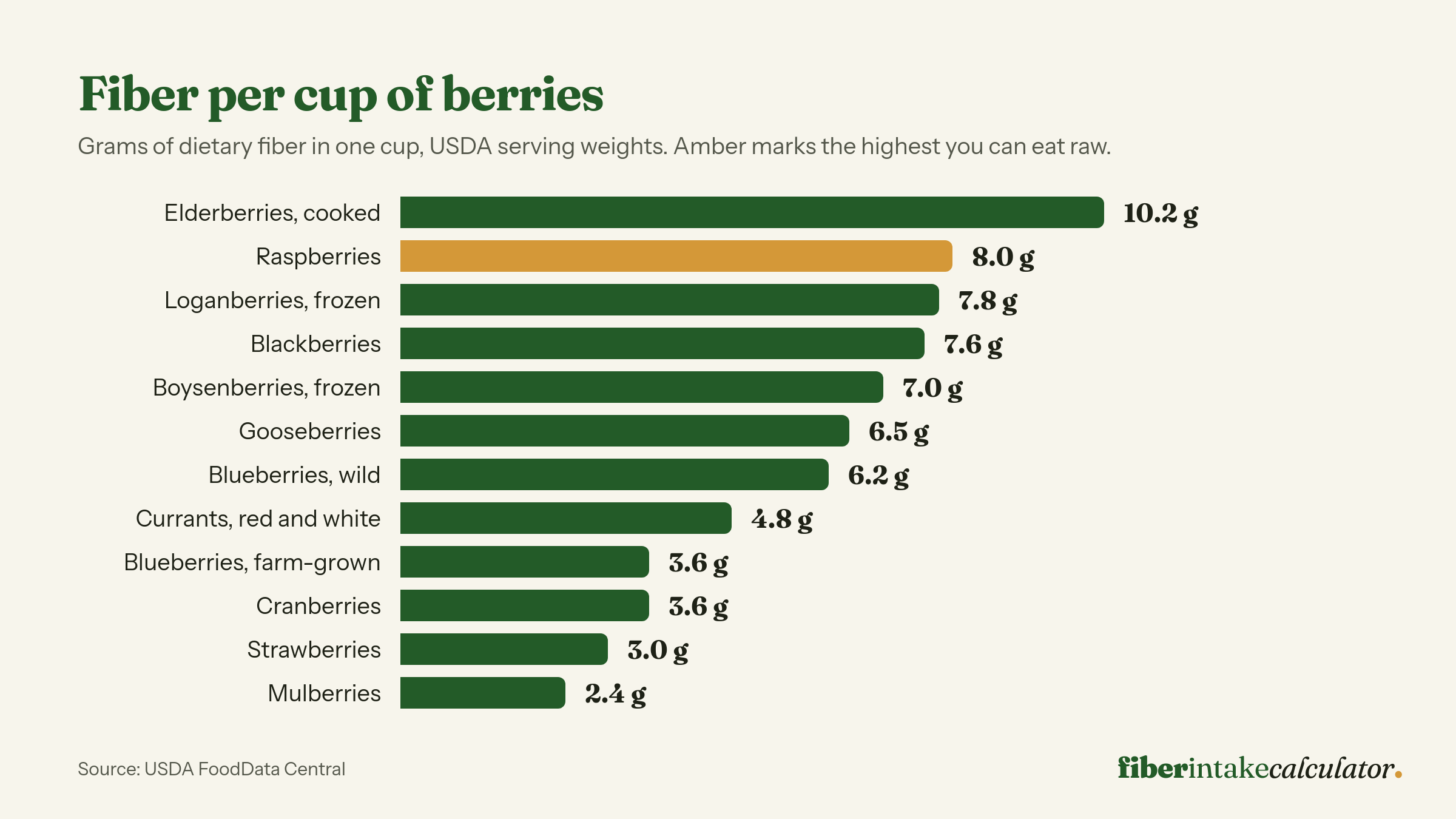
Raspberries are the highest-fiber berry you can eat straight from the carton, at 8 grams per cup. Blackberries follow at 7.6 grams, and elderberries beat both at 10.2 grams per cup, though those have to be cooked before you eat them.
Every number here is computed from USDA FoodData Central: fiber measured per 100 grams, multiplied by USDA’s own household serving weight. Each row names whether it is the fresh, frozen or dried record, because those are analysed separately and they do not always agree.
The berry lists everyone quotes stop too early
The eight-row list in circulation, the one the search results summarise, is topped by raspberries. USDA carries more berries than that, and one of them ranks higher.
Elderberries hold 7 grams of fiber per 100 grams, the densest fresh berry in the database, which is 10.2 grams in a 145 gram cup. Loganberries come close to raspberries at 7.8 grams per frozen cup. Gooseberries give 6.5 grams, and red currants 4.8 grams from a cup that almost no chart carries at all.
Before you go looking for elderberries. They are not a raw berry. CDC's report on a California outbreak describes juice pressed from elderberries together with leaves and branches, which sickened eight people at a gathering of 25 and sent one to hospital overnight. The editorial note is plain: elderberries may be safe to eat, particularly cooked, and leaves and stems should not be crushed in. Cooked into syrup or jam, the fiber still counts.
That leaves raspberries as the practical answer, and the gap to the berry most people actually buy is wide.
Wild blueberries carry 72% more fiber than farm-grown
USDA holds two blueberry records, and they are not the same food. The cultivated berries in a supermarket punnet measure 2.4 grams of fiber per 100 grams. Wild lowbush blueberries, which reach most shops frozen, measure 4.4 grams.
Per cup the gap narrows slightly, because a cup of the small wild berries weighs 140 grams against 148 grams for the large cultivated ones. It is still 6.2 grams against 3.6 grams, a 72% difference for a bag that sits in the same freezer aisle.
The reason is surface area. Fiber sits in skin and seeds, and wild lowbush blueberries are a much smaller berry than the cultivated highbush kind, so a cup of them holds far more skin.
The one swap worth making. A cup of frozen wild blueberries carries 2.6 grams more fiber than a cup of fresh cultivated ones, from the same freezer aisle.
Frozen is not automatically the same number as fresh
The standard advice is that frozen berries carry just as much fiber as fresh. USDA’s paired records are less tidy than that.
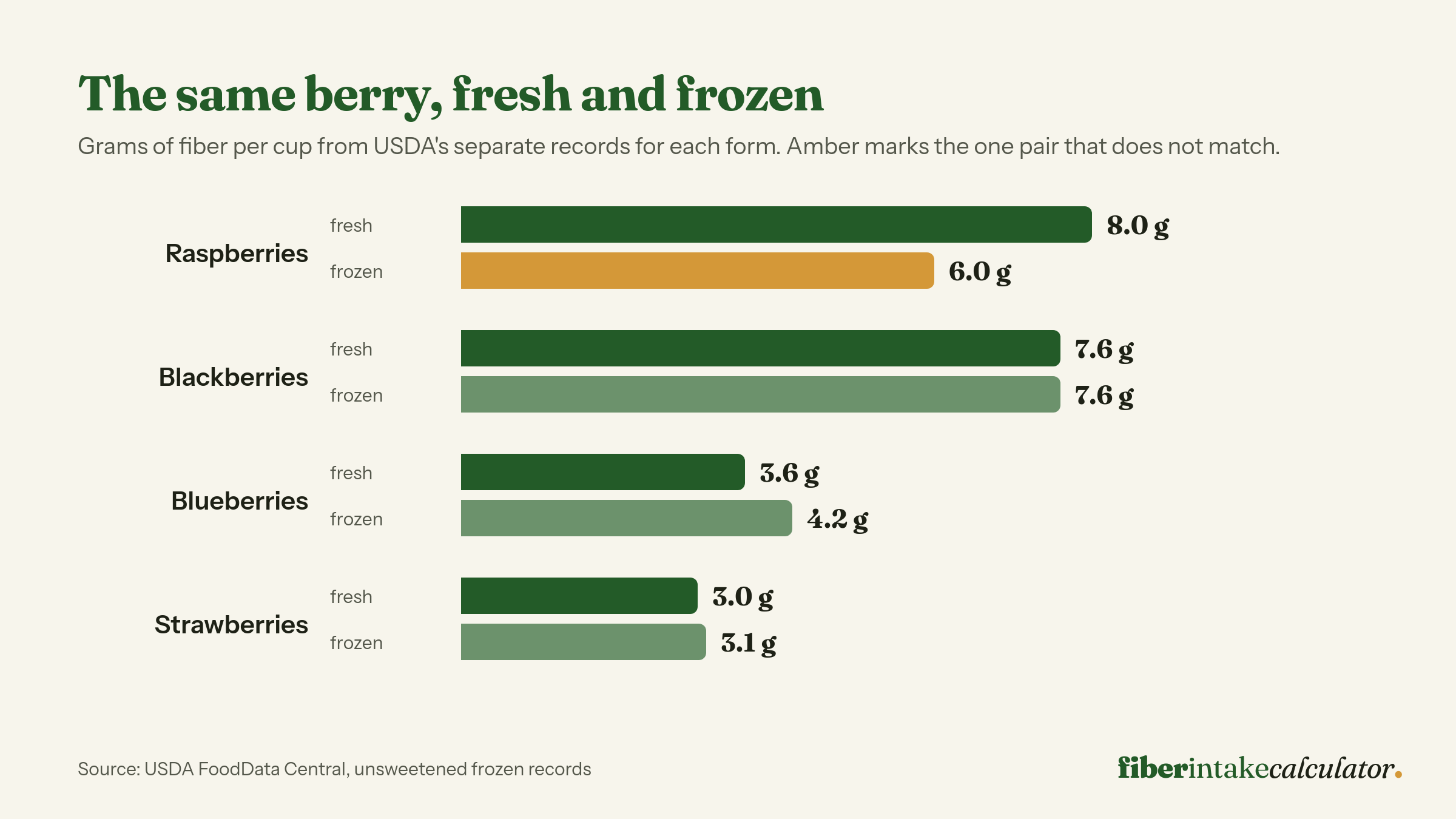
Blackberries and strawberries match almost exactly. Blueberries come out higher frozen, 4.2 grams per cup against 3.6 grams fresh. Raspberries come out lower, 6 grams against 8 grams, a quarter less.
These are separate laboratory analyses of separate samples rather than the same berries measured before and after the freezer, so the honest reading is measurement spread, not a freezing effect. Nothing in freezing removes fiber. What the spread does mean is that a single decimal place on a berry chart carries less certainty than it looks like it does, which is the same point our methodology page makes about food composition data generally.
Sweetened frozen berries are a different question, and the answer there is simple. A cup of thawed sweetened raspberries holds 11 grams of fiber, more than any fresh cup on this page, and 258 calories against 64 for the fresh cup. The fiber came along with four times the energy.
The seeds are the fiber, not the color
Berries get grouped by color, and the grouping is useless for fiber. Structure is what predicts the number.
Blackberries and mulberries look almost identical in a bowl. A cup of blackberries carries 7.6 grams of fiber. A cup of mulberries carries 2.4 grams. The blackberry is a cluster of tiny drupelets, each with a seed inside, and the mulberry is soft fruit with seeds too small to count for much.
The same split runs through the whole aisle. Per 100 grams, raspberries hold 6.5 grams of fiber and cultivated blueberries hold 2.4 grams, a factor of 2.7 between two things sold in identical plastic punnets.
| Berry | Structure | Fiber per 100 g |
|---|---|---|
| Raspberries | Cluster of seeded drupelets | 6.5 g |
| Blackberries | Cluster of seeded drupelets | 5.3 g |
| Boysenberries | Cluster of seeded drupelets | 5.3 g |
| Gooseberries | Thick skin, many small seeds | 4.3 g |
| Blueberries, cultivated | Smooth skin, soft flesh | 2.4 g |
| Strawberries | Soft flesh, seeds on the outside | 2.0 g |
| Mulberries | Soft flesh, minute seeds | 1.7 g |
Seeds and skin carry the insoluble fraction, the one that adds bulk rather than forming a gel, and the pulp carries the soluble part. USDA records total fiber only, so no database gives a berry-by-berry split; the measured splits that do exist are on our pages for soluble fiber and insoluble fiber.
Bulk is also why berries get recommended for a stuck gut, and where a bowl of them falls short. Added fiber only improved stool frequency above 10 grams a day held for four weeks or more, pooled across 16 randomized trials. A cup of raspberries is 8 grams, so berries are part of that dose rather than the whole of it, as the trial numbers on our page about fiber for constipation set out.
Berries are the cheapest fiber per calorie in the produce aisle
Ranked by serving, a cup of berries is good rather than remarkable next to a cup of legumes. Ranked per calorie, nothing in the produce aisle stays with them.
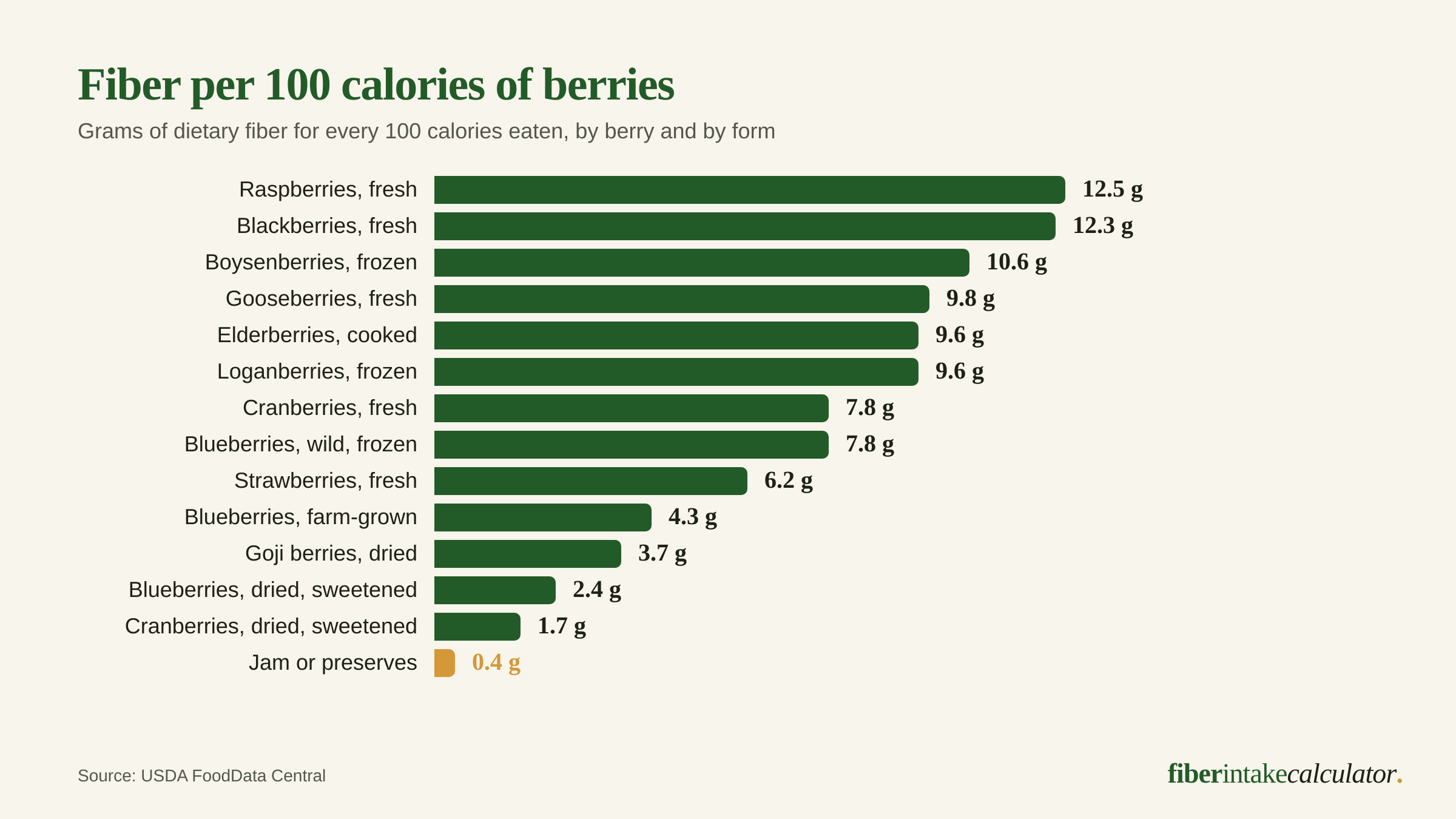
Raspberries deliver 12.5 grams of fiber per 100 calories and blackberries 12.3 grams. Those are the two highest figures on our whole high-fiber fruits chart, where grapes and watermelon manage 1.3 grams. Boysenberries reach 10.6 grams and gooseberries 9.8 grams.
Cultivated blueberries are the exception again, at 4.3 grams per 100 calories, below strawberries at 6.2 grams and below a plain orange at 5 grams.
That column is the useful one when calories are capped, which is why it drives the target arithmetic on our page about fiber while losing weight: as calories come down, the fiber target comes down with them, and cheap-per-calorie food is the only way the number still works.
Dried berries and jam are a different food
Drying concentrates fiber per gram, and sweetening, which is standard for cranberries and blueberries, concentrates calories faster than it concentrates fiber. Dried sweetened blueberries hold 7.5 grams of fiber per 100 grams against 2.4 grams fresh, a factor of 3.1, while their calories go from 57 to 317, a factor of 5.6.
| What you eat | Serving | Fiber | Calories |
|---|---|---|---|
| Raspberries, fresh | 1 cup (123 g) | 8.0 g | 64 |
| Goji berries, dried | 5 tbsp (28 g) | 3.6 g | 98 |
| Blueberries, dried and sweetened | quarter cup (40 g) | 3.0 g | 127 |
| Cranberries, dried and sweetened | quarter cup (40 g) | 2.1 g | 123 |
| Cranberry sauce, canned | 1 slice (57 g) | 0.6 g | 91 |
| Jam or preserves | 1 tbsp (20 g) | 0.2 g | 56 |
A tablespoon of jam carries 0.2 grams of fiber. The cup of raspberries it might have been made from carries 8 grams. Mashing whole berries onto toast instead keeps all of it, which is the one berry tip in circulation that survives contact with the data.
Per calorie that lands sweetened dried berries in the same band as the snack bars people buy for fiber: 1.7 grams per 100 calories for dried cranberries, against 1.4 grams for a KIND Fruit and Nut bar and 1.8 grams for a Larabar. The full comparison, including the bars that win by adding chicory root fiber, is on our high-fiber snacks ranking.
How far a bowl of berries actually gets you
Adults need 25 grams a day for women and 38 grams for men aged 19 to 50, per the Institute of Medicine reference intakes, falling to 21 and 30 grams after 50. Get your own number from the fiber calculator if you do not have one.
| A day of berries | Fiber | Calories |
|---|---|---|
| Raspberries, 1 cup | 8.0 g | 64 |
| Blackberries, 1 cup | 7.6 g | 62 |
| Wild blueberries, 1 frozen cup | 6.2 g | 80 |
| Total | 21.8 g | 206 |
That is 87% of a 25 gram target and 57% of a 38 gram one, from three cups of berries in one day.
The first two rows alone come to 15.6 grams for 126 calories. A cup of cooked lentils carries the same 15.6 grams for 230 calories, which is the comparison that puts berries in their place: unbeatable per calorie, and two cups of eating where one cup of lentils does the same job. Our legume ranking is where the cheap bulk lives, and the master high-fiber foods chart shows how the groups stack against each other.
Breakfast is where both halves meet, since a bowl that already contains oats or a bran cereal takes berries without any extra effort. The arithmetic for that meal is on our high-fiber breakfast page, and the box-by-box numbers are on the high-fiber cereal ranking.
Every berry, ranked by fiber per serving
Sort by any column. The form column is the one other berry lists leave out: fresh, frozen, dried and preserved records are measured separately by USDA, and mixing them silently is how a frozen-only berry ends up on a list of fresh ones. The % of your target column uses the result you saved in the calculator, or the FDA Daily Value of 28 g until you have one. Every figure traces to USDA FoodData Central or to the Institute of Medicine intakes, both listed on our sources page.
| Berry | Fiber per serving (g) | Serving | Form | Fiber per 100 calories (g) | % of your target |
|---|---|---|---|---|---|
| Raspberries, sweetened | 11 | 1 cup thawed (250 g) | Frozen | 4.3 | – |
| Elderberries (cook before eating) | 10.2 | 1 cup (145 g) | Fresh | 9.6 | – |
| Raspberries | 8 | 1 cup (123 g) | Fresh | 12.5 | – |
| Loganberries | 7.8 | 1 cup (147 g) | Frozen | 9.6 | – |
| Blackberries | 7.6 | 1 cup (144 g) | Fresh | 12.3 | – |
| Blackberries, unsweetened | 7.6 | 1 cup (151 g) | Frozen | 7.9 | – |
| Boysenberries, unsweetened | 7 | 1 cup (132 g) | Frozen | 10.6 | – |
| Gooseberries | 6.5 | 1 cup (150 g) | Fresh | 9.8 | – |
| Blueberries, wild | 6.2 | 1 cup (140 g) | Frozen | 7.8 | – |
| Raspberries, unsweetened | 6 | 1 cup (140 g) | Frozen | 7.7 | – |
| Currants, red and white | 4.8 | 1 cup (112 g) | Fresh | 7.7 | – |
| Blueberries, unsweetened | 4.2 | 1 cup (155 g) | Frozen | 5.3 | – |
| Blueberries, cultivated | 3.6 | 1 cup (148 g) | Fresh | 4.3 | – |
| Cranberries | 3.6 | 1 cup whole (100 g) | Fresh | 7.8 | – |
| Goji berries | 3.6 | 5 tbsp (28 g) | Dried | 3.7 | – |
| Strawberries, unsweetened | 3.1 | 1 cup (149 g) | Frozen | 5.9 | – |
| Strawberries | 3 | 1 cup halves (152 g) | Fresh | 6.2 | – |
| Blueberries, sweetened | 3 | quarter cup (40 g) | Dried | 2.4 | – |
| Mulberries | 2.4 | 1 cup (140 g) | Fresh | 4 | – |
| Cranberries, sweetened | 2.1 | quarter cup (40 g) | Dried | 1.7 | – |
| Currants, zante | 1.6 | quarter cup (36 g) | Dried | 1.5 | – |
| Cranberry sauce, canned sweetened | 0.6 | 1 slice (57 g) | Preserve | 0.7 | – |
| Jam or preserves | 0.2 | 1 tbsp (20 g) | Preserve | 0.4 | – |
Fiber per serving is USDA FoodData Central's per-100-gram value multiplied by USDA's own household serving weight, read September 2026. The form column names which USDA record each row comes from, because the fresh, frozen and dried records are analysed separately. See the methodology page for how figures are sourced and refreshed.
Frequently asked questions
Which berry has the most fiber?
Raspberries, at 8 grams per cup, are the highest-fiber berry you can eat straight from the carton. Blackberries follow at 7.6 grams and boysenberries at 7 grams per frozen cup. Elderberries beat all of them at 10.2 grams per cup, but they have to be cooked first, so they are a syrup and jam berry rather than a snacking one.
Are blueberries high in fiber?
Less than their reputation suggests, and it depends which blueberry. The farm-grown berries in the supermarket punnet carry 3.6 grams per cup, which puts them below strawberries per calorie and less than half of raspberries per cup. Wild or lowbush blueberries, sold frozen, carry 6.2 grams per cup, because the berries are smaller and a cup holds more skin.
Do frozen berries have as much fiber as fresh?
Usually close, but not always, and USDA's own paired records disagree with the common advice. A cup of fresh raspberries is 8 grams against 6 grams for a cup of frozen unsweetened raspberries, while blueberries go the other way, 3.6 grams fresh against 4.2 grams frozen. Blackberries and strawberries match within a tenth of a gram. The records are separate laboratory analyses rather than the same berries measured twice, so treat the gaps as measurement spread, not as proof that freezing removes fiber.
Are berries good for your bowels?
They help, but a bowl of berries alone is below the dose that moved the evidence. Pooled across 16 randomized trials, added fiber only improved stool frequency above 10 grams a day, sustained for at least four weeks. A cup of raspberries gives 8 grams, so berries are a useful part of that dose rather than the whole of it. The full trial numbers are on our page about fiber for constipation.
Can I get 25 grams of fiber a day from berries?
Only by eating more berries than most people buy in a week. A cup each of raspberries, blackberries and frozen wild blueberries comes to 21.8 grams for 206 calories, which is 87% of a 25 gram target and 57% of a 38 gram one. One cup of cooked lentils supplies 15.6 grams on its own, so berries work best as the cheap-per-calorie half of the day rather than the whole plan.
Built and maintained by the FiberIntake team, with data from USDA FoodData Central and peer-reviewed sources. Figures are checked against the cited source before publish. About this site →