Fiber for Constipation, at the Dose the Trials Used
Last updated: September 22, 2026
Fiber works for constipation at a dose almost nobody prints. Across 16 randomized trials in 1,251 adults with chronic constipation, 66 percent of people responded to fiber against 41 percent on control, and the benefit appeared only above 10 grams a day, held for at least four weeks (van der Schoot et al., 2022).
The 25 to 38 grams you see quoted everywhere is something else. That is the Institute of Medicine’s daily target for general health. The constipation evidence is about a specific carrier at a specific dose for a specific length of time, and the two numbers keep getting used as though they were one.
This page carries what the trials gave people, what changed, how much of it is on your plate, and the cases where more fiber is the wrong move. Every clinical figure names its study and is listed in full on our sources page; every food figure comes from USDA FoodData Central, read in September 2026.
What the trials actually gave people
Three sets of results carry most of the weight here: one pooled meta-analysis and two head-to-head trials that compared real foods against a supplement. Their doses, converted into grams of fiber using USDA’s own portion weights, are smaller than most people expect.
| Trial | What it gave, daily | Fiber in that, per USDA | Length | What changed |
|---|---|---|---|---|
| Chey et al. 2021, Michigan Medicine | 2 green kiwifruit | 4.1 g | 4 weeks | Weekly complete bowel movements rose, stool consistency, straining and bloating improved, fewest side effects of the three |
| Chey et al. 2021 | 100 g prunes | 7.1 g | 4 weeks | Weekly complete bowel movements rose, consistency and straining improved |
| Chey et al. 2021 | 12 g psyllium powder | 3 to 10 g, by product | 4 weeks | Weekly complete bowel movements rose, straining improved, most adverse events of the three |
| Attaluri et al. 2011, University of Iowa | 50 g prunes twice daily | 6 g as stated, 7.1 g by USDA | 3 weeks | Beat psyllium on both bowel movements and stool consistency |
| Attaluri et al. 2011 | 11 g psyllium twice daily | 6 g as stated | 3 weeks | Improved, but less than prunes |
| van der Schoot et al. 2022, pooled | Fiber supplements, more than 10 g | Over 10 g | 4 weeks or more | The only dose and duration where effects were consistent |
Read the middle column again. The kiwifruit arm that performed best on tolerability delivered about 4.1 grams of fiber a day, roughly a ninth of the target a 40 year old man is told to hit. It still raised weekly bowel movements. Work out your own daily number with the fiber calculator by all means, but do not mistake it for the amount that was tested here.
The dose and the target are different numbers. The daily target is about long-run health across the whole diet. The constipation dose is one carrier, taken every day, for at least a month.
One honest discrepancy: the 2011 trial describes 100 grams of dried plums as 6 grams of fiber a day, while USDA’s record for uncooked dried plums works out to 7.1 grams. Trial products and database averages differ by this much routinely. We print both rather than pick the flattering one, which is the same rule our methodology page applies to every table here.
How much fiber changed, measured in bowel movements
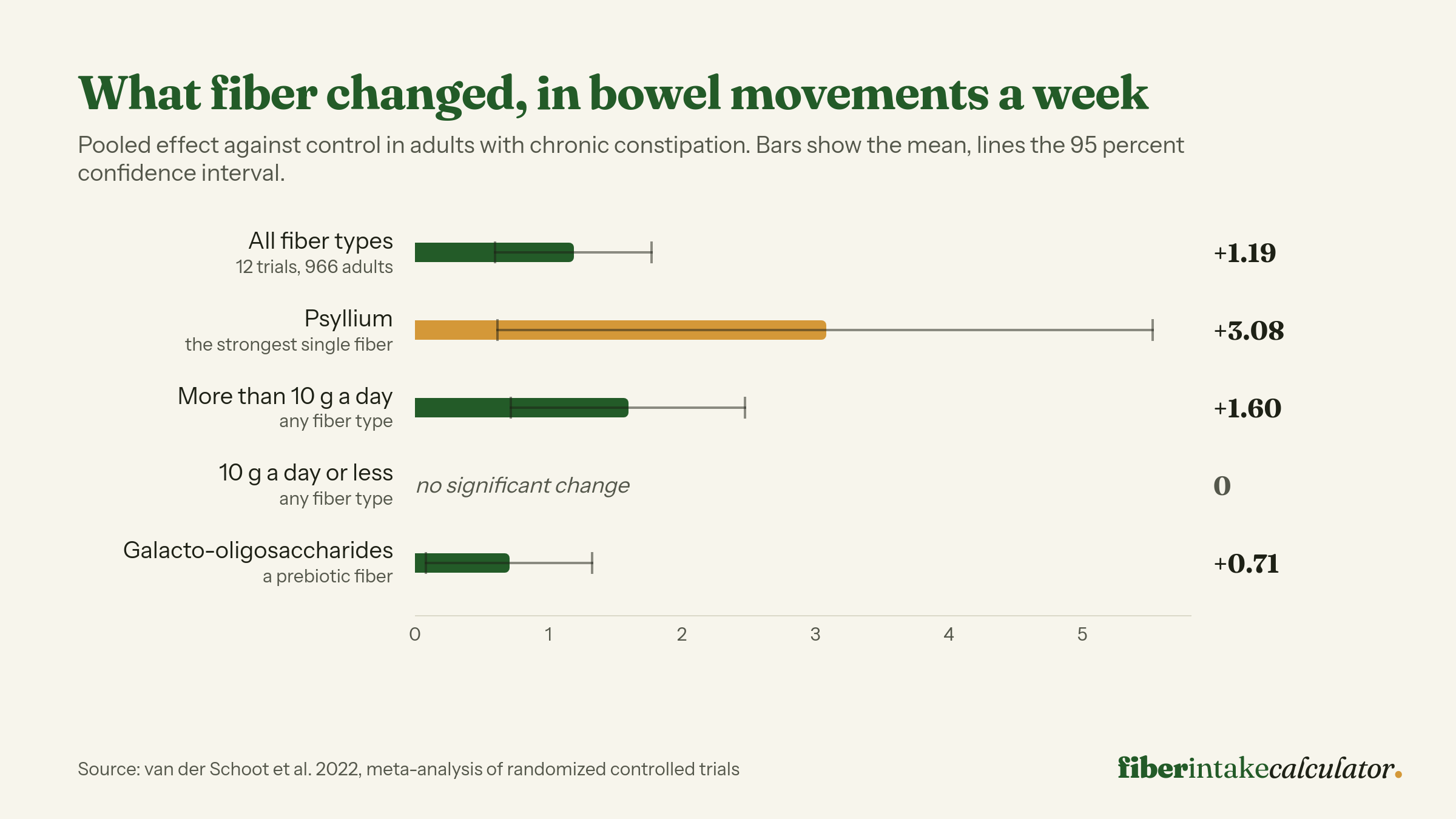
The 2022 meta-analysis reports most outcomes as standardised effect sizes, which are hard to act on. It also ran a sensitivity analysis in the 12 studies that used the same unit, and that version is in plain bowel movements a week.
| Group | Change in stool frequency | 95% confidence interval |
|---|---|---|
| All fiber types, 12 trials, 966 adults | +1.19 a week | 0.59 to 1.78 |
| Psyllium | +3.08 a week | 0.61 to 5.54 |
| More than 10 g a day | +1.60 a week | 0.71 to 2.48 |
| 10 g a day or less | No significant change | n/a |
| 4 weeks or longer | +1.33 a week | 0.62 to 2.03 |
| Under 4 weeks | No significant change | n/a |
| Galacto-oligosaccharides | +0.71 a week | 0.07 to 1.34 |
Stool consistency moved too, though less dramatically, and only for some fibers. Psyllium improved it and so did inulin-type fructans. Polydextrose and galacto-oligosaccharides did not. Doses above 10 grams a day improved consistency; doses at or below that did not.
An older meta-analysis, published in 2012 and still ranking for this search, reached a narrower conclusion from 5 trials of dietary fiber: stool frequency improved, but stool consistency, treatment success, laxative use and painful defecation did not. The two are not in conflict. The newer one pooled 16 trials of fiber supplements and found the effects concentrated above 10 grams a day, which is a dose most food-based trials never reach.
Why fiber might not be working for you
This is the most asked question on the search results page, and the meta-analysis answers part of it mechanically.
Fiber did not speed up the gut. Pooled across 7 trials, whole gut transit time fell by 7.5 hours, an amount too small to distinguish from chance. Only at four weeks or longer did transit time fall meaningfully, by 18.4 hours. Fiber mostly works by adding water-holding bulk to the stool, not by driving it through faster, so expecting a quick change in transit is expecting the wrong thing.
The dose may be under the line. At or below 10 grams a day of supplemental fiber, neither stool frequency nor consistency improved significantly. Our fiber supplement comparison does the label arithmetic on what 10 grams means per product, and for most powders it is several labeled doses.
The course may be too short. Nothing significant appeared under four weeks: not frequency, not transit time, not symptom scores. Symptom scores only improved in the trials that ran four weeks or longer.
The fiber may be the wrong kind. Rapidly fermented fibers get eaten by gut bacteria before they reach the stool. That is why polydextrose and galacto-oligosaccharides underperform on consistency while psyllium, which holds its gel through the colon, does not. We sort the common food and supplement fibers into the two groups on our page asking whether fiber actually makes you poop, which also sets the trial numbers against the one published study that found the opposite. Those same rapidly fermented fibers are the ones with the strongest evidence for feeding gut bacteria, which is the trade-off in one sentence. Our soluble and insoluble fiber page has the gram-level split for the foods behind that distinction, and the insoluble fiber ranking shows how little of psyllium is the bulking kind: 1.0 gram of its 8.0 grams per tablespoon, or 13%.
Or the cause is not a fiber shortage at all. University Hospitals gastroenterologist Vu Nguyen puts it plainly: patients who do not improve after a trial of fiber and laxatives, or who develop new symptoms, should see a gastroenterologist. Rectal bleeding, abdominal pain or weight loss point at problems that no amount of bran will fix. The sharpest version of this comes from a 1997 study that gave 149 patients psyllium for six weeks and then sorted them by what testing found: 80% of those with slow gut transit got nothing, against 15% of those whose transit and outlet both tested normal. That split, and what it means for whether too much fiber can cause constipation, has its own page.
Which single servings clear 10 grams
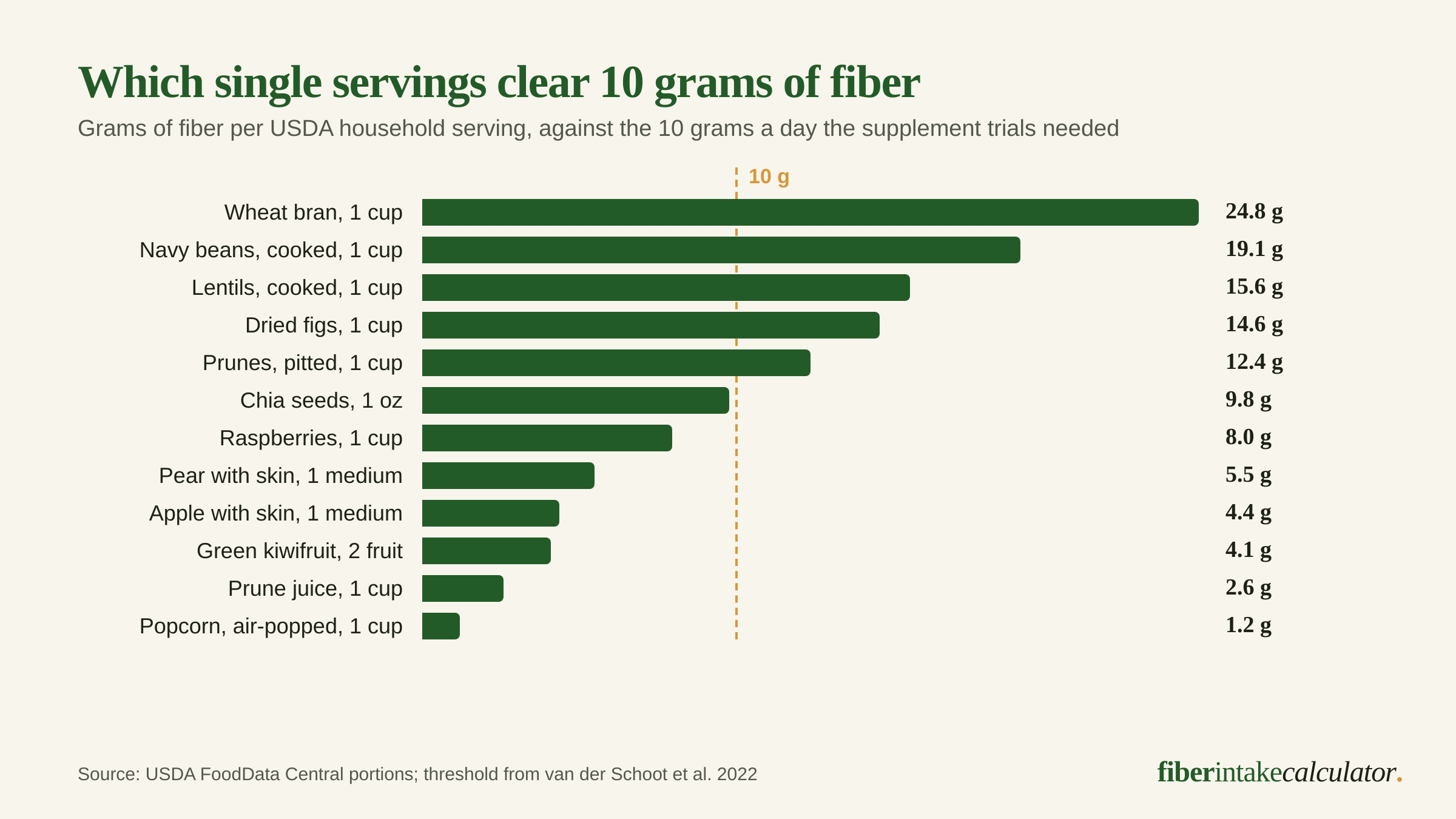
If the supplement threshold is your target, only a handful of ordinary servings reach it on their own. Here is what it takes from each food, using USDA household portions.
| Food | USDA serving | Fiber | Servings for 10 g | Calories at 10 g |
|---|---|---|---|---|
| Wheat bran, crude | 1 cup (58 g) | 24.8 g | 0.4 | 50 |
| Navy beans, cooked | 1 cup (182 g) | 19.1 g | 0.5 | 134 |
| Lentils, cooked | 1 cup (198 g) | 15.6 g | 0.6 | 147 |
| Black beans, cooked | 1 cup (172 g) | 15.0 g | 0.7 | 151 |
| Dried figs | 1 cup (149 g) | 14.6 g | 0.7 | 254 |
| Oat bran, raw | 1 cup (94 g) | 14.5 g | 0.7 | 159 |
| Prunes, pitted | 1 cup (174 g) | 12.4 g | 0.8 | 337 |
| Chia seeds | 1 oz (28 g) | 9.8 g | 1.0 | 141 |
| Raspberries | 1 cup (123 g) | 8.0 g | 1.3 | 80 |
| Pear, with skin | 1 medium (178 g) | 5.5 g | 1.8 | 184 |
| Apple, with skin | 1 medium (182 g) | 4.4 g | 2.3 | 216 |
| Oatmeal, cooked | 1 cup (234 g) | 4.0 g | 2.5 | 415 |
| Green peas, frozen | 1/2 cup (80 g) | 3.6 g | 2.8 | 172 |
| Broccoli, cooked | 1/2 cup (78 g) | 2.6 g | 3.8 | 104 |
| Green kiwifruit | 1 fruit (69 g) | 2.1 g | 4.8 | 200 |
| Flaxseed, ground | 1 tbsp (7 g) | 1.9 g | 5.3 | 195 |
| Popcorn, air-popped | 1 cup (8 g) | 1.2 g | 8.3 | 258 |
Half a cup of navy beans does what eight cups of popcorn does. Both are whole foods and both count toward your day, but only one of them is a practical way to add ten grams. The full ranking across 42 foods sits on our high-fiber foods chart, with the fruit rankings covering why berries and pears sit near the top and the vegetable rankings covering what cooking does to the numbers.
Two entries deserve a note. Wheat bran is the densest thing in the table by a distance, and it is also the one University Hospitals singles out as unhelpful in irritable bowel syndrome with constipation, where soluble fiber is recommended instead. The wheat bran you meet in a cereal box is a smaller serving with different arithmetic, which our high-fiber cereal ranking works through.
And prune juice, recommended almost as often as the fruit, carries 2.6 grams of fiber a cup against 12.4 grams in a cup of the pitted fruit. Whatever prune juice is doing, it is not delivering a fiber dose.
When more fiber makes it worse
Fiber is first-line advice because it is cheap, safe and usually helpful. It is not always the right tool, and the sources are specific about when.
It reliably causes gas. The 2022 meta-analysis found flatulence significantly higher on fiber than on control, with one of the larger effect sizes in the whole review. That is not a sign of something going wrong. It is the expected cost of feeding your gut bacteria more substrate.
Highly fermentable fiber can tip that into a problem. Dr Nguyen names rye, wheat, beans, lentils, broccoli, cabbage, Brussels sprouts, apple and peach as the foods most likely to produce excessive cramping, bloating and gas, and advises avoiding them if those symptoms are what you are dealing with.
Type matters more than amount in irritable bowel syndrome. For IBS with constipation, soluble fiber from psyllium and oat bran is recommended, while insoluble fiber from wheat bran and whole grains does not provide significant benefit. In active Crohn’s disease, insoluble fiber is not recommended at all, particularly where a blockage or stricture is suspected.
Fiber without fluid is the classic own goal. Under 21 CFR 201.319, any dry-form product whose active ingredient is psyllium, methylcellulose, guar gum, glucomannan or polycarbophil must carry a direction to take each dose with at least 8 ounces of liquid, plus a choking warning. That rule exists because these fibers swell. The same logic applies to a large bowl of bran.
For a minority, cutting fiber is what worked. In 63 patients with idiopathic constipation asked to stop eating fiber for two weeks, those still off it at six months had gone from one bowel movement every 3.75 days to one every day, and none reported bloating or straining. The study was small and uncontrolled, so treat it as a signal rather than a plan. Our low-fiber diet page carries the full table and what a low-fiber diet means in grams.
One thing is worth flagging if you have a colonoscopy booked. Chronic constipation roughly tripled the odds of an inadequate bowel preparation in a trial of 412 patients, which makes it worth mentioning when you book rather than on the day. The prep plan and the rest of that evidence are on their own page.
Straining is the part of constipation that does lasting damage. In 2,813 adults screened by colonoscopy, straining a quarter of the time or more carried the strongest association with hemorrhoids of anything measured, ahead of constipation itself and well ahead of how much fiber people ate. Our page on fiber for hemorrhoids has that table and the seven trials behind the fiber advice there.
When to stop working on this yourself. New or worsening constipation with rectal bleeding, abdominal pain or unexplained weight loss needs a clinician, not a diet change. So does constipation that has not improved after a proper trial of fiber and laxatives.
A four-week trial you can run on yourself
Every finding above points the same way: one carrier, a real dose, four weeks, measured. That is a plan, not a food list.
| Stage | What you do | Why it is there |
|---|---|---|
| The week before | Count bowel movements for seven days and write the number down | Every trial measured change against a baseline, and memory is a poor baseline |
| Pick one carrier | 2 green kiwifruit, or 100 g of prunes, or a cup of cooked navy beans, or a psyllium dose that reaches 10 g of fiber | These are the doses that were actually tested |
| Weeks 1 to 4 | Take it every day, at roughly the same time, changing nothing else | Nothing significant appeared in under four weeks, and one change at a time is the only way to read the result |
| Every dose | A full glass of water with it | The federal label rule for swelling fibers, borrowed as a habit |
| End of week 4 | Count another seven days and compare | A gain of one to three bowel movements a week is what the pooled trials produced |
If gas and bloating arrive in week one, that is the expected effect showing up, and the fix is a smaller starting amount that you build up over a few weeks rather than a different food. Our page on pushing fiber intake high covers the ramp mechanics and what going too fast costs.
If four weeks produce nothing, you have learned something useful: this is not a fiber-shortage problem, and the next step is a clinician rather than a bigger scoop.
Where fiber sits among the other options
A 2021 systematic review in the American Journal of Gastroenterology graded 41 randomized trials of over-the-counter constipation treatments, all four weeks or longer.
| Evidence grade | Treatments |
|---|---|
| Grade A, good evidence | Polyethylene glycol, senna |
| Grade B, moderate evidence | Psyllium, magnesium salts, bisacodyl and sodium picosulfate, fruit-based laxatives including kiwi, mango, prunes and figs, yogurt with galacto-oligosaccharide, prunes and linseed oil |
| Grade I, insufficient evidence | Polydextrose, inulin, fructo-oligosaccharide |
Two things are worth taking from that table. Psyllium and fruit sit in the same tier, which matches the head-to-head trials where prunes and kiwifruit held their own against the supplement. And the fibers marketed hardest as prebiotics, inulin and fructo-oligosaccharide, are the ones with insufficient evidence here and weak results in the meta-analysis.
One disclosure the review makes itself: it was funded by Bayer US LLC, which sells a polyethylene glycol product, and polyethylene glycol is one of the two grade A treatments. The grading method is published and the trials are public, so this is context rather than a reason to discard it.
How common is the problem in the first place depends on who is counting. The 2022 meta-analysis puts chronic constipation at 12 percent of adults. University Hospitals and the 2012 meta-analysis both put it nearer 20 percent. Different definitions, different populations, and a reasonable reminder that the headline numbers in this field are softer than they look.
Fiber behaves differently in every condition it has been tested in, and constipation is the one where the effective dose is lowest. Our comparison of fiber across specific conditions puts the 10 gram threshold here next to the 7 to 20 grams the hemorrhoid trials used and the 35 grams the diabetes work points at.
Frequently asked questions
What is the best form of fiber for constipation?
Psyllium has the strongest pooled evidence. In the 2022 meta-analysis of 16 randomized trials, psyllium raised stool frequency by 3.08 bowel movements a week against control and was one of only two fibers to significantly improve stool consistency. It is also the arm that caused the most side effects in the 2021 head-to-head trial at Michigan Medicine, where green kiwifruit worked about as well on bowel movements with the fewest adverse events. Both are reasonable starting points, and the choice is mostly about what you can keep taking daily for a month.
Why isn't fiber helping me poop?
Four common reasons, each measurable. The dose is too small: in the 2022 meta-analysis, supplemental fiber at or below 10 grams a day produced no significant change in stool frequency. The trial is too short: nothing significant appeared under four weeks. The fiber is the wrong kind: polydextrose, inulin-type fructans and galacto-oligosaccharides had weak or absent effects on frequency. Or fiber is not the problem, which is why gastroenterologists advise seeing someone if a proper fiber trial plus laxatives does not work.
Can too much fiber worsen constipation?
It can, and the evidence is specific about how. The 2022 meta-analysis found flatulence significantly higher on fiber than on control. University Hospitals gastroenterologist Vu Nguyen names highly fermentable fiber in rye, wheat, beans, lentils, broccoli, cabbage, Brussels sprouts, apple and peach as the trigger for excessive bloating, gas and cramping, and advises avoiding those foods if you get them. Fiber also needs fluid to move: federal label rules require dry-form psyllium, methylcellulose, guar gum, glucomannan and polycarbophil to carry a direction to take each dose with at least 8 ounces of liquid.
How long does fiber take to work for constipation?
Plan on four weeks before judging it. In the 2022 meta-analysis, treatment lasting four weeks or longer raised stool frequency by 1.33 bowel movements a week and cut whole gut transit time by 18.4 hours, while shorter courses showed no significant effect on either. The head-to-head trials ran three and four weeks, and the Michigan Medicine trial measured its results at weeks three and four rather than week one.
Is prune juice good for constipation?
Whatever prune juice does, it is not delivering a fiber dose. USDA's record for canned prune juice gives 2.6 grams of fiber per cup, against 12.4 grams in a cup of pitted prunes. The trials that tested prunes used the whole fruit: 100 grams a day at Michigan Medicine, 50 grams twice daily in the 2011 crossover trial. If you want the tested intervention, eat the prunes.
Built and maintained by the FiberIntake team, with data from USDA FoodData Central and peer-reviewed sources. Figures are checked against the cited source before publish. About this site →