A High-Fiber Diet for Hemorrhoids, Measured Against the Trials
Last updated: September 22, 2026
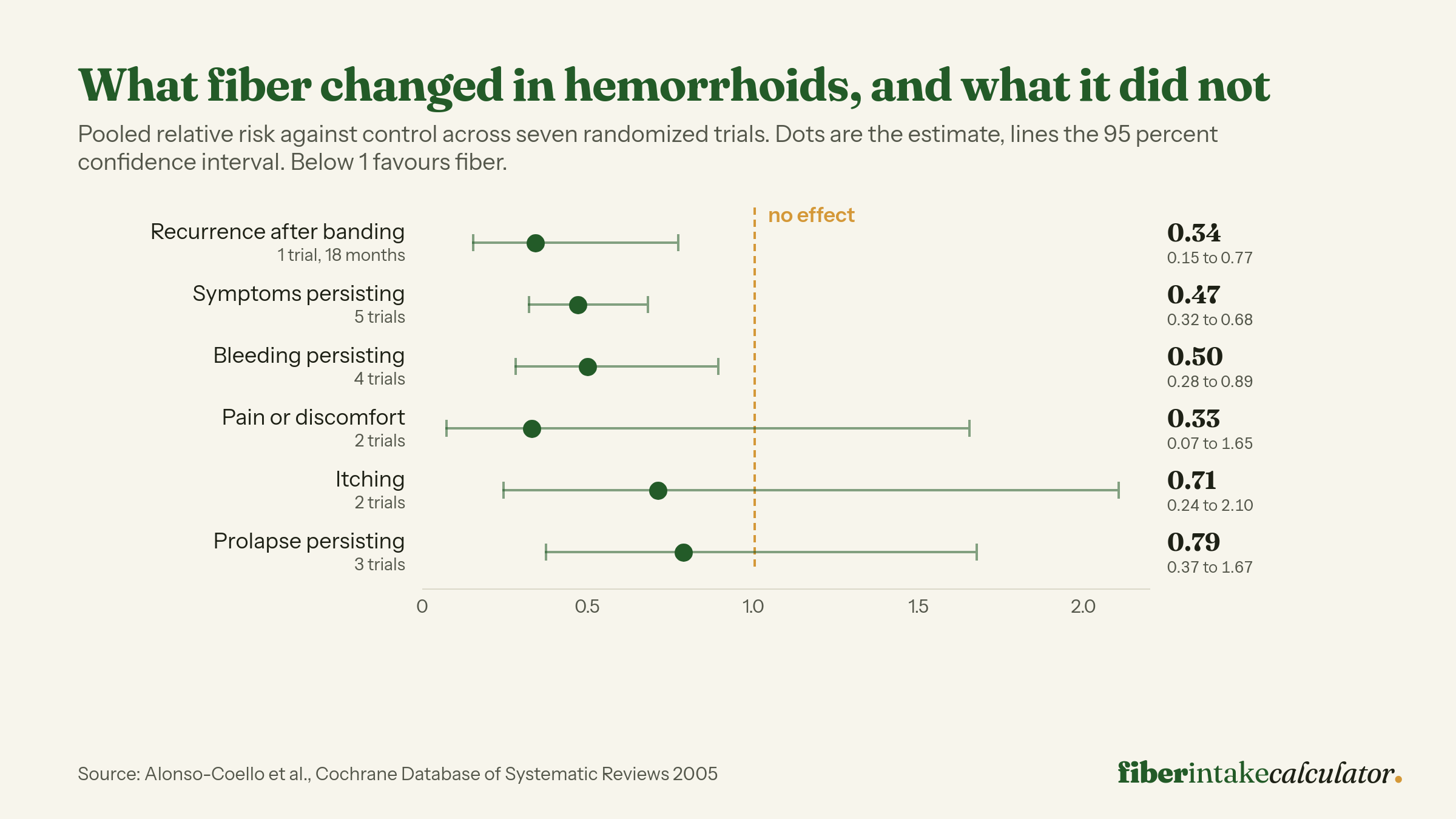
Fiber has real trial evidence in hemorrhoids, and it is narrower than the advice built on it. Across seven randomized trials in 378 patients, fiber cut the risk of persisting symptoms by about half (RR 0.47, 95% CI 0.32 to 0.68) and the risk of bleeding by half (RR 0.50, 95% CI 0.28 to 0.89), while prolapse, pain and itching showed no significant change (Alonso-Coello et al., Cochrane 2005).
Two details about those trials get lost. Every one of them used a bulk-forming fiber supplement, at 7 to 20 grams a day. None tested the high-fiber food list that every page on this subject recommends.
This page carries what the trials gave people, which symptoms moved, what the largest risk-factor study found sitting above diet, and how much fiber ordinary grain servings deliver. Every clinical figure names its study and is listed in full on our sources page; every food figure comes from USDA FoodData Central, read in September 2026.
What the seven trials actually gave people
The Cochrane review is the source behind almost every “eat more fiber” line on this topic, so it is worth seeing what it pooled. Six parallel-group trials and one crossover, in adults with grade I to III hemorrhoids, mean age around 40.
| Trial | Patients | What it gave, daily | Length | What it measured |
|---|---|---|---|---|
| Broader 1974 | 40 | Sterculia vs starch placebo | 3 months | Bleeding, prolapse, discomfort, overall impression |
| Webster 1978 | 67 | Ispaghula husk, 7 g | Two 6-week periods | Bleeding, prolapse, itching, overall symptoms, laxative use |
| Foster 1979 | 41 | Ispaghula husk vs placebo | 1 month | Overall improvement, anal and rectal pressure |
| Hunt 1981 | 28 | Ispaghula husk vs placebo | 6 weeks | Rectal bleeding, severity, ease of defecation |
| Moesgaard 1982 | 52 | Psyllium seed fiber, 20 g | 6 weeks | Bleeding, pain at defecation, prolapse and itching, endoscopy |
| Jensen 1988 | 92 | Unprocessed bran, 20 g, after rubber band ligation | 18 months | Recurrence, symptom severity, laxative use |
| Perez-Miranda 1996 | 50 | Plantago ovata, 11.6 g | 40 days | Bleeding episodes, congested cushions, prolapse |
Every entry in the third column is a husk, seed or bran preparation. Ispaghula and psyllium are the same plant, Plantago ovata, which means five of the seven trials tested one fiber.
The evidence is about a supplement, not a shopping list. Seven trials, one fiber family, 7 to 20 grams of product a day. The food advice built on top of this has never itself been tested against a control in hemorrhoid patients.
Only one of those doses converts cleanly into grams of fiber. Twenty grams of crude wheat bran carries 8.6 grams of dietary fiber per USDA FoodData Central, about a third of a cup. For the husk preparations the trials reported the weight of the product, and product weight is not fiber weight: a current psyllium label lists 1.1 grams of fiber per 1.5 grams of husk powder. Our fiber supplement comparison does that arithmetic across 15 labels, and the gap is bigger than most people assume.
Two numbers in the review do not reconcile, and it is better to say so than to smooth it over. The headline says 378 patients randomized; the per-trial counts in its own study table come to 370. Separately, the review was published twice. The Cochrane version reports overall symptoms at RR 0.47 (95% CI 0.32 to 0.68); the 2006 American Journal of Gastroenterology version of the same review reports RR 0.53 (95% CI 0.38 to 0.73). Both the estimates and the intervals differ, so these are two analyses rather than a typo. Printing both is the same rule our methodology page applies to every table on this site.
Which symptoms fiber changed, and which it did not
This is the part no page on this search prints, and it is the part that decides whether fiber is the right tool for the symptom you actually have.
| Outcome | Trials | Relative risk on fiber | 95% confidence interval | Reading |
|---|---|---|---|---|
| Recurrence 18 months after banding | 1 | 0.34 | 0.15 to 0.77 | Significant |
| Symptoms persisting or not improving | 5 | 0.47 | 0.32 to 0.68 | Significant |
| Bleeding persisting | 4 | 0.50 | 0.28 to 0.89 | Significant |
| Pain or discomfort | 2 | 0.33 | 0.07 to 1.65 | Interval crosses 1 |
| Itching | 2 | 0.71 | 0.24 to 2.10 | Interval crosses 1 |
| Prolapse persisting | 3 | 0.79 | 0.37 to 1.67 | Interval crosses 1 |
In absolute terms the overall effect is a 24 percentage point reduction in the chance of still having symptoms. Across trials, 16 to 40 percent of people on fiber were not improved, against 23 to 61 percent on control. For bleeding specifically, 7 to 31 percent still had bleeding on fiber against 38 to 76 percent on control.
Prolapse is the interesting failure. The review authors explain it rather than shrug at it: prolapse is a structural change, and damage to the connective tissue supporting the hemorrhoidal cushions is not going to reverse because stool got softer. Softer stool prevents further straining. It does not repair what straining already did.
The single long-term result comes from the bran trial. In 92 patients with grade III hemorrhoids treated with rubber band ligation, adding 20 grams of bran a day cut recurrence at 18 months from 45 percent to 15 percent, and recurrent protrusion from 38 percent to 10 percent. Patients on bran also needed fewer ligations before symptoms cleared, a median of 2 against 3.
Which is worth matching to your own symptom. Bleeding and overall symptom relief are what fiber has been shown to do. A lump that comes out and stays out is a different problem, and the 2026 AGA practice update routes it to banding or infrared coagulation rather than to diet.
One caveat the review makes about itself: study quality was moderate, four of seven trials had adequate allocation concealment, none used a validated symptom questionnaire, and the authors flag publication bias as a real possibility given how few and how small the trials are.
Straining is the lever, not the food list
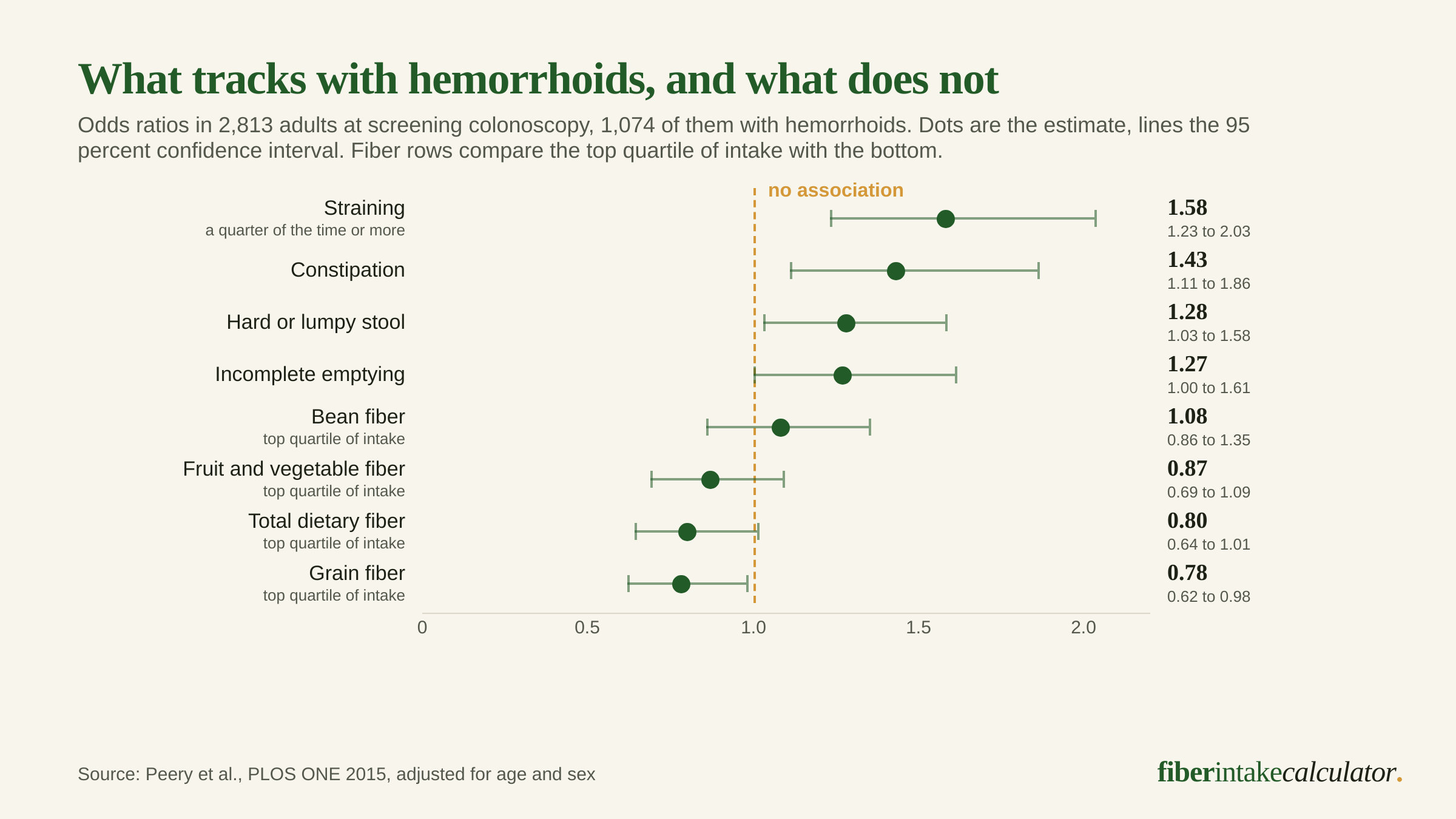
The largest study of what is actually associated with hemorrhoids looked at 2,813 adults having a screening colonoscopy, 1,074 of whom had hemorrhoids recorded (Peery et al., 2015). It tested the standard list of culprits at once.
| Factor | Odds ratio | 95% confidence interval |
|---|---|---|
| Straining 25% or more of the time | 1.58 | 1.23 to 2.03 |
| Constipation, Rome I definition | 1.43 | 1.11 to 1.86 |
| Hard or lumpy stool 25% or more of the time | 1.28 | 1.03 to 1.58 |
| Incomplete emptying 25% or more of the time | 1.27 | 1.00 to 1.61 |
| Fewer than 3 bowel movements a week | 1.42 | 0.78 to 2.58 |
| Total dietary fiber, top quartile vs bottom | 0.80 | 0.64 to 1.01 |
| Grain fiber, top quartile vs bottom | 0.78 | 0.62 to 0.98 |
| Fruit and vegetable fiber, top quartile vs bottom | 0.87 | 0.69 to 1.09 |
| Bean fiber, top quartile vs bottom | 1.08 | 0.86 to 1.35 |
Three things fall out of that table.
Straining is the strongest signal in the study. Not total fiber, not bowel frequency, not body weight, which showed nothing. Straining at least a quarter of the time carried an odds ratio of 1.58. That matches the mechanism: chronic straining stretches the tissue that holds the cushions in place.
Total fiber only trended. The top quartile averaged 24.5 grams a day against 7.9 grams in the bottom quartile, and the odds ratio was 0.80 with an interval touching 1.01. Mean intake was nearly identical in cases and controls, 14.9 grams a day against 15.1 grams. Fiber matters here mainly because it is one way to stop straining, which is exactly how the 2026 AGA practice update frames it: increase fiber and avoid straining or long sitting on the toilet.
Among fiber subtypes, only grain fiber reached significance. Grain fiber in the top quartile carried an odds ratio of 0.78. Bean fiber showed nothing at all (1.08), and fruit and vegetable fiber showed nothing (0.87). That is close to the reverse of the order every high-fiber food list for hemorrhoids uses, which starts with legumes and fruit.
Hold that finding loosely. It is one cross-sectional study, adjusted only for age and sex, in adults aged 45 to 75 who had already had an adenoma removed. It cannot show that grains prevent anything. But it is the only evidence anyone has on the question, and it does not support ranking beans first. The same study also found sedentary behaviour associated with a lower risk, which is a good reminder of how much a cross-sectional design can and cannot tell you.
Constipation being upstream of all this is well supported elsewhere: pooling 19 studies, people with hemorrhoids were about twice as likely to have functional constipation as controls (OR 2.09, 95% CI 1.27 to 3.44). If that is your situation, the dose evidence is better developed there than here, and our page on fiber for constipation has the thresholds the constipation trials used.
What a grain-fiber day looks like
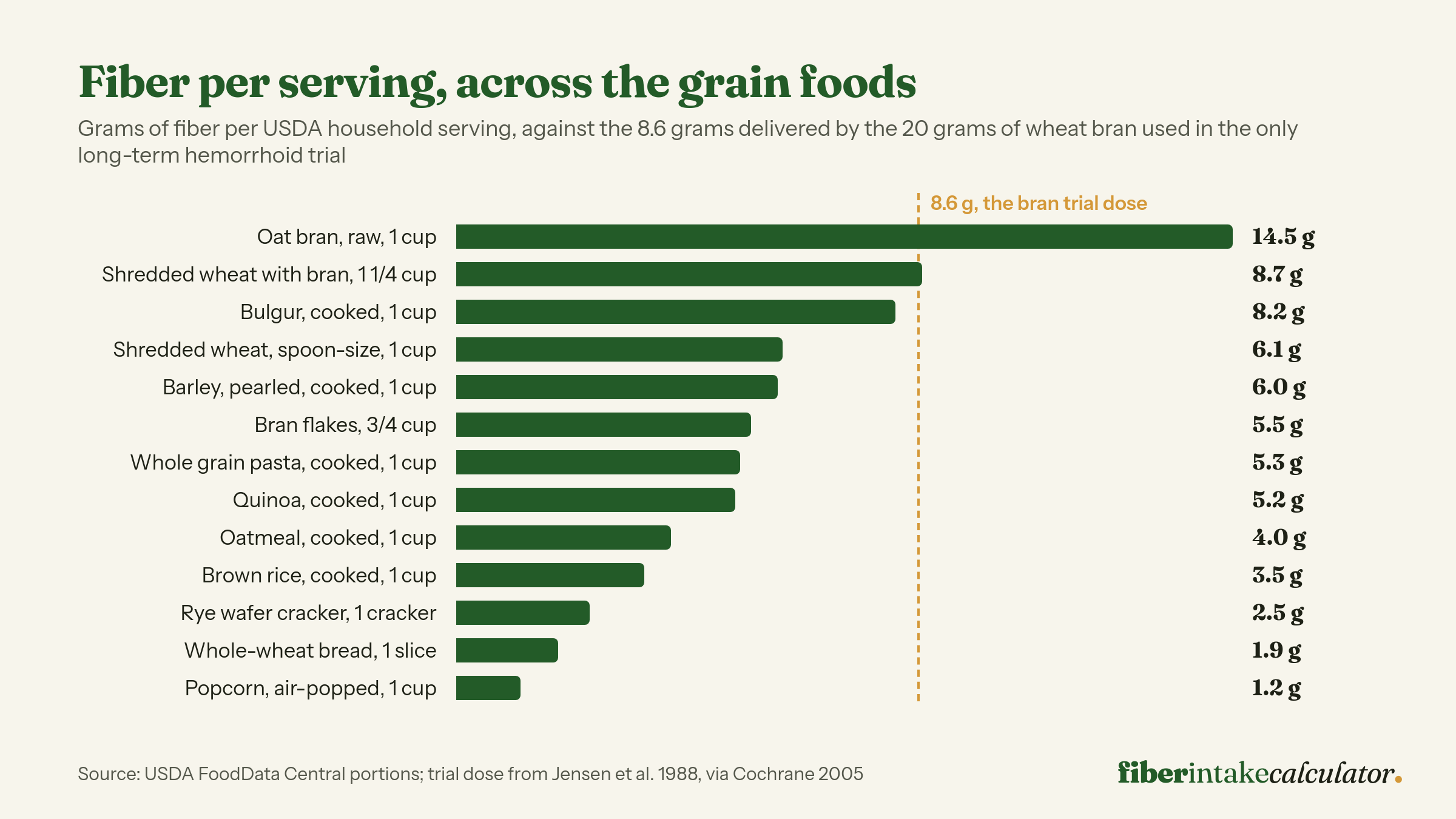
If the bran trial’s 20 grams of wheat bran is the reference, that is 8.6 grams of fiber a day for 43 calories. Here is what ordinary grain servings deliver against it, using USDA household portions.
| Food | USDA serving | Fiber | Calories | Servings for 8.6 g |
|---|---|---|---|---|
| Wheat bran, crude | 20 g, about 1/3 cup | 8.6 g | 43 | 1.0 |
| Oat bran, raw | 1 cup (94 g) | 14.5 g | 231 | 0.6 |
| Shredded wheat with bran | 1 1/4 cup (59 g) | 8.7 g | 200 | 1.0 |
| Bulgur, cooked | 1 cup (182 g) | 8.2 g | 151 | 1.0 |
| Shredded wheat, spoon-size | 1 cup (49 g) | 6.1 g | 172 | 1.4 |
| Barley, pearled, cooked | 1 cup (157 g) | 6.0 g | 193 | 1.4 |
| Bran flakes | 3/4 cup (30 g) | 5.5 g | 98 | 1.6 |
| Whole grain pasta, cooked | 1 cup spaghetti (116 g) | 5.3 g | 184 | 1.6 |
| Quinoa, cooked | 1 cup (185 g) | 5.2 g | 222 | 1.7 |
| Oatmeal, cooked | 1 cup (234 g) | 4.0 g | 166 | 2.2 |
| Brown rice, cooked | 1 cup (195 g) | 3.5 g | 218 | 2.5 |
| Rye wafer cracker | 1 cracker (11 g) | 2.5 g | 37 | 3.4 |
| Whole-wheat bread | 1 slice (32 g) | 1.9 g | 81 | 4.5 |
| Rye bread | 1 regular slice (32 g) | 1.9 g | 83 | 4.5 |
| Popcorn, air-popped | 1 cup (8 g) | 1.2 g | 31 | 7.2 |
The spread in the calorie column is the practical point. A third of a cup of wheat bran and two and a half cups of brown rice deliver similar fiber, at 43 calories against 545. Bran cereals land in between, and our high-fiber cereal ranking works through the serving-size rules that make box comparisons misleading.
None of this replaces your overall daily target, which is a different number for a different purpose. The general recommendation is 14 grams of fiber per 1,000 calories, so 28 grams on a 2,000 calorie diet, and the fiber calculator works out your own. The trial dose is a specific carrier taken daily; the daily target is the whole diet.
Add it over weeks rather than days. Bloating was the most common complaint in the trials, reported by half the bran group in the 18-month study against none of the controls. Starting small and building is the standard fix, and our page on pushing fiber intake high covers the ramp and what going too fast costs.
Beans, berries and greens still count toward your day, and the full high-fiber foods chart ranks them across 42 foods. The argument here is about ordering, not exclusion: on the only evidence available, grain fiber is the subtype with a signal, so it is the odd thing to leave until last.
When fiber is the wrong tool
Fiber is first-line advice because it is cheap, safe and has the evidence above behind it. Three situations are not fiber problems, and the current guidance is specific.
Severe pain usually means something else. The 2026 AGA clinical practice update states that hemorrhoids only cause significant pain when acutely thrombosed, and that sharp pain on defecation is most likely an anal fissure. That matters because the fiber evidence for pain is the weakest of all the outcomes in the meta-analysis. If the dominant symptom is sharp pain, the question to settle is the diagnosis, not the diet.
Acute thrombosis is a procedure, not a plan. The same update describes thrombosed hemorrhoids as often extremely painful and best treated surgically with incision and drainage.
New rectal bleeding needs a diagnosis first. The update advises anoscopy on every new patient with suspected hemorrhoids, before treatment. Bleeding is the symptom fiber has the best evidence for, and it is also the symptom most worth being certain about.
See a clinician first if this is new. Rectal bleeding, a lump that will not reduce, or pain severe enough to dominate your day all need examining before a diet change. Fiber is the right first move for known, uncomplicated hemorrhoids, not a substitute for finding out what you have.
In active Crohn’s disease or ulcerative colitis, the update says hemorrhoid management should wait until remission. And people with grade III hemorrhoids often carry other bowel symptoms alongside: in one Swedish comparison, only 37 percent described their bowel movements as normal against 55 and 67 percent of two control groups, and 34 percent had abdominal pain with evacuation against 3 and 5 percent.
Where fiber sits in current guidance
The most recent statement is the American Gastroenterological Association’s July 2026 clinical practice update. Its second piece of best practice advice puts fiber first, and pairs it with something the food lists leave out.
Dietary and lifestyle modifications, including increasing fiber intake and avoiding straining or prolonged time on the toilet, are reasonable first-line therapies for symptomatic hemorrhoids.
Two halves, and the second half is the one Peery’s data picks out as the strongest association. Sitz baths get a more cautious line in the same statement: often advised, with limited supporting data. Topical treatments including anesthetics, witch hazel, corticosteroids and vasoactive agents “can be considered”, with the update noting there is little data to support efficacy and that topical steroids should not be used for more than two weeks at a time.
Pregnancy gets its own advice, and it is conservative: hemorrhoids occur in up to two-thirds of women during pregnancy, and treatment should generally involve fiber, treating the constipation, and topical ointments, with procedures held until after delivery if symptoms persist.
So the honest summary of a high-fiber diet for hemorrhoids is this. It is first-line, it has moderate-quality evidence behind it for bleeding and overall symptoms, the trials that produced that evidence used a husk or bran supplement at 7 to 20 grams a day for four to six weeks, and the lifestyle half of the same recommendation is about how you sit and push, not what is on the plate. If you want the gel-forming versus bulking distinction behind husk and bran in grams, our soluble and insoluble fiber page has the split. For how the 7 to 20 gram dose here compares with what the trials used in constipation, irritable bowel syndrome and diverticulitis, our overview of fiber across specific conditions puts every effect size and tested dose in one table.
Frequently asked questions
What is the best fiber to take for hemorrhoids?
A bulk-forming husk fiber, because that is what the trials used. Of the seven randomized trials pooled by the Cochrane review, three used ispaghula husk, two used psyllium or plantago ovata, one used sterculia and one used unprocessed wheat bran. No trial has tested a high-fiber food list against a control, so the food-versus-supplement question has never been answered for hemorrhoids. Stated doses ran from 7 grams a day of ispaghula husk to 20 grams a day of psyllium seed fiber or bran.
What shrinks hemorrhoids fastest?
Fiber does not shrink them, and the trial data is clear about that. Pooled across three trials, persistent prolapse was no less likely on fiber than on control (RR 0.79, 95% CI 0.37 to 1.67). The Cochrane authors give the reason: prolapse is a structural change, and damage to the connective tissue that supports the hemorrhoidal cushions does not reverse because stool got softer. Fiber's measured effects are on overall symptoms and on bleeding. For prolapse that persists, the 2026 AGA practice update points to office procedures such as rubber band ligation or infrared coagulation.
How long does fiber take to work for hemorrhoids?
The trials ran between 40 days and 18 months, with most assessing symptoms at four to six weeks. The Cochrane review notes that in trials measuring at more than one time point, usually six weeks and three months, the later results closely matched the earlier ones. So six weeks is a fair window to judge it, and there is no evidence that waiting longer than three months adds anything.
Can too much fiber make hemorrhoids worse?
It can make you more uncomfortable, mostly through gas. The Cochrane review found a non-significant trend toward more mild adverse events on fiber (RR 6.0, 95% CI 0.57 to 64.8), and in the 18-month bran trial half the treatment group reported bloating against none of the controls. Two other trials recorded no adverse effects at all. Fiber also needs fluid: federal label rules require dry-form psyllium, methylcellulose, guar gum, glucomannan and polycarbophil to carry a direction to take each dose with at least 8 ounces of liquid.
Will fiber stop hemorrhoid bleeding?
Bleeding is the single symptom with the clearest trial evidence. Across four trials, fiber halved the risk of bleeding persisting (RR 0.50, 95% CI 0.28 to 0.89), and in absolute terms 7 to 31 percent of people on fiber still had bleeding against 38 to 76 percent on control. That said, rectal bleeding is a symptom that needs a diagnosis before it needs a diet. The 2026 AGA practice update advises anoscopy on every new patient with suspected hemorrhoids, before treatment, so that something else is not being treated as a hemorrhoid.
Built and maintained by the FiberIntake team, with data from USDA FoodData Central and peer-reviewed sources. Figures are checked against the cited source before publish. About this site →