Soluble Fiber Foods, With Numbers
Last updated: September 26, 2026
Every fiber site tells you oats and beans “contain soluble fiber.” Almost none tell you how many grams, because the USDA database only tracks total fiber. There is no official split to look up. The table below is compiled from peer-reviewed lab analyses instead.
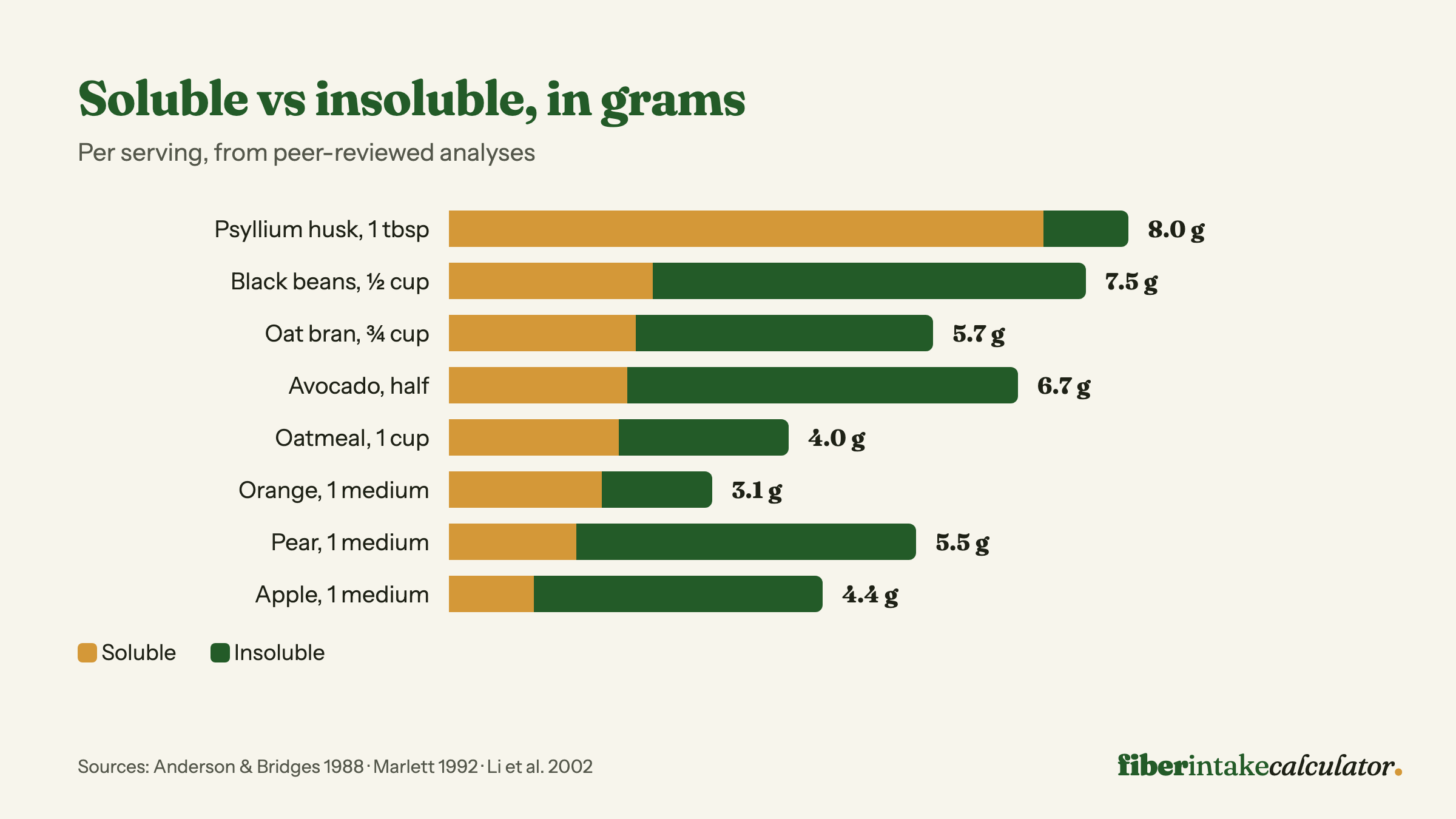
If your goal is cholesterol, sort by the soluble column: psyllium, oat bran, and beans are where the viscous, gel-forming fiber actually lives. To add up a whole day of them, our soluble fiber calculator totals the grams you pick and measures them against the 7 grams FDA ties to its psyllium heart claim.
Oat bran is the easiest of those to eat every morning, at 5 g of total fiber per half cup dry. Bran flakes are not the same thing: the wheat bran that leads the ingredient list on most high-fiber cereals is almost entirely insoluble, which bulks stool rather than lowering cholesterol.
Barley is the other grain carrying beta-glucan, and FDA treats the two together: 21 CFR 101.81 asks for 0.75 g of soluble fiber per serving and 3 g a day from whole oats or barley before a label may make the heart claim. A cooked cup of pearled barley is 6.0 g of total fiber, which our whole grains ranking puts alongside every other grain on the same serving basis.
Read the same table from the other side and the ranking changes shape. Sorted by the insoluble column, black beans lead at 5.1 g per half cup, and apple with the skin turns out to be 77% insoluble despite being the standard example on every soluble fiber list. It is not the only one that fails that check: scoring each published list against these grams on our soluble vs insoluble fiber comparison leaves exactly one of the eleven named soluble foods majority soluble by weight.
Some foods are missing from the table on purpose. Lentils are the one people ask about most, and the published analyses disagree with each other by nearly five times on how much of a half cup is soluble, so there is no row we can stand behind. The full comparison of what each source claims is on our page about soluble fiber in lentils.
Psyllium sits at the top of that column, which is why it dominates the supplement aisle. Getting a meaningful dose from a jar is another matter: our comparison of the best fiber supplements works out how many spoonfuls or capsules each product takes to reach the 7 grams of soluble psyllium fiber the FDA ties to its heart-disease claim.
Solubility is not the only axis, and on gut bacteria it is the wrong one. A soluble fiber can be a gel-forming psyllium that resists fermentation or a freely fermented inulin, and the two behave nothing alike in the colon, which our page on high-fiber foods for gut health works through with the trial effect sizes attached. The axes that do predict are gel formation, particle size and fermentability, and our explainer on what fiber actually does sets each of them against the benefit it produces and the size that benefit was measured at.
The split also decides which fiber to reach for when the goal is regularity rather than cholesterol. On that outcome the useful question is not whether a fiber dissolves but whether it is still there when the stool forms, which divides these foods differently from the table above. Psyllium’s gel survives fermentation and holds water all the way through the colon, which is why it leads the pooled trial results on fiber for constipation, while the wheat bran above it on total grams is the type gastroenterologists steer away from in irritable bowel syndrome. That preference has a number behind it: soluble fiber cut persisting irritable bowel symptoms at a relative risk of 0.83 in the pooled trials and bran did not, one of several results our comparison of fiber across specific conditions sets side by side. Solubility is only half of what decides tolerance there, though, because rapidly fermentable soluble fibers such as inulin cause the gas the advice is trying to avoid, and our page on fiber for IBS sorts the options on both axes.
Blood sugar is where the split stops predicting anything, which is worth saying because it is the claim soluble fiber gets made for most often. Meta regression across 42 randomized trials in adults with diabetes found that fiber type did not influence the improvement in HbA1c, fasting glucose or any lipid marker, and the one type difference it did find favoured non-viscous fiber on HDL. Our page on fiber for diabetes sets out that analysis and ranks foods by fiber per gram of net carbohydrate instead.
| Food | Soluble (g) | Insoluble (g) | Total (g) | Serving |
|---|---|---|---|---|
| Psyllium husk | 7 | 1 | 8 | 1 tbsp |
| Kidney beans, cooked | 2.9 | 2.8 | 5.7 | 1/2 cup |
| Black beans, cooked | 2.4 | 5.1 | 7.5 | 1/2 cup |
| Oat bran, cooked | 2.2 | 3.5 | 5.7 | 3/4 cup |
| Avocado | 2.1 | 4.6 | 6.7 | half (100 g) |
| Oatmeal, cooked | 2 | 2 | 4 | 1 cup |
| Orange | 1.8 | 1.3 | 3.1 | 1 medium |
| Sweet potato, cooked | 1.8 | 2 | 3.8 | 1 medium |
| Pear, with skin | 1.5 | 4 | 5.5 | 1 medium |
| Flaxseed, whole | 1.1 | 1.7 | 2.8 | 1 tbsp (10 g) |
| Carrots, cooked | 1.1 | 1.2 | 2.3 | 1/2 cup |
| Apple, with skin | 1 | 3.4 | 4.4 | 1 medium |
| Barley, cooked | 1 | 2 | 3 | 1/2 cup |
| Brussels sprouts, cooked | 1 | 1 | 2 | 1/2 cup |
Soluble and insoluble values are compiled from peer-reviewed analyses (Anderson & Bridges 1988; Marlett 1992; Li et al. 2002). USDA's database carries total fiber only, so this split table is hand-curated from the literature. See methodology.
Frequently asked questions
What is soluble fiber?
Fiber that dissolves in water into a gel. The gel slows digestion, which is why soluble fiber (especially viscous types like psyllium and oat β-glucan) helps lower LDL cholesterol and steady blood sugar. Insoluble fiber stays intact and adds stool bulk instead.
Why do most sites only say which foods 'contain' soluble fiber, without amounts?
Because the standard database (USDA FoodData Central) only measures total dietary fiber; there is no official soluble/insoluble breakdown to copy. The gram values here are compiled from peer-reviewed laboratory analyses instead, which is rarer and slower work.
How much soluble fiber per day should I aim for?
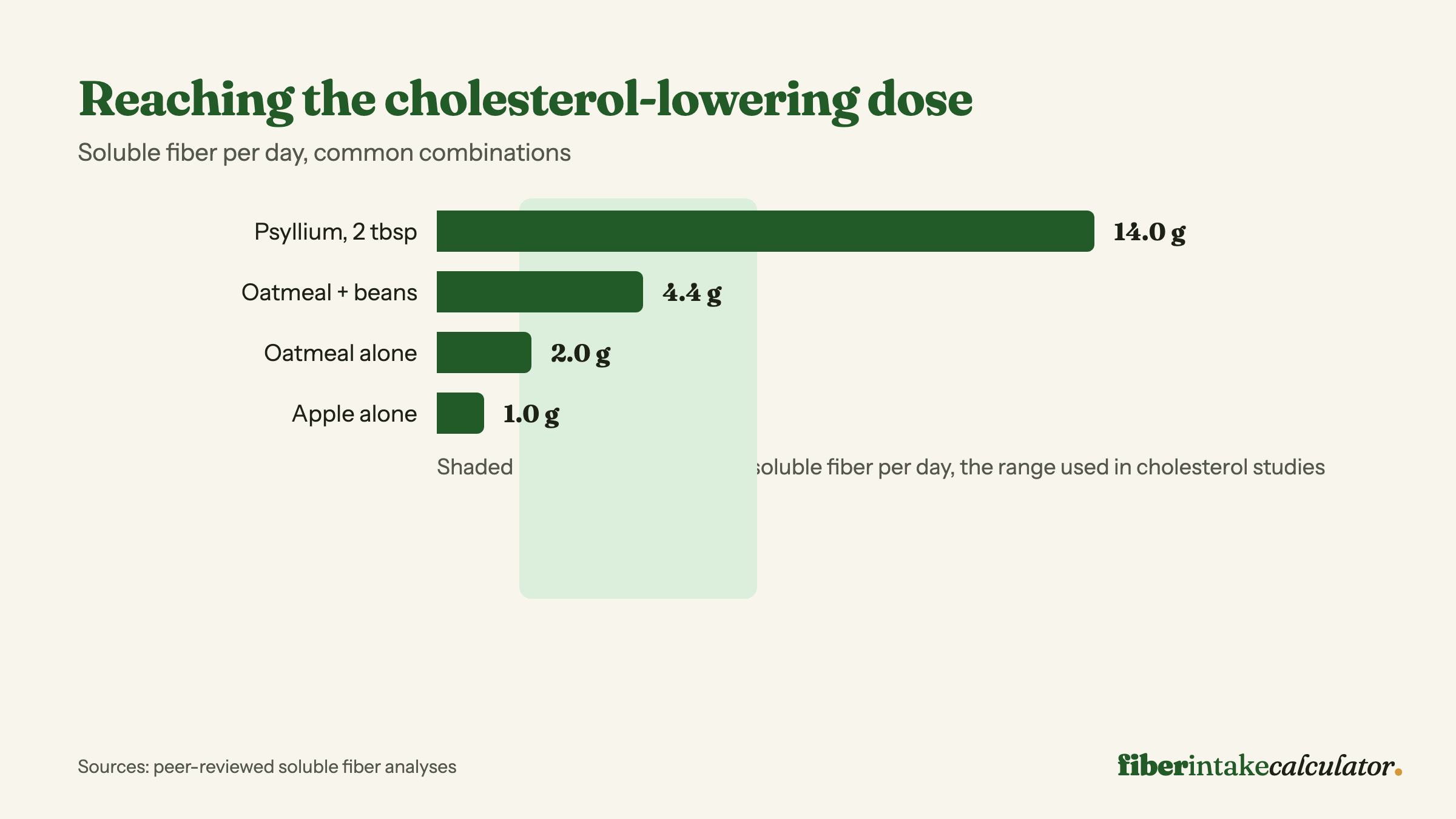
There's no official daily target for soluble fiber alone. For cholesterol-lowering, studies typically used 5 to 10 g of viscous soluble fiber per day: roughly a bowl of oatmeal plus a serving of beans, or one dose of psyllium.
Built and maintained by the FiberIntake team, with data from USDA FoodData Central and peer-reviewed sources. Figures are checked against the cited source before publish. About this site →