Soluble Fiber in Lentils, Source by Source
Last updated: September 24, 2026
A cooked cup of lentils holds 15.6 grams of total fiber, per USDA FoodData Central. How much of that is soluble fiber is not settled: published values for half a cup run from 0.6 grams to 2.8 grams, a spread of nearly five times, and there is no official number to break the tie.
That is the honest answer, and it is more useful than a confident one. Below is every source that publishes a figure, what each one says, and why the total is solid while the split is not.
The short version. Count lentils for total fiber, not for soluble fiber. The 15.6 grams a cup is measured and reliable. The soluble share is an estimate somewhere between 8% and 36%, and even the high end makes lentils an insoluble-led food.
How much soluble fiber is in lentils?
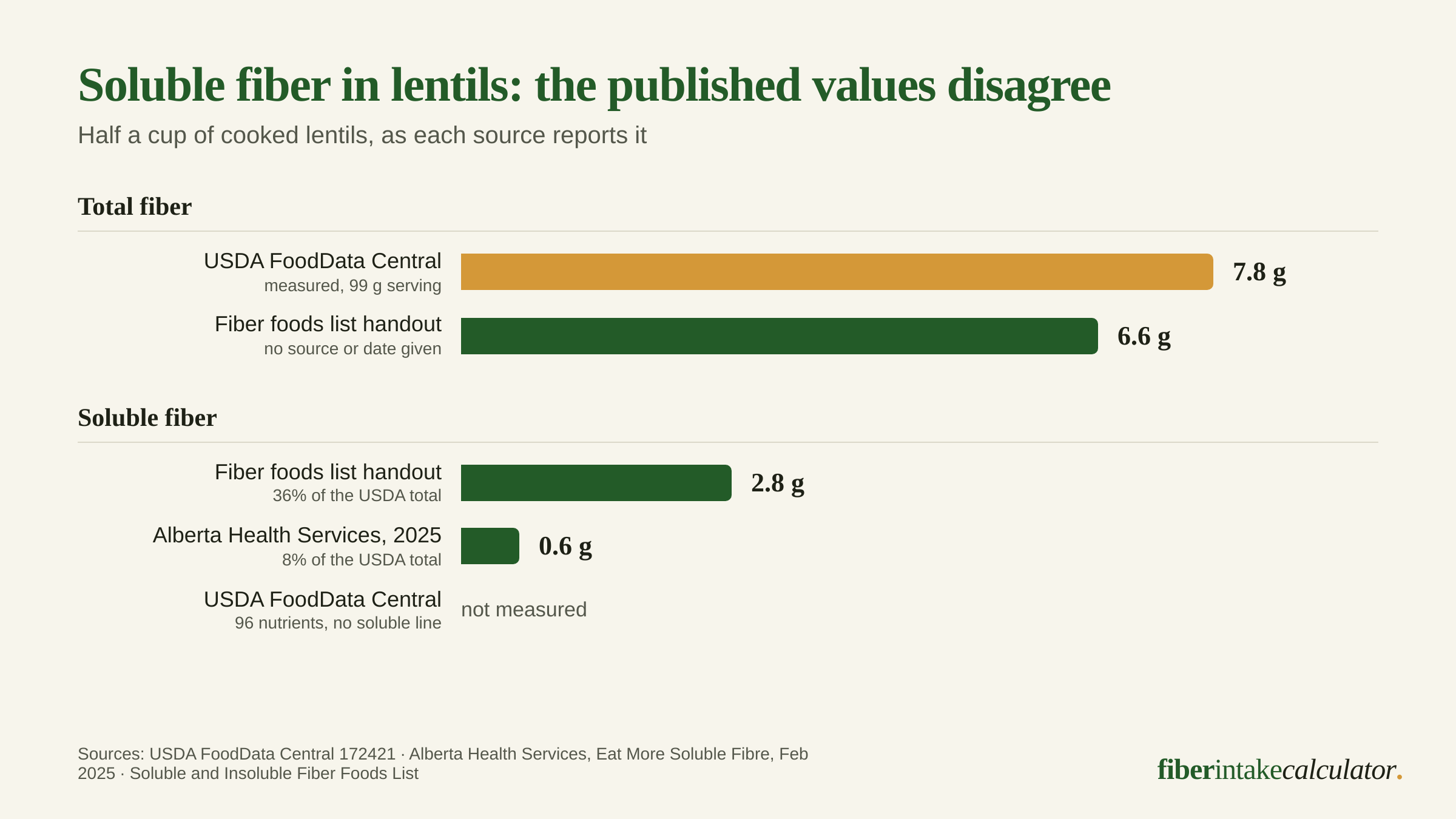
Two published handouts supply almost every soluble figure you will find for lentils, and they disagree.
| Source | Serving | Soluble | Insoluble | Total |
|---|---|---|---|---|
| USDA FoodData Central | 1/2 cup (99 g) | not measured | not measured | 7.8 g |
| Alberta Health Services, 2025 | 1/2 cup (125 mL) | 0.6 g | not listed | not listed |
| Soluble and Insoluble Fiber Foods List | 1/2 cup | 2.8 g | 3.8 g | 6.6 g |
The gap is 4.7 times on the same food at the same serving. Against USDA’s total, the low figure makes lentils 8% soluble and the high figure makes them 36% soluble. Neither handout’s total matches USDA’s either.
Doubling to a full cooked cup, the range is 1.2 to 5.6 grams of soluble fiber. Anyone publishing a single number for that cup is picking one handout and not telling you.
Why the published numbers disagree
USDA does not measure it. The FoodData Central record for cooked lentils carries 96 nutrients and not one of them is a soluble or insoluble fiber line; the only fiber entry is total dietary fiber at 7.9 grams per 100 grams. Nutrition Facts panels work the same way, which is why no lentil package will answer this either.
So every soluble figure in circulation traces back to laboratory analyses of a few dozen foods published between 1988 and 2002, re-tabulated by different groups who made different choices. Our own soluble fiber table is compiled from those same analyses, and our methodology page lists which paper each row comes from. Lentils are not in that table, and this page is the reason: we have no row we can stand behind.
The higher handout can be checked. On foods where it overlaps our split table, its soluble column reads apple with skin at 4.2 grams against our 1.0 gram, and wheat bran at 11.3 grams soluble against 1.0 gram insoluble. Wheat bran is the food every other reference treats as overwhelmingly insoluble, and our insoluble fiber ranking is built on that consensus. A sheet that inverts wheat bran carries the same doubt into its lentil row.
The sheet lists no source, no date and no method. That is the signal to check a number rather than copy it. The Alberta Health Services handout is dated February 2025 and published by a provincial health authority, which is why its 0.6 grams gets equal billing here despite being the less flattering figure.
Are lentils soluble or insoluble fiber?
Insoluble-led, on every reading of the data. The low estimate puts soluble fiber at 8% of the total. The high estimate puts it at 36%. There is no published figure that makes lentils a majority-soluble food.
The classification systems agree. Alberta Health Services sorts soluble fiber into gel-forming and prebiotic types, and puts legumes in the prebiotic and fermentable group, alongside onions, garlic, bananas and inulin. Its gel-forming list is barley and oats, apples, apricots, oranges, pears, sweet potato, winter squash, ground flax and chia, konjac and psyllium. Lentils are not on it.
University of Florida extension reaches the same place from the other direction: beans, peas and lentils run about 7 grams of fiber a half cup and are especially high in insoluble fiber, and what soluble fiber they carry is highly fermentable in the colon. That fermentation is the gas, which is the trade every legume asks you to make.
It matters because the two fibers do different jobs. Gel-forming soluble fiber is the one tied to cholesterol and blood sugar. Fermentable fiber feeds gut bacteria, and the dose at which each fiber family measurably did that is on our page about high-fiber foods for gut health. Bulk and transit come mostly from the insoluble side, which is the mechanism behind lentils in fiber for constipation.
Lentils against the other legumes
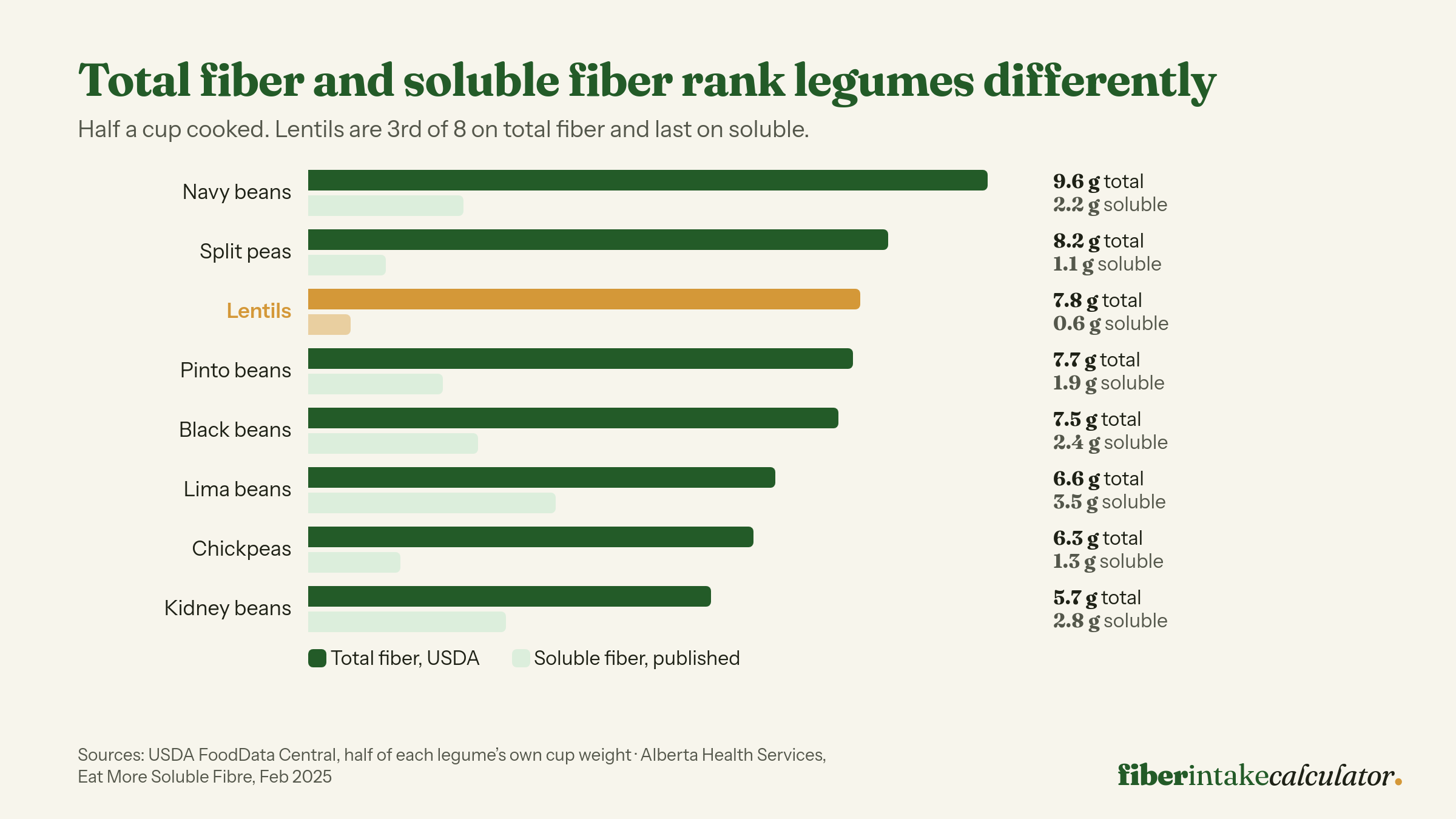
Rank the legumes on total fiber and lentils sit near the top. Rank them on published soluble fiber and they sit at the bottom. The order inverts almost completely.
| Legume, 1/2 cup cooked | Total fiber | Published soluble | Soluble share |
|---|---|---|---|
| Navy beans | 9.6 g | 2.2 g | 23% |
| Split peas | 8.2 g | 1.1 g | 13% |
| Lentils | 7.8 g | 0.6 g | 8% |
| Pinto beans | 7.7 g | 1.9 g | 25% |
| Black beans | 7.5 g | 2.4 g | 32% |
| Lima beans | 6.6 g | 3.5 g | 53% |
| Chickpeas | 6.3 g | 1.3 g | 21% |
| Kidney beans | 5.7 g | 2.8 g | 49% |
Lentils are third of eight on total fiber and last of eight on soluble. Kidney beans are the mirror image: last on total, second on soluble. Lima beans lead the soluble column at 3.5 grams.
Read the columns carefully, because they come from different places. Total fiber is USDA, taken as half of that legume’s own USDA cup weight, the same basis as our ranking of legumes by fiber. Soluble fiber is the Alberta Health Services half cup. The share column divides one by the other, so treat it as an estimate of direction rather than a measured value.
The direction is what to act on. If you want soluble fiber from a legume, kidney and lima beans are the better pick. If you want fiber in bulk, lentils and navy beans are.
What a cooked cup of lentils is actually worth
This is where lentils earn the reputation, and every figure here is USDA’s.
| Per cooked cup (198 g) | Amount |
|---|---|
| Total fiber | 15.6 g |
| Calories | 230 kcal |
| Protein | 17.9 g |
| Carbohydrate | 39.9 g |
| Fiber per 100 calories | 6.8 g |
One cup covers 62% of a 25 gram daily target and 41% of a 38 gram one. Reaching 25 grams on lentils alone takes 1.6 cups and 367 calories; reaching 38 grams takes 2.4 cups and 558 calories. Few foods get that far that cheaply.
The density is the real number. At 6.8 grams of fiber per 100 calories, lentils deliver 68 grams per 1,000 calories eaten, and the Institute of Medicine sets its adequate intake at 14 grams per 1,000 calories. A cup of lentils is close to five times the density the recommendation asks for. Your own target depends on your age, sex and calorie intake, which the fiber intake calculator works out in two clicks.
If you are counting soluble fiber specifically
Alberta Health Services tells adults to aim for at least 5 to 10 grams of soluble fiber a day. Lentils are an inefficient way to get there.
At the low published value, 5 grams would take 4.2 cups of cooked lentils in a day. At the high value it takes 0.9 cups. The honest guidance is that you cannot know which, so do not build a soluble target on lentils.
One tablespoon of psyllium husk carries 7.0 grams of soluble fiber, enough on its own, and our comparison of the best fiber supplements works through what each label actually delivers per dose. From whole food, oats, barley, citrus and the beans higher up the soluble column do it with less volume. To add up a full day of them, the soluble fiber calculator totals the grams as you pick foods.
None of that is an argument against lentils. It is an argument for counting them where they are strong. Every figure on this page is listed with its publication on our sources page. If you are managing cholesterol or a gut condition, take the dosing question to your clinician rather than to a food table.
Frequently asked questions
Are lentils soluble or insoluble fiber?
Both, led by insoluble. A cooked cup carries 15.6 grams of total fiber in USDA's record, and the published soluble estimates run from 8% to 36% of that. Alberta Health Services files legumes under prebiotic and fermentable fiber rather than the gel-forming group it lists barley, oats, flax and psyllium in, and University of Florida extension describes beans, peas and lentils as especially high in insoluble fiber.
How much soluble fiber is in a cup of cooked lentils?
Somewhere between 1.2 and 5.6 grams, and no source can narrow it further. The two published handouts behind most lentil answers give 0.6 grams and 2.8 grams for half a cup, which doubles to 1.2 and 5.6 grams a cup. USDA FoodData Central measures total fiber only, so there is no official figure to settle it.
Which legume has the most soluble fiber?
Lima beans, at 3.5 grams per cooked half cup in the Alberta Health Services table, ahead of kidney beans at 2.8 grams and black beans at 2.4 grams. Lentils come last in that list at 0.6 grams, which reverses their position on total fiber, where they rank third of the eight legumes compared here.
Do lentils make you poop?
They add a large amount of bulk: 15.6 grams of fiber a cooked cup is 62% of a 25 gram daily target. Most of that fiber is the insoluble and fermentable kind, which speeds transit and feeds gut bacteria, and the fermentation is also why lentils produce gas. Increase the portion over two to three weeks rather than at once, and drink more water alongside it.
Which has more fiber, lentils or chickpeas?
Lentils, by a quarter. A cooked cup of lentils holds 15.6 grams of fiber against 12.5 grams for a cooked cup of chickpeas in USDA's records. Chickpeas carry more of the published soluble fraction, at 1.3 grams a half cup against 0.6 grams for lentils, so the answer flips depending on which fiber you are counting.
Built and maintained by the FiberIntake team, with data from USDA FoodData Central and peer-reviewed sources. Figures are checked against the cited source before publish. About this site →