Legumes High in Fiber, Ranked by the Cooked Cup
Last updated: September 15, 2026
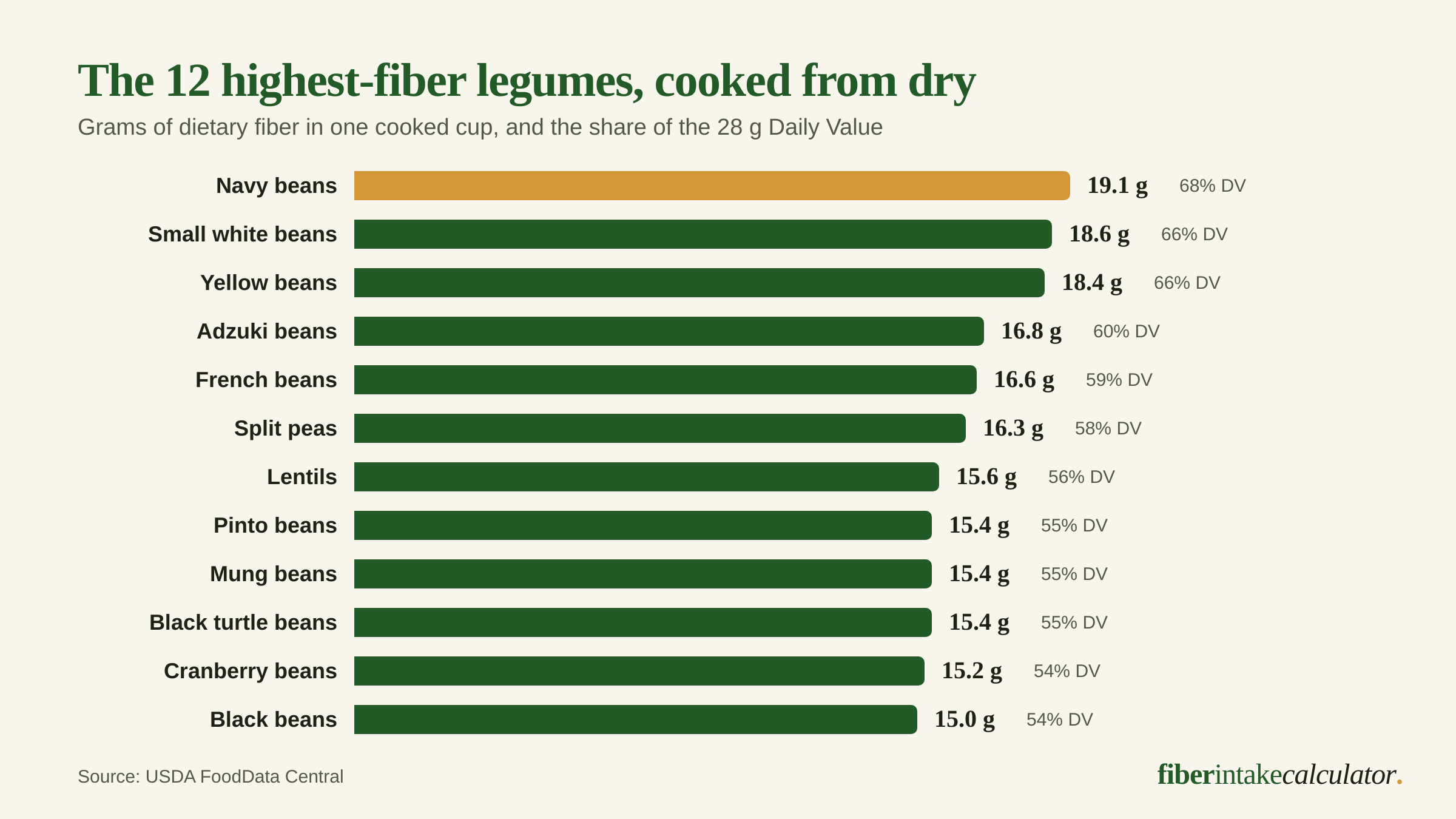
Navy beans carry the most fiber of any legume per cooked cup, at 19.1 grams, ahead of small white beans at 18.6 grams and yellow beans at 18.4 grams. Lentils, the legume most published lists put first, sit seventh at 15.6 grams.
One cooked cup of navy beans is 68% of the FDA’s 28 gram Daily Value. No other food group moves a daily total that far in a single serving.
Every figure here is computed from USDA FoodData Central: fiber per 100 grams, multiplied by USDA’s own household serving weight, with cooked, canned or dry named on every row. Those three states get mixed together in published bean charts, and each mix-up is worth several grams.
The bean at the top is one almost nobody lists
Search for legumes high in fiber and the answer starts at split peas or lentils. Google’s AI Overview opens with split peas at 16.0 grams per cup, then lentils, then black beans, and sources all of it to one Mayo Clinic table.
That table has no row for navy beans, small white beans, yellow beans, adzuki beans or French beans. USDA has all five, and all five outrank split peas.
| Legume, cooked from dry | Fiber per cup | Cup weight | Per 100 g |
|---|---|---|---|
| Navy beans | 19.1 g | 182 g | 10.5 g |
| Small white beans | 18.6 g | 179 g | 10.4 g |
| Yellow beans | 18.4 g | 177 g | 10.4 g |
| Adzuki beans | 16.8 g | 230 g | 7.3 g |
| French beans | 16.6 g | 177 g | 9.4 g |
| Split peas | 16.3 g | 196 g | 8.3 g |
| Lentils | 15.6 g | 198 g | 7.9 g |
| Pinto beans | 15.4 g | 171 g | 9.0 g |
| Mung beans | 15.4 g | 202 g | 7.6 g |
| Black turtle beans | 15.4 g | 185 g | 8.3 g |
| Cranberry beans | 15.2 g | 177 g | 8.6 g |
| Black beans | 15.0 g | 172 g | 8.7 g |
Adzuki beans are the instructive row. They hold the least fiber per 100 grams of anything in that table, and still place fourth, because USDA’s adzuki cup weighs 230 grams. Cup rankings are partly a ranking of how densely a bean packs.
Rule of thumb. Every legume in the top twelve clears 15 grams per cooked cup. Which one you pick matters far less than whether you eat any of them, so buy the one you will actually cook.
Lentils earn their place at the front of most lists on a different axis. They cook in about 20 minutes with no soak, which is why they anchor the food stack in our fiber calculator and why they turn up in the tested doses on our page about fiber for constipation.
Ask how much of that 15.6 grams is soluble fiber and the ranking stops being reliable. Published values for half a cup of lentils run from 0.6 to 2.8 grams, and we walk through every source in soluble fiber in lentils, which also pairs this table’s totals against the soluble figures for eight legumes. The two orders barely overlap.
A canned cup is not a cooked cup
USDA records canned beans in a cup that includes the packing liquid, and that cup weighs 240 to 262 grams. A cup of beans you cooked from dry weighs 164 to 202 grams, all of it beans.
The two cups are different measures, so comparing them gram for gram tells you nothing. A cup of canned navy beans weighs 44% more than a cup of home-cooked navy beans and carries 30% less fiber.
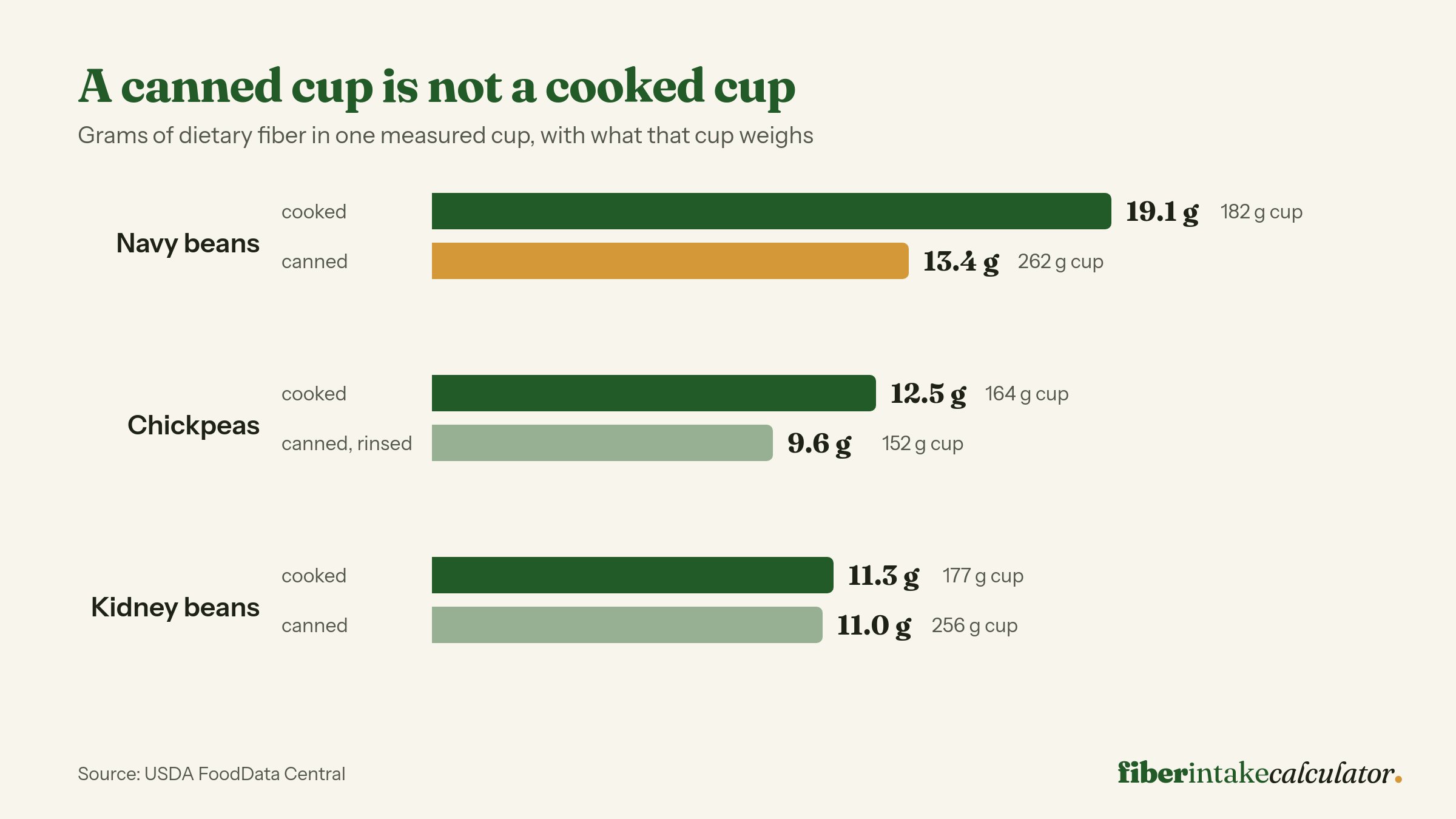
Chickpeas are the one clean comparison USDA publishes, because both records are drained beans measured into a cup:
| Chickpeas | Cup weight | Fiber per cup |
|---|---|---|
| Cooked from dry | 164 g | 12.5 g |
| Canned, drained and rinsed | 152 g | 9.6 g |
That is 23% less fiber from the same measuring cup. Across the three legumes USDA records both ways with the liquid drained, the loss per 100 grams of beans runs from 16% to 39%:
| Per 100 g of drained beans | Cooked | Canned | Difference |
|---|---|---|---|
| Pinto beans | 9.0 g | 5.5 g | 39% less |
| Kidney beans, red | 7.4 g | 5.5 g | 26% less |
| Chickpeas | 7.6 g | 6.4 g | 16% less |
Rinsing is not what costs you. USDA’s drained chickpeas hold 6.4 grams of fiber per 100 grams and its drained-and-rinsed chickpeas hold 6.3 grams. Rinse the can for the sodium and lose almost no fiber doing it.
The one thing to remember. Canned beans are still one of the strongest fiber foods in a supermarket. They are just not interchangeable with home-cooked beans gram for gram, and no chart tells you which record its number came from.
Processed legume foods drop further. A cup of commercial hummus gives 13.5 grams, but nobody eats a cup: the usual two tablespoons give 1.7 grams. Canned refried beans give 11.4 grams per cup and plain canned baked beans 10.4 grams.
A dry-bean number cannot be converted
Dry beans are about 11% water. Cooked beans are roughly two thirds water. So a per-100-gram figure from a dry record describes about three times as much actual bean as the same weight on a plate.
USDA lists kidney beans at 24.9 grams of fiber per 100 grams dry and 6.4 grams cooked. Same bean, 3.9 times apart.
The gap is different for every legume, which is why no conversion factor works:
| Legume | Per 100 g dry | Per 100 g cooked | Ratio |
|---|---|---|---|
| Kidney beans, all types | 24.9 g | 6.4 g | 3.9x |
| Split peas | 22.2 g | 8.3 g | 2.7x |
| Small white beans | 24.9 g | 10.4 g | 2.4x |
| Black beans | 15.5 g | 8.7 g | 1.8x |
| Navy beans | 15.3 g | 10.5 g | 1.5x |
| Lentils | 10.7 g | 7.9 g | 1.4x |
The cooking itself is predictable. Working from USDA’s cup weights and water content, one cup of dry beans makes close to three cups cooked: 2.8 for navy beans and chickpeas, 2.9 for lentils and black beans, 3.0 for split peas. The published fiber values do not track that ratio, so the cooked record is the only one worth quoting. Our methodology page sets out the serving basis used throughout this site.
This is the same trap that shows up in vegetables, where a cup of spinach holds 0.7 grams raw and 4.3 grams cooked. The high-fiber vegetables chart puts numbers on that one.
Fiber per calorie reorders the legumes
Navy beans lead here too, at 7.5 grams of fiber per 100 calories among legumes cooked from dry. The reordering happens further down, where the legume foods people actually reach for fall off a cliff.
| Legume food | Fiber per 100 calories | Fiber per usual serving |
|---|---|---|
| Navy beans, cooked | 7.5 g | 19.1 g per cup |
| Split peas, cooked | 7.0 g | 16.3 g per cup |
| Lentils, cooked | 6.8 g | 15.6 g per cup |
| Chickpeas, cooked | 4.6 g | 12.5 g per cup |
| Edamame, cooked | 3.0 g | 7.6 g per cup |
| Hummus, commercial | 2.3 g | 1.7 g per 2 tbsp |
| Tofu, firm | 1.6 g | 5.8 g per cup |
| Peanuts, dry-roasted | 1.4 g | 2.4 g per oz |
| Peanut butter | 0.8 g | 1.6 g per 2 tbsp |
Peanuts are legumes botanically and behave like nuts nutritionally. They carry 8.4 grams of fiber per 100 grams, which sounds excellent until you notice the 587 calories that come with it. Sort the chart below by the per-calorie column to see the full order, and see our page on fiber and weight loss for why that column is the one that matters on a calorie budget.
Beans are also where soluble fiber lives in useful quantity, which is the fraction that binds cholesterol. Our soluble fiber page splits the totals here into soluble and insoluble. Both fractions are large: half a cup of cooked black beans is 2.4 grams of soluble fiber and 5.1 grams of insoluble, which is the highest serving on our insoluble fiber ranking.
One cup of beans is most of a day
Adults need 25 grams a day for women and 38 grams for men aged 19 to 50, per the Institute of Medicine reference intakes. Those fall to 21 and 30 grams after 50. Get your own number from the fiber calculator if you do not have one.
| One cooked cup | Fiber | Of a 25 g target | Of a 38 g target |
|---|---|---|---|
| Navy beans | 19.1 g | 76% | 50% |
| Split peas | 16.3 g | 65% | 43% |
| Lentils | 15.6 g | 62% | 41% |
| Chickpeas | 12.5 g | 50% | 33% |
Compare that with a day built on vegetables. A green salad, a baked potato with skin, a cup of cooked broccoli and a cup of cooked carrots come to 17.1 grams between them. One cup of navy beans does more, in one pot.
It also beats every supplement dose on the shelf. Labeled servings in our fiber supplement comparison run from 0.5 to 9 grams, so a cup of beans outperforms the strongest of them for the price of a bag of dried beans.
Add it gradually. Published ramp guidance ranges from 3 grams per week to 5 grams per day, as our page on pushing fiber intake high sets out. Beans and lentils are also on the short list of highly fermentable foods that a gastroenterologist quoted on our fiber for constipation page names as the usual cause of gas and bloating.
Every legume, ranked
Sort by any column. Rows carry their preparation in the name, so cooked, canned and drained versions of the same legume sit in the list as the different foods they are. The % of your target column uses the result you saved in the calculator, or the FDA Daily Value of 28 g until you have one. Every figure traces to USDA FoodData Central or to the Institute of Medicine intakes, both listed on our sources page, and the full chart across every food group is on the high-fiber foods page.
| Legume | Fiber per serving (g) | Serving | Fiber per 100 calories (g) | Protein per serving (g) | % of your target |
|---|---|---|---|---|---|
| Navy beans, cooked | 19.1 | 1 cup (182 g) | 7.5 | 15 | – |
| Small white beans, cooked | 18.6 | 1 cup (179 g) | 7.3 | 16.1 | – |
| Yellow beans, cooked | 18.4 | 1 cup (177 g) | 7.2 | 16.2 | – |
| Adzuki beans, cooked | 16.8 | 1 cup (230 g) | 5.7 | 17.3 | – |
| French beans, cooked | 16.6 | 1 cup (177 g) | 7.3 | 12.5 | – |
| Black turtle beans, canned | 16.6 | 1 cup (240 g) | 7.6 | 14.5 | – |
| Cranberry (borlotti) beans, canned | 16.4 | 1 cup (260 g) | 7.6 | 14.4 | – |
| Split peas, cooked | 16.3 | 1 cup (196 g) | 7 | 16.3 | – |
| Peanuts, boiled | 15.8 | 1 cup shelled (180 g) | 2.8 | 24.3 | – |
| Lentils, cooked | 15.6 | 1 cup (198 g) | 6.8 | 17.9 | – |
| Mung beans, cooked | 15.4 | 1 cup (202 g) | 7.2 | 14.2 | – |
| Pinto beans, cooked | 15.4 | 1 cup (171 g) | 6.3 | 15.4 | – |
| Black turtle beans, cooked | 15.4 | 1 cup (185 g) | 6.4 | 15.1 | – |
| Cranberry (borlotti) beans, cooked | 15.2 | 1 cup (177 g) | 6.3 | 16.5 | – |
| Black beans, cooked | 15 | 1 cup (172 g) | 6.6 | 15.2 | – |
| Baby lima beans, cooked | 14 | 1 cup (182 g) | 6.1 | 14.6 | – |
| Hummus, commercial | 13.5 | 1 cup (246 g) | 2.3 | 19.1 | – |
| Navy beans, canned | 13.4 | 1 cup (262 g) | 4.5 | 19.7 | – |
| Lima beans, large, cooked | 13.2 | 1 cup (188 g) | 6.1 | 14.7 | – |
| Great northern beans, canned | 12.8 | 1 cup (262 g) | 4.3 | 19.3 | – |
| White beans, canned | 12.6 | 1 cup (262 g) | 4.2 | 19 | – |
| Chickpeas, cooked | 12.5 | 1 cup (164 g) | 4.6 | 14.5 | – |
| Great northern beans, cooked | 12.4 | 1 cup (177 g) | 5.9 | 14.7 | – |
| Lima beans, large, canned | 11.6 | 1 cup (241 g) | 6.1 | 11.9 | – |
| Refried beans, canned | 11.4 | 1 cup (242 g) | 5.7 | 12.8 | – |
| Kidney beans, cooked | 11.3 | 1 cup (177 g) | 5 | 15.3 | – |
| White beans, cooked | 11.3 | 1 cup (179 g) | 4.5 | 17.4 | – |
| Pigeon peas, cooked | 11.3 | 1 cup (168 g) | 5.5 | 11.4 | – |
| Black-eyed peas, cooked | 11.1 | 1 cup (171 g) | 5.6 | 13.2 | – |
| Kidney beans, canned | 11 | 1 cup (256 g) | 5.1 | 13.4 | – |
| Baked beans, canned, plain | 10.4 | 1 cup (254 g) | 4.4 | 12.1 | – |
| Soybeans, mature, cooked | 10.3 | 1 cup (172 g) | 3.5 | 31.3 | – |
| Chickpeas, canned, drained and rinsed | 9.6 | 1 cup (152 g) | 4.6 | 10.7 | – |
| Natto | 9.5 | 1 cup (175 g) | 2.6 | 33.9 | – |
| Fava beans, canned | 9.5 | 1 cup (256 g) | 5.2 | 14 | – |
| Fava beans, cooked | 9.2 | 1 cup (170 g) | 4.9 | 12.9 | – |
| Green peas, cooked | 8.8 | 1 cup (160 g) | 6.5 | 8.6 | – |
| Black-eyed peas, canned | 7.9 | 1 cup (240 g) | 4.3 | 11.4 | – |
| Edamame (green soybeans), cooked | 7.6 | 1 cup (180 g) | 3 | 22.2 | – |
| Yardlong beans, cooked | 6.5 | 1 cup (171 g) | 3.2 | 14.2 | – |
| Tofu, firm | 5.8 | 1 cup (252 g) | 1.6 | 43.5 | – |
| Lupini beans, cooked | 4.6 | 1 cup (166 g) | 2.4 | 25.8 | – |
| Peanuts, dry-roasted | 2.4 | 1 oz (28 g) | 1.4 | 6.9 | – |
| Peanut butter, smooth | 1.6 | 2 tbsp (32 g) | 0.8 | 7.1 | – |
Fiber per serving is USDA FoodData Central's per-100-gram value multiplied by USDA's own household serving weight, read September 2026. Rows marked cooked are boiled from dry without salt. Rows marked canned use USDA's canned cup, which includes packing liquid and weighs 240 to 262 grams, so canned and cooked cups are not the same measure. See the methodology page for how figures are sourced and refreshed.
Frequently asked questions
Which legume has the most fiber?
Navy beans, at 19.1 grams per cooked cup, then small white beans at 18.6 grams and yellow beans at 18.4 grams. All three are cooked from dry, which is how USDA records them. Lentils, the legume most published lists put first, sit seventh at 15.6 grams per cup.
Do canned beans have less fiber than dried beans?
Per 100 grams of drained beans, yes, by 16% to 39% depending on the bean. Per cup the comparison breaks down, because USDA's canned cup includes packing liquid and weighs 240 to 262 grams while a home-cooked cup is 164 to 202 grams of beans alone. The one clean pair USDA publishes is chickpeas: 12.5 grams in a cooked cup against 9.6 grams in a canned, drained and rinsed cup.
Why do bean fiber numbers differ so much between charts?
Because some charts quote USDA's dry-bean record and some quote its cooked record, and neither says which. USDA lists kidney beans at 24.9 grams of fiber per 100 grams dry and 6.4 grams cooked, a gap of 3.9 times. The gap is different for every bean, so a dry figure cannot be converted into a cooked one. Only the cooked record describes what lands on a plate.
Are lentils or beans higher in fiber?
Beans, once you look past the beans that get listed. Navy, small white, yellow, adzuki and French beans all carry more fiber per cooked cup than lentils at 15.6 grams. Lentils still beat black beans, chickpeas and kidney beans, and they cook in 20 minutes without soaking, which is why they show up first on most lists.
How many beans do I need to hit my fiber target?
One cup of cooked navy beans covers 76% of a 25 gram target and 50% of a 38 gram one. A cup of lentils covers 62% and 41%. No other food group moves a daily total that far in one serving, which is why a single legume serving a day is the shortcut. Add it gradually rather than all at once.
Built and maintained by the FiberIntake team, with data from USDA FoodData Central and peer-reviewed sources. Figures are checked against the cited source before publish. About this site →