Insoluble Fiber Foods, Ranked in Actual Grams
Last updated: September 16, 2026
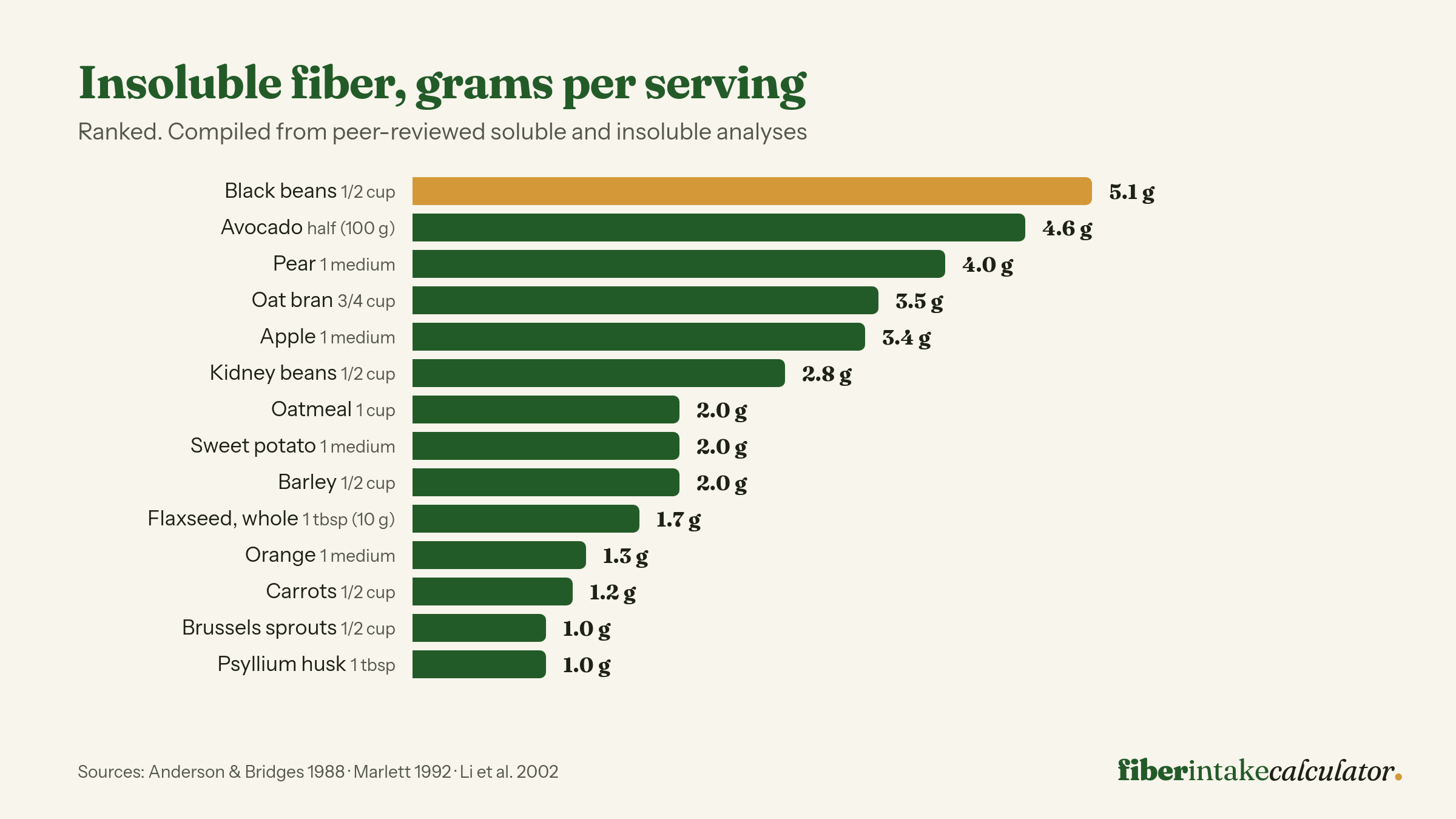
A half cup of cooked black beans carries 5.1 grams of insoluble fiber, the most of any serving in the table below. Avocado follows at 4.6 grams and a pear with the skin on at 4.0 grams.
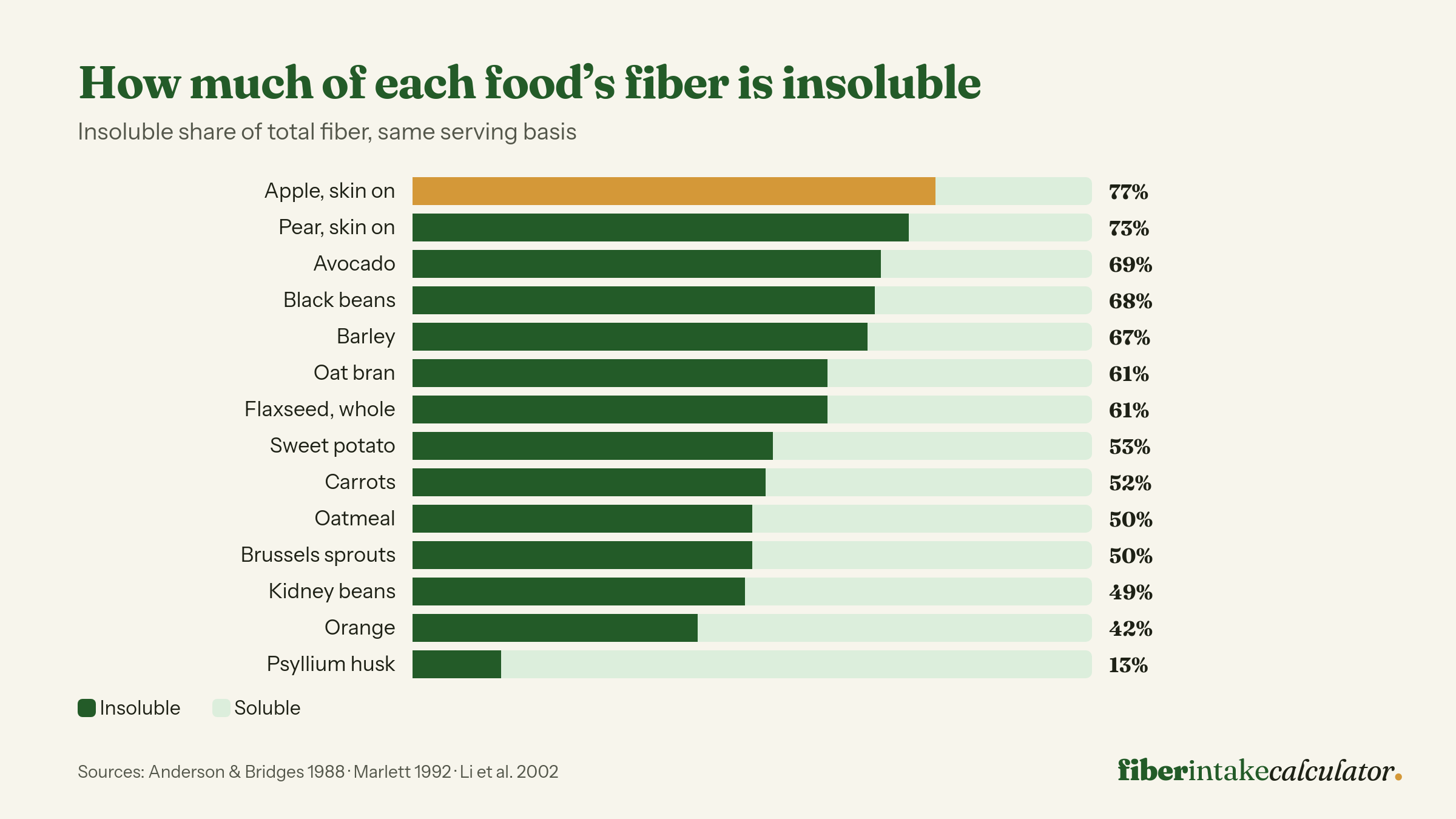
The second number matters more. Insoluble fiber is 77% of an apple’s total fiber and 13% of psyllium’s. That share is how you tell an insoluble food from a food that merely contains some, and no other fiber page publishes it. Read from the other end, the same share is why counting soluble grams directly beats taking a third of the total fiber and calling it soluble.
USDA FoodData Central carries total fiber only, so there is no official split to look up. The grams here come from peer-reviewed laboratory analyses instead (Anderson & Bridges 1988; Marlett 1992; Li et al. 2002), the same compilation behind our soluble fiber table. For the two fibers set against each other, with the pooled trial effect size on each goal, see soluble vs insoluble fiber.
Which foods carry the most insoluble fiber per serving
Two patterns run through the top of the ranking: cooked beans, and fruit eaten with the skin on.
Black beans lead on both counts. Half a cup is 7.5 grams of total fiber, matching USDA’s record exactly (8.7 grams per 100 grams, half cup 86 grams), and roughly two thirds of that is insoluble. Kidney beans sit sixth at 2.8 grams and are the one bean in the table that is majority soluble. Our legume ranking covers the rest of the family per cooked cup.
Avocado is the row people do not expect. Half a California avocado is 4.6 grams of insoluble fiber, more than a pear and more than any vegetable here.
Apple and pear earn their places through the skin. USDA records apple flesh without the peel at 1.3 grams of fiber per 100 grams against 2.4 grams for a golden delicious with the peel on, so peeling costs roughly half the fiber before the split is even considered.
Worth remembering. The insoluble fiber in fruit sits in and just under the skin. A peeled apple and an unpeeled apple are not the same food, and the gap is bigger than the gap between most fruits.
The share is what separates the two lists
Every page ranking for insoluble fiber names the same foods: whole grains, vegetables, fruit skins, nuts and seeds. Most of those foods appear on soluble fiber lists too. Without a share, both lists are true and neither is useful.
Ranked by share, the order changes completely. Apple with the skin is 77% insoluble and pear 73%, the two most insoluble-dominant foods in the table, despite both being standard examples on soluble fiber lists. Oatmeal, the food most associated with soluble fiber, turns out to be an even split: 2.0 grams of each per cooked cup. Orange is the lowest whole food at 42%.
Psyllium sits last at 13%, which is why it forms a gel rather than adding grit, and why it leads our comparison of the best fiber supplements.
Across the thirteen whole foods in the table, insoluble fiber is 61% of the total (34.6 grams of 56.5). Most of the fiber anyone eats is already insoluble.
Which is a reason not to sort by the label alone. What decides an effect is how coarse the particles are, whether the fiber forms a gel, and whether bacteria ferment it before it reaches the stool. Our explainer on what fiber actually does prices each of those three jobs against the outcome it produces, from stool frequency to LDL cholesterol.
Wheat bran is the exception this table cannot show
Every list on the results page names wheat bran first and it deserves the spot. USDA records crude wheat bran at 42.8 grams of fiber per 100 grams, ahead of everything below it here except corn bran at 79.0. None of the brans has a soluble and insoluble row in the analyses above, so the figures below are total fiber, read from USDA FoodData Central in September 2026.
| Food | Fiber per 100 g | Serving | Fiber per serving |
|---|---|---|---|
| Corn bran, crude | 79.0 g | 1/2 cup (38 g) | 30.0 g |
| Wheat bran, crude | 42.8 g | 1/2 cup (29 g) | 12.4 g |
| Rice bran, crude | 21.0 g | 1 cup (118 g) | 24.8 g |
| Wheat germ, crude | 13.2 g | 1 cup (115 g) | 15.2 g |
| Wheat flour, whole-grain | 10.7 g | 1 cup (120 g) | 12.8 g |
| Figs, dried | 9.8 g | 1 cup (149 g) | 14.6 g |
| Kale, cooked | 4.0 g | 1 cup (118 g) | 4.7 g |
| Brown rice, cooked | 1.6 g | 1 cup (202 g) | 3.2 g |
Brown rice is the useful correction in that table. It appears on every insoluble fiber list, and a whole cooked cup is 3.2 grams of total fiber, less than one medium pear. Kale is the same story at 4.7 grams a cup.
Grams are not the only reason bran leads these lists. Coarse wheat bran is poorly fermented, so it reaches the end of the colon intact, and the laxative effect scales with how rough the particles are. That mechanism, and why it beats the soluble and insoluble labels at predicting which fibers actually move stool, has its own page.
A bran cereal moves a daily total much faster than either, because wheat bran is what leads the ingredient list on the products at the top of our high-fiber cereal ranking. Bran on its own is denser still: a quarter cup of crude wheat bran carries 6.2 grams for 31 calories, which is 20 grams of fiber per 100 calories, more than any cooked grain in our whole grains ranking.
Insoluble fiber is also the subtype with the clearer signal in the one cohort that ranked them against diverticulitis, at a hazard ratio of 0.86 against 0.95 for soluble fiber, and the subtype that ran the other way in the colonoscopy study of the pouches themselves. Both results sit side by side on our fiber and diverticulitis page.
The one published table of insoluble grams does not add up
Of the seventeen organic results for “insoluble fiber foods”, exactly one carries gram figures: MedicineNet’s chart of 37 foods. Four of its rows fail a check against USDA totals for the same serving.
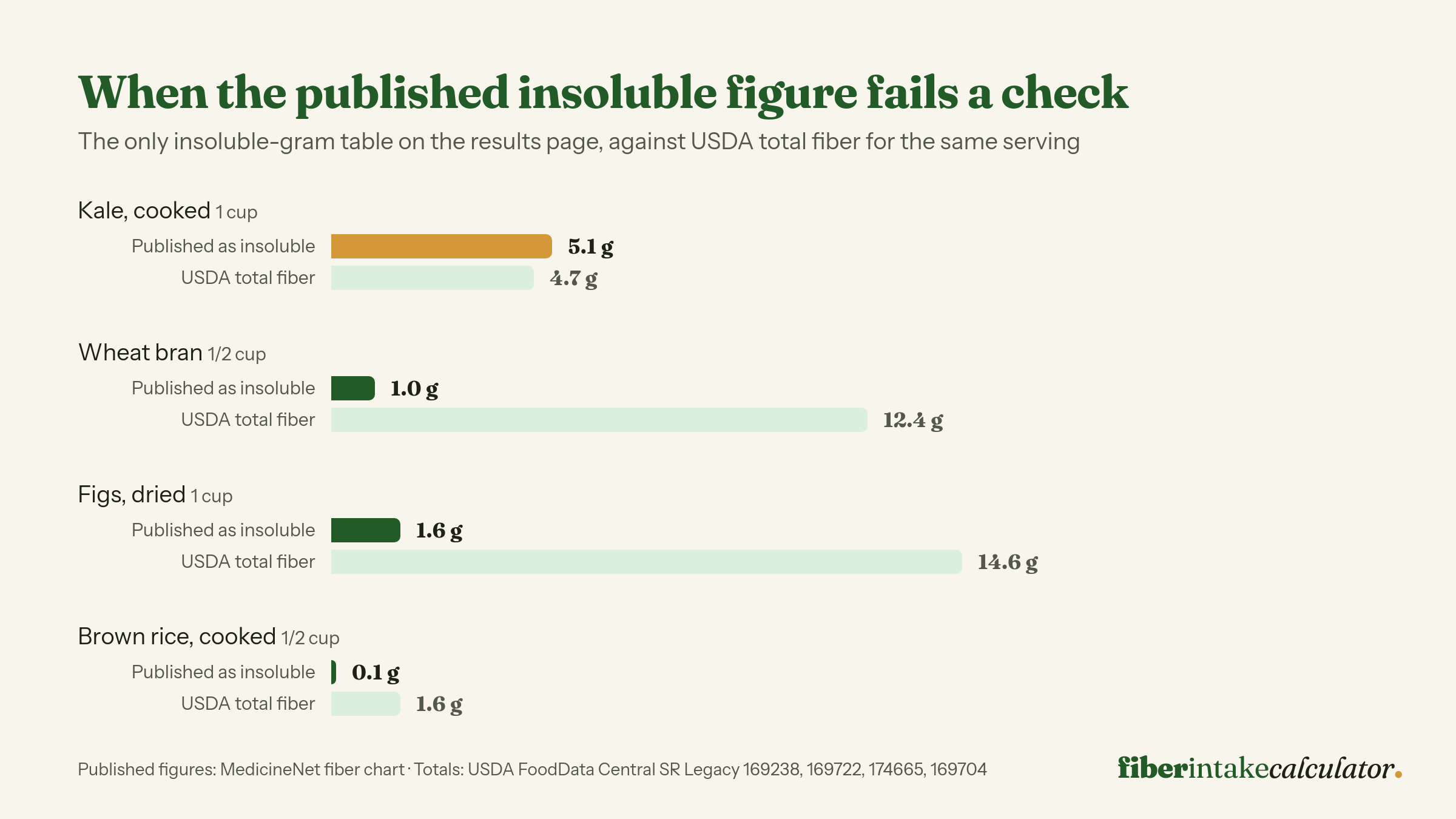
- Cooked kale, 1 cup: 5.1 grams of insoluble fiber against 4.7 grams of total fiber. Insoluble fiber cannot exceed total fiber. Both of USDA’s cooked kale records fail it.
- Wheat bran, 1/2 cup: 1.0 gram against a 12.4 gram total. That would make the food every list names first 8% insoluble, a smaller share than an orange.
- Dried figs, 1 cup: 1.6 grams against a 14.6 gram total, or 11%.
- Cooked brown rice, 1/2 cup: 0.1 grams against a 1.6 gram total, or 6%.
The references under that chart are two patient handouts and a health centre PDF, not composition analyses. Naming the disagreement is the same rule we apply to our own numbers, set out on our methodology page: the oat bran row here reads 5.7 grams of total fiber per three quarter cup where USDA’s cooked oat bran record works out to 4.3 grams, a gap that cooked-cereal water content explains. We show the analysis figure because it is the one carrying a split, and we say so rather than quietly picking one.
There is no daily target for insoluble fiber
The Institute of Medicine sets targets for total fiber only: 25 grams a day for women and 38 grams for men aged 19 to 50, dropping to 21 and 30 after 50. The FDA Daily Value printed on food labels is 28 grams, also total. Neither carries an insoluble sub-target, and neither does the Nutrition Facts panel.
The arithmetic follows from the 61% figure above. A 25 gram day lands near 15 grams of insoluble fiber and a 38 gram day near 23, without anyone aiming at it. Track the total instead: the fiber calculator gives your number from your age, sex or calorie intake.
Two cautions if you are adding bulk on purpose. Increase over two to three weeks rather than at once, and drink more water as you go. And bulking fiber is not automatically the right fiber for constipation. The pooled trials favour psyllium, a gel-forming fiber, which our page on fiber for constipation works through dose by dose. The same distinction runs through the bran evidence on fiber for hemorrhoids.
There is a group for whom added bulk is the wrong move entirely. When 149 chronic constipation patients were sorted by what physical testing found, 80% of those with slow gut transit got no benefit from six weeks of psyllium, against 15% of those whose transit and outlet both tested normal. We work through that split, and whether too much fiber can cause constipation, on its own page.
One practical detail on flaxseed. USDA weighs a tablespoon of whole seed at 10.3 grams and a tablespoon of ground seed at 7 grams, so the same spoon carries 2.8 grams of fiber whole and 1.9 grams ground. The row below uses the whole-seed spoon.
Every food, ranked by insoluble grams
Every column sorts, including the share. Full references sit on our sources page, the complete set of foods by total fiber is on the high-fiber foods chart, and the fruit cut is broken out on high-fiber fruits.
| Food | Insoluble (g) | Insoluble share (%) | Soluble (g) | Total (g) | Serving | % of your target |
|---|---|---|---|---|---|---|
| Black beans, cooked | 5.1 | 68 | 2.4 | 7.5 | 1/2 cup | – |
| Avocado | 4.6 | 69 | 2.1 | 6.7 | half (100 g) | – |
| Pear, with skin | 4 | 73 | 1.5 | 5.5 | 1 medium | – |
| Oat bran, cooked | 3.5 | 61 | 2.2 | 5.7 | 3/4 cup | – |
| Apple, with skin | 3.4 | 77 | 1 | 4.4 | 1 medium | – |
| Kidney beans, cooked | 2.8 | 49 | 2.9 | 5.7 | 1/2 cup | – |
| Oatmeal, cooked | 2 | 50 | 2 | 4 | 1 cup | – |
| Sweet potato, cooked | 2 | 53 | 1.8 | 3.8 | 1 medium | – |
| Barley, cooked | 2 | 67 | 1 | 3 | 1/2 cup | – |
| Flaxseed, whole | 1.7 | 61 | 1.1 | 2.8 | 1 tbsp (10 g) | – |
| Orange | 1.3 | 42 | 1.8 | 3.1 | 1 medium | – |
| Carrots, cooked | 1.2 | 52 | 1.1 | 2.3 | 1/2 cup | – |
| Brussels sprouts, cooked | 1 | 50 | 1 | 2 | 1/2 cup | – |
| Psyllium husk | 1 | 13 | 7 | 8 | 1 tbsp | – |
Soluble and insoluble values are compiled from peer-reviewed analyses (Anderson & Bridges 1988; Marlett 1992; Li et al. 2002), because USDA FoodData Central publishes total fiber only. The share column is insoluble divided by total for that row. Totals were checked against USDA where a matching record exists; see methodology.
Frequently asked questions
What food has the most insoluble fiber?
Per serving, cooked black beans: 5.1 grams of insoluble fiber in half a cup, ahead of avocado at 4.6 grams and a pear with the skin at 4.0 grams. Per gram of food, wheat bran wins by a distance, at 42.8 grams of total fiber per 100 grams in USDA's record against 79.0 grams for corn bran. Those are two different questions and they have two different answers, which is why lists that mix them disagree.
What helps you poop more, soluble or insoluble fiber?
Insoluble fiber adds bulk and speeds transit, which is the classic mechanism, but the trial evidence points the other way. In the 2022 meta-analysis of 16 randomized trials, psyllium raised stool frequency by 3.08 bowel movements a week and was one of only two fibers to significantly improve consistency. Psyllium is 13% insoluble in our table. The mechanism story and the outcome data do not line up, so go by the outcome data.
Is Metamucil soluble or insoluble fiber?
Soluble, overwhelmingly. Its active ingredient is psyllium husk, which our split table records at 7.0 grams soluble against 1.0 gram insoluble per tablespoon, so 13% of it is insoluble. Psyllium appears on plenty of insoluble fiber lists anyway, which is one reason the share column on this page exists.
Can too much insoluble fiber cause constipation?
Bulk without fluid is the problem more often than bulk itself. Federal label rules require dry-form psyllium, methylcellulose, guar gum, glucomannan and polycarbophil to carry a direction to take each dose with at least 8 ounces of liquid. Fermentable fiber in wheat, rye, beans, lentils, broccoli, cabbage, Brussels sprouts, apple and peach is also a common trigger for bloating, gas and cramping. Add fiber over two to three weeks rather than at once.
How much insoluble fiber do I need per day?
There is no target, and no authority publishes one. The Institute of Medicine sets 25 grams a day for women and 38 for men aged 19 to 50, dropping to 21 and 30 after 50, all of it total fiber; the FDA Daily Value of 28 grams on food labels is total fiber too. Insoluble runs about 61% of the fiber in the whole foods on this page, so a 25 gram day lands near 15 grams of insoluble fiber without anyone aiming at it. Track the total.
Built and maintained by the FiberIntake team, with data from USDA FoodData Central and peer-reviewed sources. Figures are checked against the cited source before publish. About this site →