High-Fiber Whole Grains, Ranked by the Cooked Cup
Last updated: September 18, 2026
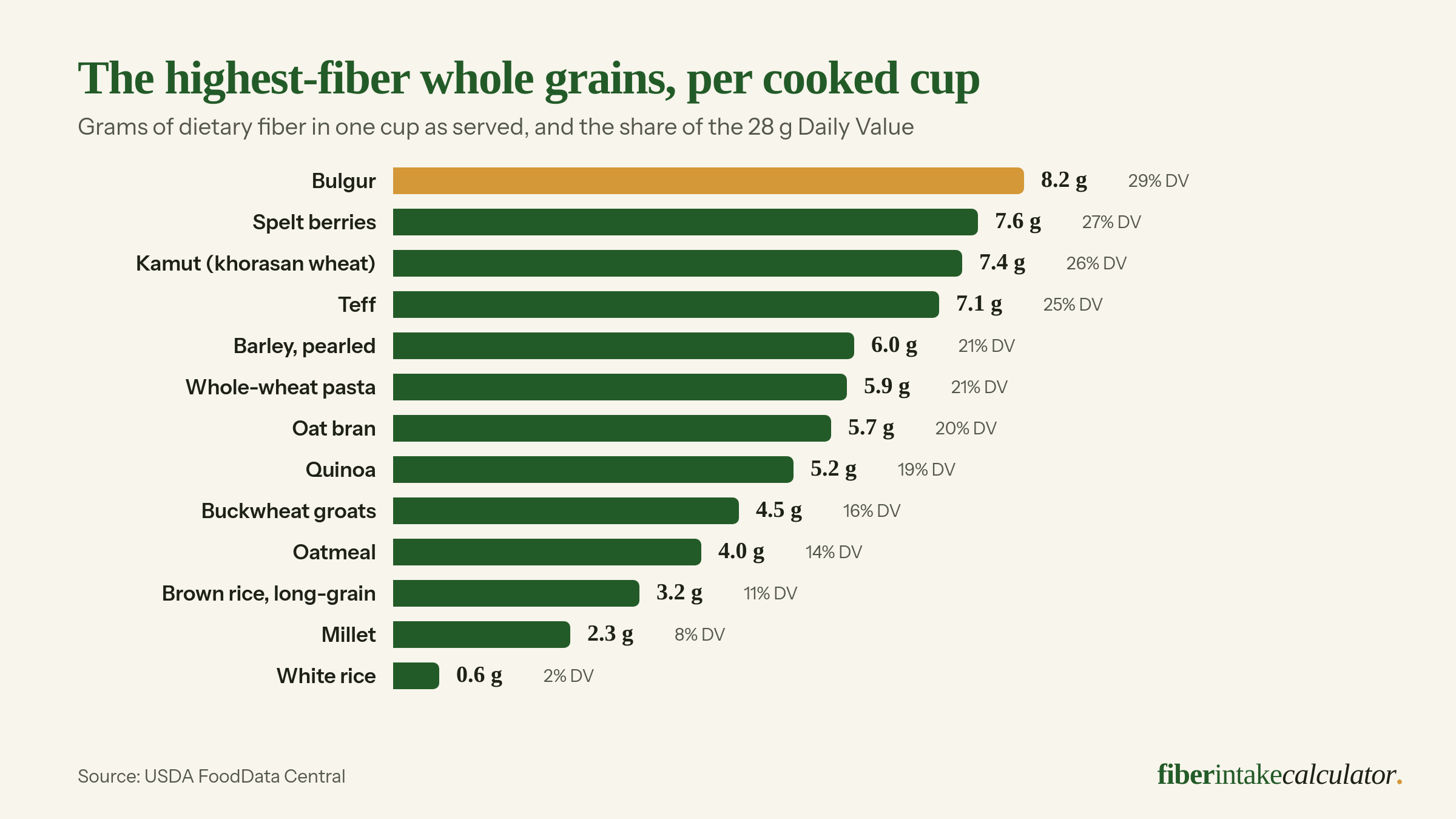
Bulgur holds the most fiber of any common whole grain per cooked cup, at 8.2 grams, ahead of cooked spelt berries at 7.6 grams and cooked Kamut at 7.4 grams. Brown rice, the grain most people switch to first, gives 3.2 grams per cooked cup, less than half as much.
Every figure here is computed from USDA FoodData Central: fiber per 100 grams multiplied by USDA’s own household gram weight, with dry or cooked stated on every row. That matters more here than in any other food group, because the numbers in circulation for grains mix the two.
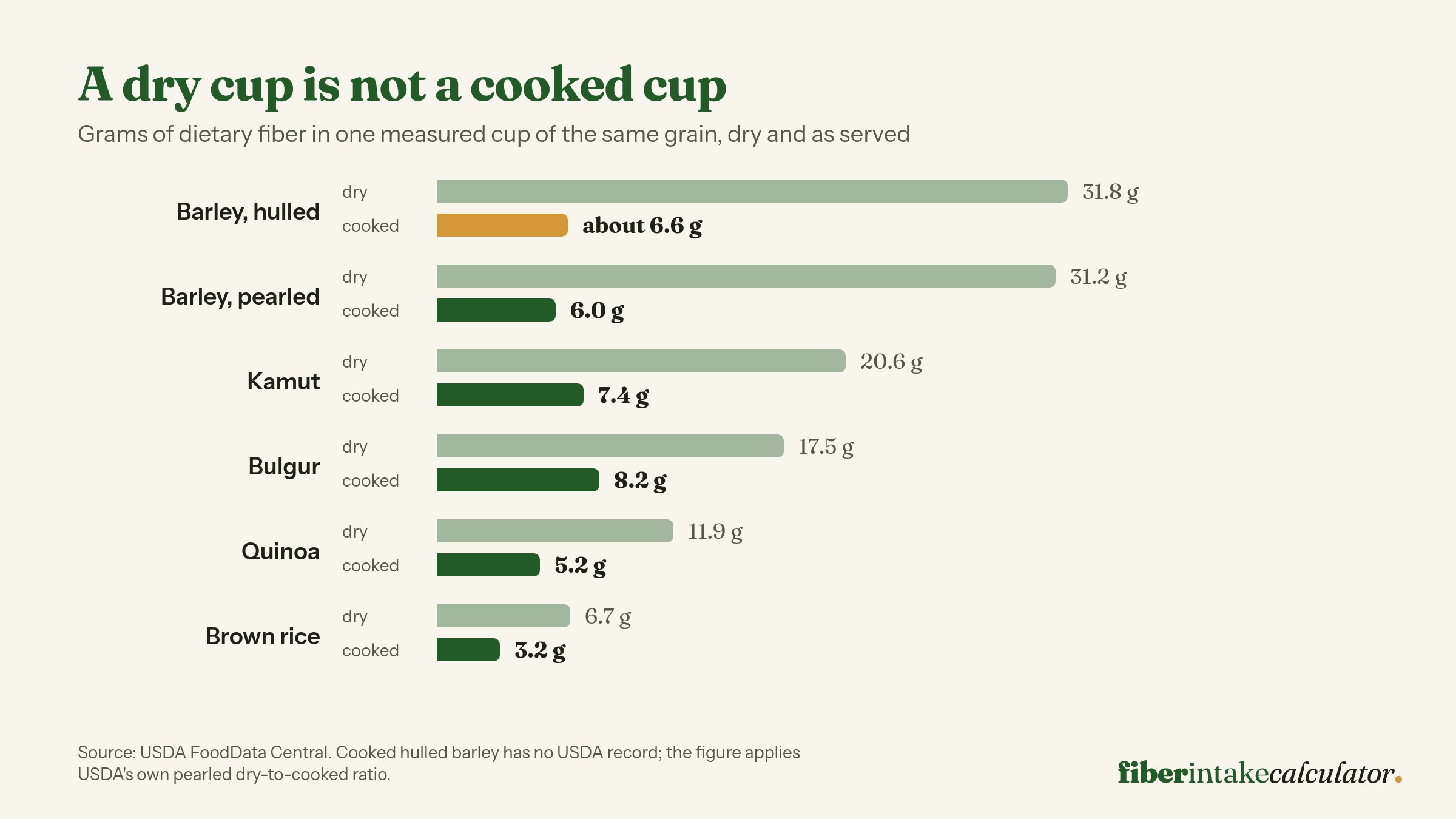
The 31.8 gram barley figure is a dry cup
Search for high-fiber whole grains and the summary above these results will tell you hulled barley carries about 31.8 grams of fiber per cooked cup. USDA holds three barley grain records, and not one of them is cooked hulled barley:
| USDA record | Fiber per 100 g | Cup weight | Fiber per cup | Calories |
|---|---|---|---|---|
| Barley, hulled (dry) | 17.3 g | 184 g | 31.8 g | 651 |
| Barley, pearled, raw | 15.6 g | 200 g | 31.2 g | 704 |
| Barley, pearled, cooked | 3.8 g | 157 g | 6.0 g | 193 |
31.8 grams is the first row. It is a cup of hard dry grain, and it comes with 651 calories, which is a third of a day for most people. Nobody eats it.
Cooking does not destroy fiber. It adds water. USDA’s own pearled pair shows how much: cooked pearled barley holds 3.8 grams per 100 grams against 15.6 grams dry, so a cooked barley grain carries 24% of the dry record’s fiber density. Apply that same ratio to hulled barley and a cooked cup comes to roughly 6.6 grams.
The one thing to remember. Hulled barley is about 10% higher in fiber than pearled, not five times higher. The gap you see quoted is the gap between a dry cup and a cooked one.
The rest of that summary holds up. Bulgur at 8.2 grams, quinoa at 5.2 grams and oatmeal at 4.0 grams per cooked cup all match the USDA records exactly. Its brown rice figure of 3.5 grams is right too, for medium-grain rice; long-grain, which is what most bags contain, is 3.2 grams. Four of five figures are sound, and the one it leads with is out by a factor of almost five.
This is the same mistake that makes vegetable charts disagree, where a cup of spinach goes from 0.7 grams raw to 4.3 grams cooked. The direction is just reversed: greens gain fiber per cup in the pot and grains lose it. Our high-fiber vegetables chart works through that one.
Whole grain is a claim about the grain, not about fiber
A whole grain food keeps the bran, germ and endosperm in the flour. That is a statement about milling. It says nothing about how much fiber lands on your plate, and bread is where the two ideas separate most clearly.
| Bread | Fiber per 100 g | Per slice | Per 50 g label serving | Claim it earns |
|---|---|---|---|---|
| Multi-grain | 7.4 g | 1.9 g (26 g) | 3.7 g | Good source |
| Pumpernickel | 6.5 g | 2.1 g (32 g) | 3.3 g | Good source |
| Whole-wheat | 6.0 g | 1.9 g (32 g) | 3.0 g | Good source |
| Rye | 5.8 g | 1.9 g (32 g) | 2.9 g | Good source |
| Wheat, not whole wheat | 4.0 g | 1.2 g (29 g) | 2.0 g | None |
| White | 2.7 g | 0.8 g (29 g) | 1.4 g | None |
Under 21 CFR 101.54, a food may say high fiber at 20% or more of the 28 gram Daily Value per reference amount, which is 5.6 grams, and good source at 10 to 19%, which is 2.8 to 5.5 grams. The reference amount for bread is 50 grams, set in 21 CFR 101.12.
Not one plain bread in USDA’s records reaches 5.6 grams. Whole-wheat bread gets to 3.0, a little over half the threshold. A loaf that prints “high fiber” on the bag has added something to the flour, usually bran or an isolated fiber, which is the same move the boxes make in our high-fiber cereal ranking.
Rule of thumb. A slice of whole-wheat bread is worth about 2 grams of fiber. Two slices of bread and a bowl of cereal will not carry a day; they are the base you build on.
The serving on the label is 140 grams, not a cup
Cups are how recipes talk. Labels use the reference amount customarily consumed, and 21 CFR 101.12 sets it at 140 grams prepared for grains and pasta, against USDA cup weights that run from 151 grams to 252 grams. Measured that way, the claim a grain can legally make often contradicts the one people assume it makes:
| Grain, cooked | Fiber per 140 g serving | What the label may say |
|---|---|---|
| Bulgur | 6.3 g | High fiber |
| Kamut (khorasan wheat) | 6.0 g | High fiber |
| Spelt berries | 5.5 g | Good source, short by 0.1 g |
| Whole-wheat pasta | 5.5 g | Good source |
| Barley, pearled | 5.3 g | Good source |
| Quinoa | 3.9 g | Good source |
| Teff | 3.9 g | Good source |
| Buckwheat groats | 3.8 g | Good source |
| Amaranth | 2.9 g | Good source |
| Brown rice, long-grain | 2.2 g | None |
| Millet | 1.8 g | None |
| White rice | 0.6 g | None |
Two grains clear the high fiber bar on their own. Spelt misses it by a tenth of a gram. Brown rice and millet, both whole grains in every other sense, sit below the floor for calling a food a good source of fiber at all.
Per calorie the order changes again
Grains are dense. A cup of cooked amaranth carries 5.2 grams of fiber and 251 calories, while a cup of cooked oat bran carries 5.7 grams and 88 calories. Same fiber, roughly a third of the energy. That swap is the single cheapest one available at breakfast, which is why oat bran leads the grains on our ranking of high-fiber breakfast foods at 7.2 grams per dry half cup.
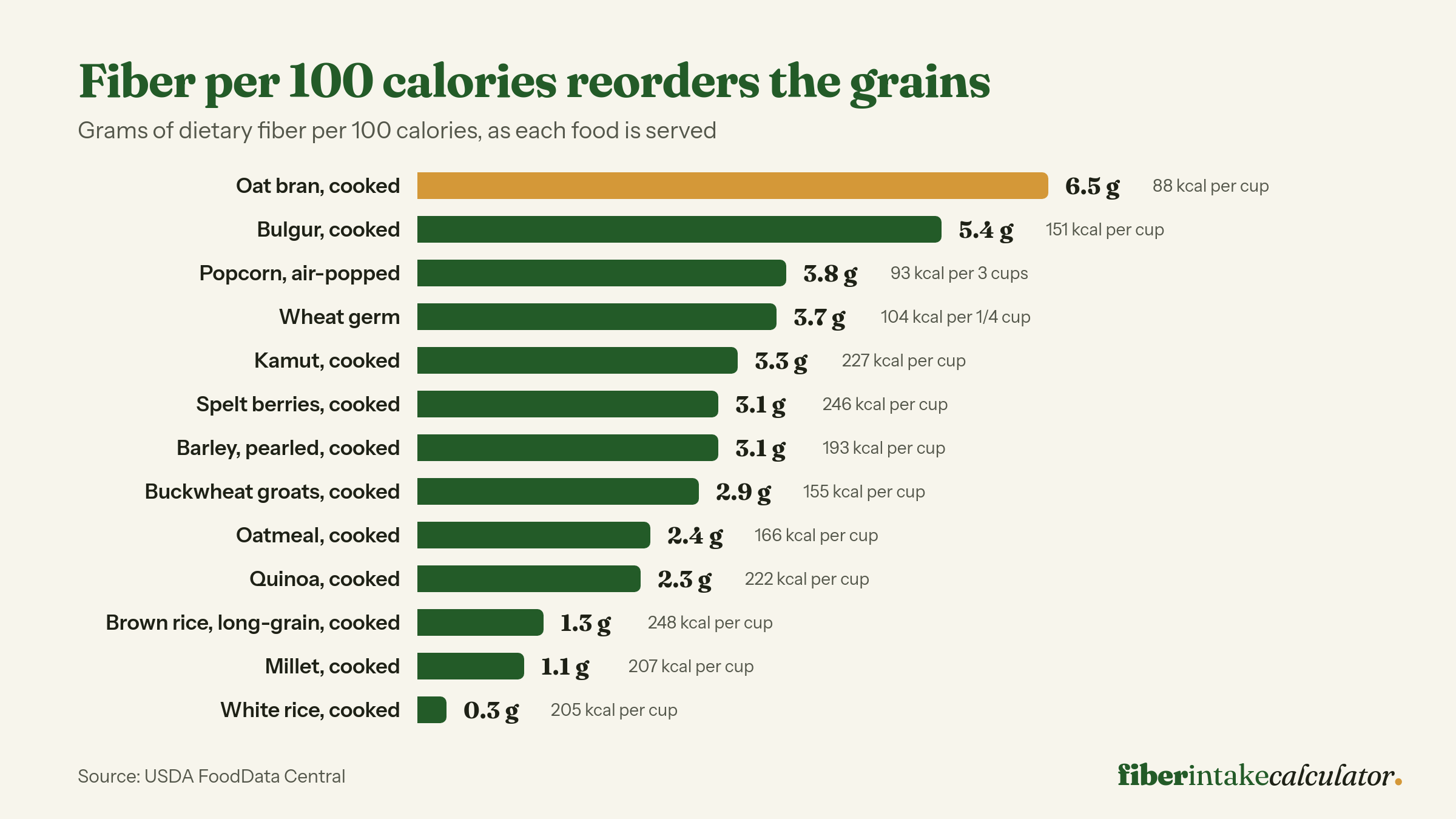
Cooked oat bran delivers 6.5 grams of fiber per 100 calories, cooked bulgur 5.4 grams, and air-popped popcorn 3.8 grams. Long-grain brown rice delivers 1.3 grams and cooked millet 1.1 grams. Popcorn beating brown rice by three to one per calorie is why it keeps turning up in our high-fiber snacks ranking, and the same column is the reason grains behave so differently on a calorie budget, which our page on fiber and weight loss works through.
Wheat bran is the outlier at the top: 20 grams of fiber per 100 calories, a quarter cup carrying 6.2 grams for 31 calories. It is the insoluble end of the range, and what it does in the gut is covered on our insoluble fiber page. Oats and barley sit at the other end, carrying the beta-glucan behind the cholesterol claim in 21 CFR 101.81, which asks for 0.75 grams of soluble fiber per serving and 3 grams a day. Our soluble fiber guide puts numbers on that split.
Three swaps, same three meals
Adults need 25 grams a day for women and 38 grams for men aged 19 to 50, per the Institute of Medicine reference intakes, dropping to 21 and 30 grams after 50. Get your own figure from the fiber calculator if you do not have one.
Here is an ordinary day built on whole grains:
| A usual grain day | Fiber | Swapped | Fiber |
|---|---|---|---|
| Oatmeal, 1 cup cooked | 4.0 g | Oat bran, 1 cup cooked | 5.7 g |
| Whole-wheat bread, 2 slices | 3.8 g | Whole-wheat pita, 1 large | 3.9 g |
| Brown rice, 1 cup cooked | 3.2 g | Bulgur, 1 cup cooked | 8.2 g |
| Total | 11.0 g | Total | 17.8 g |
The left column is 44% of a 25 gram target and 29% of a 38 gram one. The right column is 71% and 47%. That is 6.8 grams more, a 62% increase, from three meals that look the same on the plate.
It is also the ceiling. One cup of cooked navy beans carries 19.1 grams on its own, more than the entire swapped day above, which is the arithmetic our legume ranking keeps running into. Grains are the base of the day. Legumes are how the number closes.
Where the published grain tables come from
Three quirks explain most of the disagreement between grain charts, and all three are visible in the records themselves.
Old releases. The Whole Grains Council table, which ranks fourth for this search, is drawn from USDA’s 2013 data. Most of its rows still match: barley at 17.3%, oats at 10.6%, rye at 15.1%, quinoa at 7.0%, spelt at 10.7%. Bulgur does not. It is listed at 18.3% fiber and USDA now records dry bulgur at 12.5 grams per 100 grams. The same page also gives the high fiber threshold as 5 grams per serving, which was correct before the Daily Value moved from 25 to 28 grams and took the threshold to 5.6 with it.
Packed cups. USDA gives whole-wheat pasta two household measures on one record. A packed cup of cooked spaghetti weighs 151 grams and holds 5.9 grams of fiber. A loose cup weighs 117 grams and holds 4.6 grams. Charts quoting “6 grams per cup” are using the packed one without saying so.
Which record. USDA keeps separate long-grain and medium-grain brown rice records, at 3.2 and 3.5 grams per cup, and separate 100% whole wheat and 51% whole wheat pasta records, where the blend is the higher of the two at 4.6 grams per 100 grams against 3.9. Neither pairing is wrong. They are different foods measured separately, and a chart that prints one number for “brown rice” has quietly picked one.
Our methodology page sets out which record is used where, and the full reference list sits on our sources page.
Every grain food, ranked as you eat it
Sort by any column. Dry-grain cups are deliberately kept out of this table, because a dry cup is not a serving; they appear above where they can be explained. The % of your target column uses the result you saved in the calculator, or the FDA Daily Value of 28 g until you have one. This list sits inside the wider high-fiber foods chart, where grains meet legumes, fruit and vegetables on one scale.
| Grain or grain food | Fiber per serving (g) | Serving | Fiber per 100 calories (g) | % of your target |
|---|---|---|---|---|
| Bulgur, cooked | 8.2 | 1 cup (182 g) | 5.4 | – |
| Spelt berries, cooked | 7.6 | 1 cup (194 g) | 3.1 | – |
| Kamut (khorasan wheat), cooked | 7.4 | 1 cup (172 g) | 3.3 | – |
| Teff, cooked | 7.1 | 1 cup (252 g) | 2.8 | – |
| Whole-grain pasta, 51% whole wheat, cooked | 6.9 | 1 cup packed (151 g) | 2.9 | – |
| Wheat bran, crude | 6.2 | 1/4 cup (14.5 g) | 20 | – |
| Barley, pearled, cooked | 6 | 1 cup (157 g) | 3.1 | – |
| Whole-wheat pasta, cooked, packed cup | 5.9 | 1 cup packed (151 g) | 2.6 | – |
| Oat bran, cooked | 5.7 | 1 cup (219 g) | 6.5 | – |
| Quinoa, cooked | 5.2 | 1 cup (185 g) | 2.3 | – |
| Amaranth, cooked | 5.2 | 1 cup (246 g) | 2.1 | – |
| Whole-wheat pasta, cooked, loose cup | 4.6 | 1 cup spaghetti (117 g) | 2.6 | – |
| Buckwheat groats, cooked | 4.5 | 1 cup (168 g) | 2.9 | – |
| Whole-wheat English muffin | 4.4 | 1 muffin (66 g) | 3.3 | – |
| Rolled oats, dry, as portioned | 4.1 | 1/2 cup dry (40.5 g) | 2.7 | – |
| Oatmeal, cooked | 4 | 1 cup (234 g) | 2.4 | – |
| Whole wheat hot cereal, cooked | 3.9 | 1 cup (242 g) | 2.6 | – |
| Whole-wheat pita | 3.9 | 1 large pita (64 g) | 2.3 | – |
| Wheat germ, crude | 3.8 | 1/4 cup (28.75 g) | 3.7 | – |
| Popcorn, air-popped | 3.5 | 3 cups (24 g) | 3.8 | – |
| Brown rice, medium-grain, cooked | 3.5 | 1 cup (195 g) | 1.6 | – |
| Popcorn, oil-popped | 3.3 | 3 cups (33 g) | 2 | – |
| Brown rice, long-grain, cooked | 3.2 | 1 cup (202 g) | 1.3 | – |
| Wild rice, cooked | 3 | 1 cup (164 g) | 1.8 | – |
| Whole-wheat crackers | 2.9 | 1 serving (28 g) | 2.4 | – |
| Wheat English muffin, not whole wheat | 2.6 | 1 muffin (57 g) | 2 | – |
| Brown rice, parboiled, cooked | 2.6 | 1 cup (155 g) | 1.1 | – |
| Millet, cooked | 2.3 | 1 cup (174 g) | 1.1 | – |
| Couscous, cooked | 2.2 | 1 cup (157 g) | 1.3 | – |
| Pumpernickel bread | 2.1 | 1 slice (32 g) | 2.6 | – |
| Multi-grain bread | 1.9 | 1 slice (26 g) | 2.8 | – |
| Whole-wheat bread | 1.9 | 1 slice (32 g) | 2.3 | – |
| Rye bread | 1.9 | 1 slice (32 g) | 2.3 | – |
| Corn tortilla | 1.5 | 1 tortilla (24 g) | 2.9 | – |
| Wheat bread, not whole wheat | 1.2 | 1 slice (29 g) | 1.5 | – |
| White bread | 0.8 | 1 slice (29 g) | 1 | – |
| White rice, long-grain, cooked | 0.6 | 1 cup (158 g) | 0.3 | – |
Fiber per serving is USDA FoodData Central per-100-gram value multiplied by USDA own household serving weight, read September 2026. Every cooked row is the cooked USDA record, never a dry grain weighed dry, because a dry cup and a cooked cup of the same grain hold very different amounts of food. See the methodology page for how figures are sourced and refreshed.
Frequently asked questions
Which whole grain has the most fiber?
Per cooked cup, bulgur at 8.2 grams, then cooked spelt berries at 7.6 grams and cooked Kamut at 7.4 grams. Pearled barley, the grain most lists put first, gives 6.0 grams per cooked cup. If bran counts as a grain food, wheat bran beats all of them: a quarter cup carries 6.2 grams for 31 calories, which is 20 grams of fiber per 100 calories.
Does hulled barley really have 31.8 grams of fiber per cooked cup?
No. That figure is USDA's dry cup. USDA FoodData Central holds three barley grain records and none of them is cooked hulled barley: hulled barley at 17.3 grams of fiber per 100 grams with a 184 gram cup, pearled barley raw at 15.6 grams per 100 grams, and pearled barley cooked at 3.8 grams per 100 grams. The 184 gram dry cup works out to 31.8 grams of fiber and 651 calories, which is most of a day of eating. Applying USDA's own dry-to-cooked ratio for pearled barley gives hulled barley about 6.6 grams per cooked cup.
Does whole grain bread have fiber?
Some, and less than the front of the bag suggests. USDA records commercially prepared whole-wheat bread at 6.0 grams of fiber per 100 grams, which is 1.9 grams in a 32 gram slice. Two slices make 3.8 grams. Rye bread is the same at 1.9 grams a slice, pumpernickel is 2.1 grams, and white bread is 0.8 grams. A whole grain claim is a statement about which parts of the kernel are in the flour, not about how much fiber ends up in the slice.
Is brown rice a high fiber food?
Not by the federal definition. A cup of cooked long-grain brown rice gives 3.2 grams of fiber for 248 calories, and the reference amount that food labels use for a cooked grain is 140 grams, which puts brown rice at 2.2 grams. The floor for calling a food a good source of fiber is 2.8 grams per reference amount, so brown rice sits below even that. It is a genuine whole grain. It is simply one of the lowest-fiber ones.
How much fiber can whole grains realistically give me in a day?
About 11 grams from an ordinary day of them: a cup of oatmeal at 4.0 grams, two slices of whole-wheat bread at 3.8 grams and a cup of cooked long-grain brown rice at 3.2 grams. That is 44% of a 25 gram target and 29% of a 38 gram one. Swapping the same three meals to oat bran, a whole-wheat pita and bulgur reaches 17.8 grams, 62% more, for roughly the same calories.
Built and maintained by the FiberIntake team, with data from USDA FoodData Central and peer-reviewed sources. Figures are checked against the cited source before publish. About this site →