High-Fiber Breakfast Foods, Rebuilt From USDA Weights
Last updated: September 21, 2026
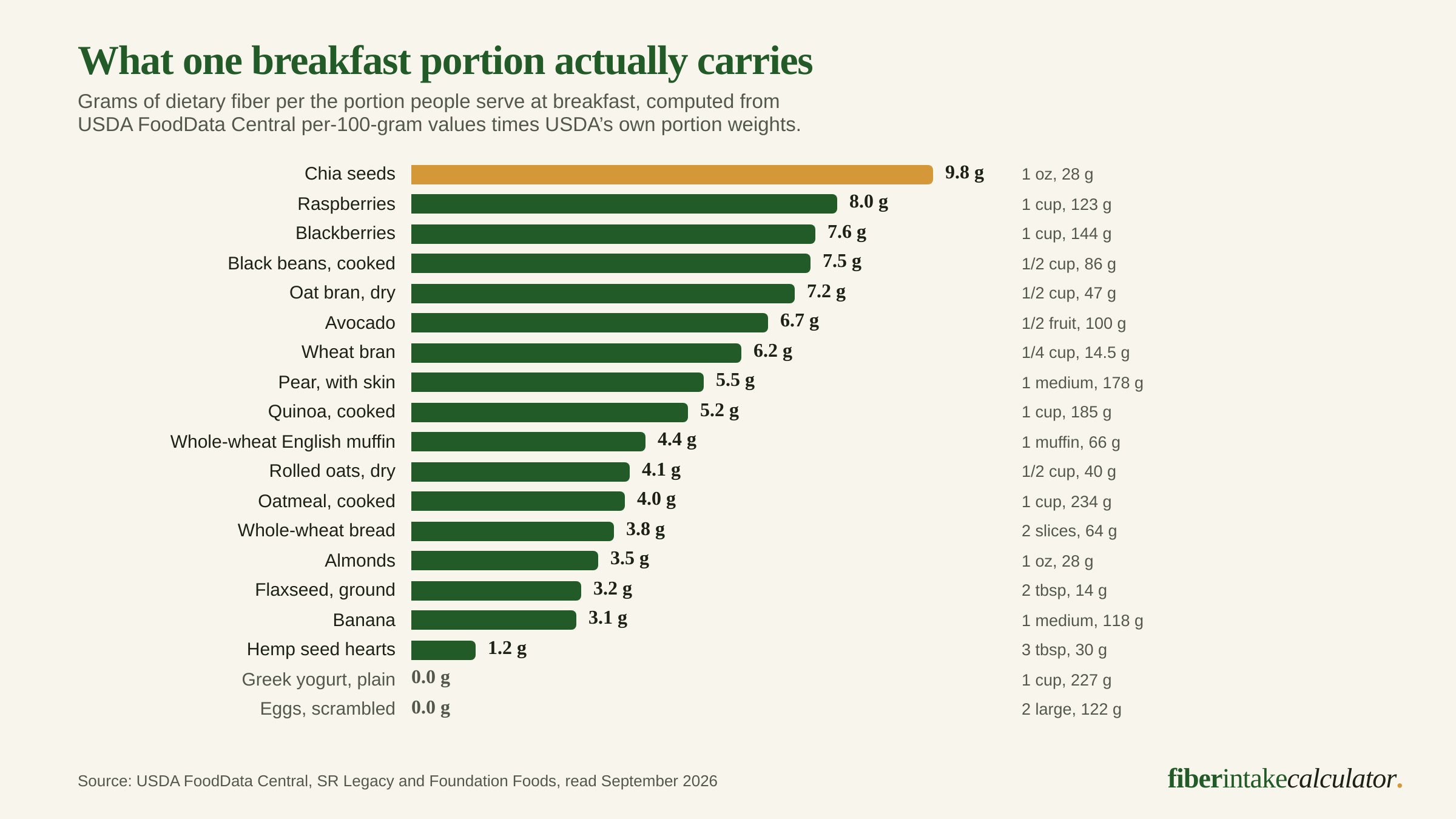
An ounce of chia seeds carries 9.8 grams of fiber, the most of any single breakfast food here. Of the four breakfasts Google’s summary prints above these results, three check out against USDA data and one is 19% high: the berry Greek yogurt bowl computes to 8.1 grams, not the 10 grams claimed.
Every number below is USDA FoodData Central’s per-100-gram value multiplied by USDA’s own portion weight, read in September 2026, with the calorie cost printed beside it. No page ranking for this search prints a calorie figure, and none shows the arithmetic behind a recipe total.
The four breakfasts Google prints, rebuilt
The summary above these results is unusually specific. It gives four breakfasts with full quantities and a gram total on each, which makes every one of them checkable.
| Breakfast, as published | Claimed | Computed | Calories |
|---|---|---|---|
| Overnight chia oats: 1/2 cup rolled oats, 1 tbsp chia, 1/2 cup raspberries, 1 cup almond milk | 10 to 13 g | 12.7 g | 282 |
| Avocado toast: 2 slices sprouted bread, 1/2 avocado, 1 tbsp hemp seeds | about 14 g | 13.1 g | 396 |
| Avocado toast: the same, with 1 tbsp chia instead of hemp | about 14 g | 16.8 g | 399 |
| Black bean bowl: 1/2 cup black beans, 2 scrambled eggs, 2 tbsp salsa, 1/4 avocado | 11 g | 11.6 g | 386 |
| Berry Greek yogurt bowl: 1 1/2 cups Greek yogurt, 1/2 cup raspberries, 1 tbsp chia | roughly 10 g | 8.1 g | 297 |
Three of the four land close. The yogurt bowl does not, and the reason is structural rather than arithmetic: a cup and a half of Greek yogurt is more than half the weight of that bowl and contributes 0.0 grams.
The avocado toast is the more interesting row. It is published as one recipe with an either-or ingredient, “a sprinkle of hemp or chia seeds”. Those two seeds are not interchangeable. A tablespoon of hemp hearts carries 0.4 grams of fiber. A tablespoon of chia carries 4.1 grams. Same sentence, same spoon, a tenfold difference, and it moves the plate from 13.1 grams to 16.8.
The swap worth making. Chia for hemp, one tablespoon, costs 3 calories and adds 3.7 grams of fiber. It is the cheapest single change on this page.
That gap runs through the whole seed and nut shelf, which is why the group has a ranking of its own. Our high-fiber nuts and seeds chart computes 32 rows and sorts out which topping is worth the spoon: chia at 9.8 grams an ounce, whole in-shell pumpkin seeds at 5.2 grams, and hulled pepitas at 1.8 grams despite the 5 grams most lists print.
Ranked: what one breakfast portion actually carries
Portions here are the ones people actually serve at breakfast, with USDA’s gram weight on every row so the figure can be checked or rescaled.
| Food | Portion | Fiber | Calories | Fiber per 100 kcal |
|---|---|---|---|---|
| Chia seeds | 1 oz (28 g) | 9.8 g | 138 | 7.1 g |
| Raspberries | 1 cup (123 g) | 8.0 g | 64 | 12.5 g |
| Blackberries | 1 cup (144 g) | 7.6 g | 62 | 12.3 g |
| Black beans, cooked | 1/2 cup (86 g) | 7.5 g | 114 | 6.6 g |
| Oat bran, dry | 1/2 cup (47 g) | 7.2 g | 116 | 6.2 g |
| Avocado | 1/2 fruit (100 g) | 6.7 g | 161 | 4.2 g |
| Wheat bran | 1/4 cup (14.5 g) | 6.2 g | 31 | 20.0 g |
| Pear, with skin | 1 medium (178 g) | 5.5 g | 101 | 5.4 g |
| Quinoa, cooked | 1 cup (185 g) | 5.2 g | 222 | 2.3 g |
| Apple, with skin | 1 medium (182 g) | 4.4 g | 95 | 4.6 g |
| Whole-wheat English muffin | 1 muffin (66 g) | 4.4 g | 134 | 3.3 g |
| Rolled oats, dry | 1/2 cup (40 g) | 4.1 g | 153 | 2.7 g |
| Kiwifruit | 2 fruits (138 g) | 4.1 g | 84 | 4.9 g |
| Oatmeal, cooked | 1 cup (234 g) | 4.0 g | 166 | 2.4 g |
| Sweet potato, baked in skin | 1 medium (114 g) | 3.8 g | 103 | 3.7 g |
| Whole-wheat bread | 2 slices (64 g) | 3.8 g | 161 | 2.4 g |
| Blueberries | 1 cup (148 g) | 3.6 g | 84 | 4.3 g |
| Almonds | 1 oz (28 g) | 3.5 g | 164 | 2.1 g |
| Prunes | 5 prunes (48 g) | 3.4 g | 114 | 3.0 g |
| Flaxseed, ground | 2 tbsp (14 g) | 3.2 g | 75 | 4.3 g |
| Medjool dates | 2 dates (48 g) | 3.2 g | 133 | 2.4 g |
| Banana | 1 medium (118 g) | 3.1 g | 105 | 3.0 g |
| Orange | 1 fruit (131 g) | 3.1 g | 62 | 5.0 g |
| Strawberries | 1 cup halves (152 g) | 3.0 g | 49 | 6.1 g |
| Sprouted whole grain bread | 1 slice (36 g) | 3.0 g | 90 | 3.3 g |
| Walnuts | 1 oz (28 g) | 1.9 g | 185 | 1.0 g |
| Pumpkin seed kernels | 1 oz (28 g) | 1.8 g | 163 | 1.1 g |
| Peanut butter | 2 tbsp (32 g) | 1.6 g | 191 | 0.8 g |
| Hemp seed hearts | 3 tbsp (30 g) | 1.2 g | 166 | 0.7 g |
| Spinach, raw | 1 cup (30 g) | 0.7 g | 7 | 10.0 g |
| Almond milk, unsweetened | 1 cup (262 g) | 0.5 g | 39 | 1.3 g |
| Greek yogurt, plain nonfat | 1 cup (227 g) | 0.0 g | 138 | 0.0 g |
| Eggs, scrambled | 2 large (122 g) | 0.0 g | 182 | 0.0 g |
Wheat bran is the outlier: 6.2 grams for 31 calories, which is 20.0 grams of fiber per 100 calories and four times the density of anything else here. Nobody eats it alone, and it does not need to be eaten alone. A quarter cup disappears into yogurt or a smoothie.
Berries hold the next two places per calorie, which is the same ordering as the high-fiber fruits chart, where raspberries also finish first. Which berry goes in the bowl is worth a second of thought: a cup of frozen wild blueberries brings 6.2 grams and a cup of the farm-grown fresh ones brings 3.6 grams, one of several gaps our berry ranking puts numbers on. Raw spinach reads high per calorie for the opposite reason: a cup of it weighs 30 grams and carries almost nothing, so the ratio is a rounding artifact rather than a reason to add it.
Boxed cereal is the one breakfast answer missing from this table, because serving weights on cereal boxes run from 30 to 65 grams and make the panel numbers uncomparable without them. Our high-fiber cereal ranking prints the weight beside every figure, and the spread there is wider than anything on this page.
Where the published ingredient numbers go wrong
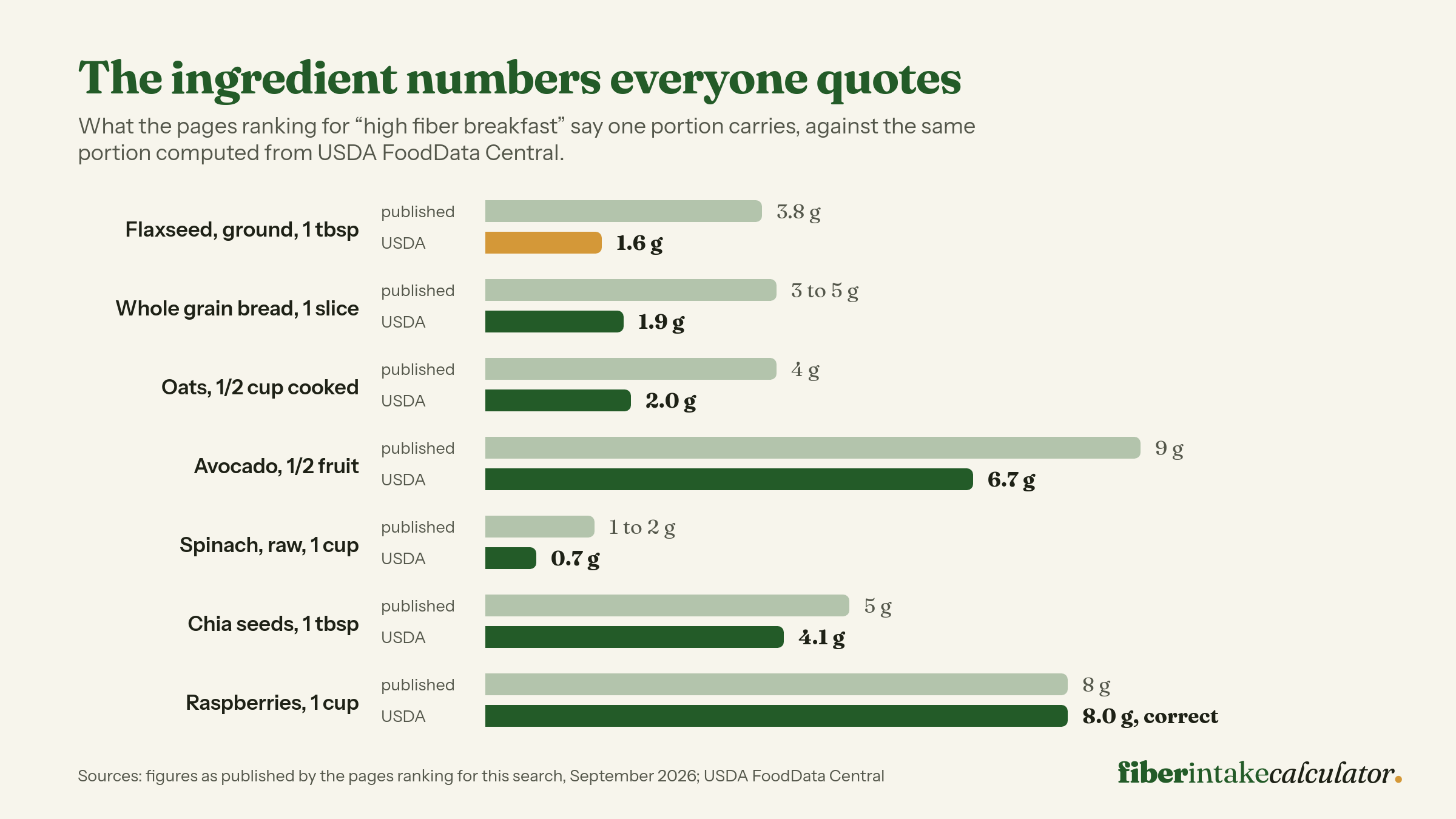
Recipe totals are only as good as the per-ingredient numbers underneath them, and six of those numbers are repeated across this entire search with no source attached.
| Ingredient | What ranking pages say | USDA computation | Gap |
|---|---|---|---|
| Ground flaxseed, 1 tbsp | 3.0 to 3.8 g | 1.6 g | USDA's ground tablespoon is 7 g |
| Whole grain bread, 1 slice | 3 to 5 g | 1.9 g | whole-wheat; sprouted reaches 3.0 g |
| Oats, 1/2 cup cooked | 4 g | 2.0 g | 4.1 g is half a cup dry |
| Avocado, 1/2 fruit | 5 g and 9 g | 6.7 g | two top pages, 26% low and 34% high |
| Chia seeds, 1 tbsp | 5 g | 4.1 g | at the 12 g tablespoon on chia labels |
| Raw spinach, 1 cup | 1 to 2 g | 0.7 g | a cup of raw leaves weighs 30 g |
| Raspberries, 1 cup | 8 g | 8.0 g | correct |
| Almonds, 1 oz | 3.5 g | 3.5 g | correct |
| Black beans, 1/2 cup cooked | 7 to 8 g | 7.5 g | correct |
Flaxseed is the biggest miss and the easiest to explain. USDA’s whole-seed tablespoon weighs 10.3 grams and carries 2.8 grams of fiber. The ground tablespoon weighs 7 grams and carries 1.6 grams. Nobody stirs whole flaxseed into breakfast, because whole seeds pass through largely intact, so the number that gets quoted belongs to the form nobody uses.
The oat error is the familiar one. Half a cup of dry rolled oats is 4.1 grams of fiber; that same half cup after cooking has absorbed water and become a full cup. Reading a dry figure against a cooked measure doubles the answer, which is the same failure the whole grains ranking documents across 37 grains.
Rule of thumb. Any fiber figure given without a gram weight beside it is unverifiable, and for seeds and grains it is wrong more often than not. Weigh once, then you know your own spoon.
The yogurt and the eggs carry the calories and none of the fiber
Two foods appear as the base of most published high-fiber breakfasts, and USDA records 0.0 grams of dietary fiber in both.
| Bowl | Base ingredient | Fiber it adds | Calories it adds | Share of the bowl's calories |
|---|---|---|---|---|
| Berry Greek yogurt bowl | 1 1/2 cups nonfat Greek yogurt | 0.0 g | 207 | 70% |
| Black bean breakfast bowl | 2 scrambled eggs | 0.0 g | 182 | 47% |
This is not an argument against either food. Both carry the protein that makes a breakfast hold, which is why they anchor these recipes in the first place. It is an argument for knowing which part of the bowl is doing the work, because the fiber has to come from the half cup of beans or the tablespoon of chia, and those are the parts people cut when they are in a hurry.
The same trade decides whether a breakfast helps with appetite later in the day. Fiber per calorie, not fiber per bowl, is the measure that matters there, and it is set out on our fiber and weight loss page.
Five breakfasts that clear 10 grams
Computed from the same USDA records, with the calorie bill attached.
| Breakfast | Fiber | Calories |
|---|---|---|
| Overnight oats: 1/2 cup oats, 2 tbsp chia, 1 cup raspberries, 1 cup almond milk | 20.9 g | 373 |
| Savory bean plate: 1 cup black beans, 2 eggs, 1/4 avocado, 2 tbsp salsa | 19.1 g | 499 |
| Oat bran bowl: 1/2 cup dry oat bran, 1 cup raspberries, 2 tbsp ground flax, 1 cup almond milk | 18.9 g | 294 |
| Bran and berry yogurt bowl: 1 cup Greek yogurt, 1/4 cup wheat bran, 1 cup blackberries, 1 tbsp chia | 17.9 g | 289 |
| Avocado toast: 2 slices whole-wheat, 1/2 avocado, 1 tbsp chia | 14.6 g | 380 |
For contrast, two breakfasts most people would describe as healthy:
| Breakfast | Fiber | Calories |
|---|---|---|
| 1 cup cooked oatmeal, 1 banana, 1 cup almond milk | 7.6 g | 310 |
| 2 slices whole-wheat toast, 2 eggs, 1 orange | 6.9 g | 405 |
The oat bran bowl beats the oatmeal bowl by 11.3 grams for 16 fewer calories. The whole difference is swapping oats for oat bran and a banana for a cup of raspberries. Neither change takes longer to make.
The savory plate is the outlier on calories, and it is also the only one that works as a real meal rather than a bowl of toppings. Black beans are the reason: a full cup carries 15.0 grams, which is the pattern that runs through our ranking of legumes, where legumes hold most of the top of the chart.
If your usual breakfast is closer to 4 grams than 14, move in steps rather than in one morning. Jumping the daily total by 10 grams overnight is the most common cause of the bloating people blame on fiber itself, and the ramp schedule is on our fibermaxxing page.
How much fiber breakfast should carry
Adults need 25 grams a day for women and 38 grams for men aged 19 to 50 under the Institute of Medicine reference intakes. Those fall to 21 and 30 grams after 50. The more precise method, also from the IOM, is 14 grams per 1,000 calories eaten.
A third of the day puts breakfast at 7 to 12.7 grams. That is where the advice to aim for about 10 grams comes from, and it is worth saying that most published versions of it name no source.
Get your own target from the fiber calculator first, because the number changes what counts as a good breakfast. At 21 grams a day, the oatmeal and banana bowl at 7.6 grams is already a full third. At 38 grams, it is a fifth, and the gap has to be closed twice over later in the day.
One number to carry. 10 grams before you leave the house. Reaching it takes one dense base (oat bran, black beans, or a quarter cup of wheat bran) plus one cup of berries. Everything else on the plate is protein and calories.
For readers whose reason for asking is regularity rather than a daily total, the fiber type matters more than the quantity. Wheat bran and the other insoluble fibers are what add bulk and speed transit, and the distinction is set out on our insoluble fiber page, with the trial evidence on our fiber and constipation page.
The full chart of every food group, not just the breakfast ones, is on our high-fiber foods page. Our methodology page sets out the serving basis used here, and every USDA record behind these figures is listed on our sources page.
Frequently asked questions
What breakfast food has the most fiber?
An ounce of chia seeds, at 9.8 grams. Behind it: a cup of raspberries at 8.0 grams, a cup of blackberries at 7.6 grams, half a cup of cooked black beans at 7.5 grams and half a cup of dry oat bran at 7.2 grams. Every figure is USDA FoodData Central's per-100-gram value multiplied by USDA's own portion weight, read in September 2026.
How much fiber should a breakfast have?
Between 8 and 13 grams, if breakfast carries a third of the day. Adults need 25 grams a day for women and 38 grams for men aged 19 to 50 under the Institute of Medicine reference intakes, dropping to 21 and 30 grams after 50. A third of that range is 7 to 12.7 grams, which is why most published advice lands near 10 grams without saying where the number comes from.
Is oatmeal a high-fiber breakfast?
It is mid-table. One cup of cooked oatmeal carries 4.0 grams of fiber for 166 calories, per USDA. Half a cup of the dry oats you measure before cooking carries 4.1 grams, and several published guides quote that figure against half a cup cooked, which is 2.0 grams. Oat bran is the stronger version of the same bowl at 7.2 grams per dry half cup.
Do eggs or Greek yogurt have any fiber?
Neither has any. USDA records 0.0 grams of dietary fiber in scrambled eggs and in plain nonfat Greek yogurt. That matters because both are the structural base of the breakfasts most often published as high fiber: in Google's berry yogurt bowl the yogurt is 207 of 297 calories and none of the 8.1 grams of fiber.
What breakfast is best for bowel movements?
The one built on insoluble fiber and wheat bran in particular. A quarter cup of wheat bran carries 6.2 grams of fiber for 31 calories, the highest fiber-to-calorie ratio of any food on this page, and bran is the fiber type with the strongest evidence for stool bulk and transit. Stirring it into yogurt with a cup of blackberries makes a 17.9 gram breakfast for 289 calories.
Built and maintained by the FiberIntake team, with data from USDA FoodData Central and peer-reviewed sources. Figures are checked against the cited source before publish. About this site →