High-Fiber Nuts and Seeds, Ranked per Ounce
Last updated: October 4, 2026
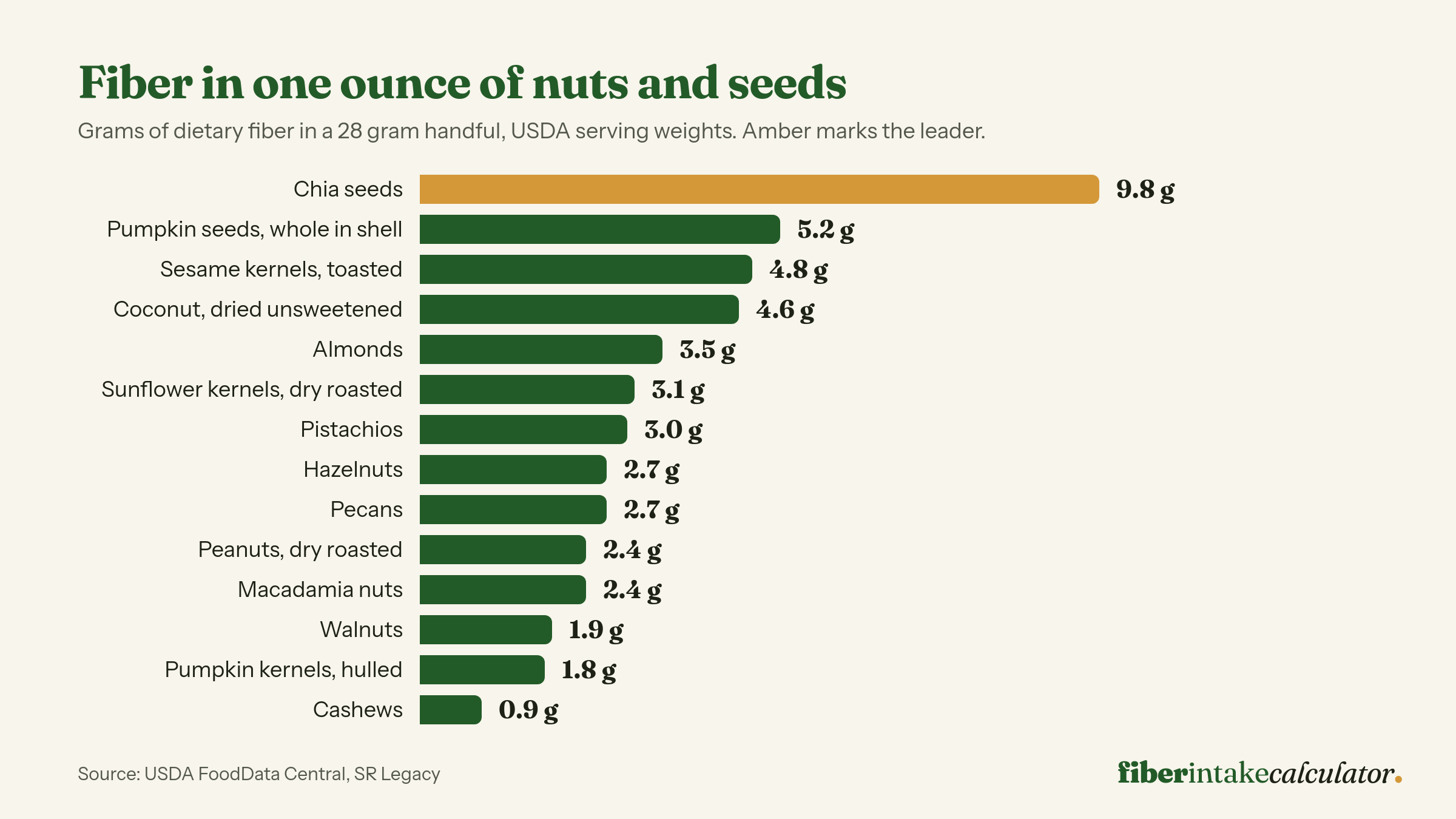
Chia seeds are the highest-fiber thing in the nut and seed aisle, at 9.8 grams per ounce. Whole pumpkin seeds eaten in their shells come second at 5.2 grams, and the best nut, the almond, manages 3.5 grams.
Every number here is computed from USDA FoodData Central: fiber measured per 100 grams, multiplied by a portion weight carried on that same record. Each row names which record it came from, because in-shell and hulled seeds, raw and roasted nuts, and whole and ground flaxseed are analysed separately and the answers differ by a factor of three.
One seed does almost all of the work
Rank the group per ounce and the shape is not a gentle slope. It is chia, then a cliff.
Chia at 9.8 grams an ounce is 88% ahead of the second-place seed and 180% ahead of the best nut. Nothing else in the group is close, and no reshuffling of the list changes that.
| Per 1 oz handful | Fiber | Calories |
|---|---|---|
| Chia seeds | 9.8 g | 138 |
| Pumpkin seeds, whole in shell | 5.2 g | 126 |
| Sesame kernels, toasted | 4.8 g | 161 |
| Coconut, dried unsweetened | 4.6 g | 187 |
| Almonds | 3.5 g | 164 |
| Pistachios | 3.0 g | 159 |
| Pecans | 2.7 g | 196 |
| Walnuts | 1.9 g | 185 |
| Cashews | 0.9 g | 157 |
The label rules put a sharp edge on that spread. A food may call itself high in fiber at 20% of the Daily Value per reference amount, which is 5.6 grams, and a good source at 10 to 19%, which is 2.8 to 5.5 grams. USDA’s own nut and seed records carry a 30 gram reference amount. At 30 grams, chia is the only thing in this group that clears the high bar, at 10.3 grams. Almonds, pistachios, pecans, hazelnuts, toasted sesame and dried coconut land in the good-source band. Walnuts, macadamias, peanuts, hulled pumpkin kernels and cashews clear neither.
Why the bag still says it. A fiber claim on a food that is not low in total fat has to disclose the fat level right next to the claim, under the same rule. That is why a bag of almonds carries the fiber line and the fat line together.
Cashews are the one worth naming out loud. At 0.9 grams an ounce they are a quarter of an almond and a ninth of chia, and they appear on high-fiber nut lists anyway.
The pumpkin seeds in the chart are not the pumpkin seeds in your bag
This is the largest error in circulation on this topic, and it is a shopping error rather than an arithmetic one.
USDA holds two pumpkin seed records. Whole roasted seeds, eaten in their white shells, measure 18.4 grams of fiber per 100 grams. Hulled kernels, the flat green pepitas sold in bags and sprinkled on salads, measure 6.5 grams.
| What you buy | Fiber per 100 g | Per 1 oz | Calories per oz |
|---|---|---|---|
| Whole seeds, roasted in shell | 18.4 g | 5.2 g | 126 |
| Hulled kernels, roasted (pepitas) | 6.5 g | 1.8 g | 163 |
| Hulled kernels, raw | 6.0 g | 1.7 g | 158 |
The in-shell seed carries 2.9 times the fiber for 37 fewer calories. The shell is the difference, and the shell is almost entirely the insoluble fraction that adds bulk rather than forming a gel, which is the split our insoluble fiber page sets out.
Every list quoting “pumpkin seeds, 5 grams per ounce” is quoting the in-shell record. Most people reading it own the other bag.
The swap worth making. Buy whole roasted pumpkin seeds and eat the shells. Same aisle, 3.4 grams more fiber an ounce, fewer calories.
USDA’s newer lab work moved most of these numbers down
Every nut chart in circulation, this page’s own table included, is built on USDA’s SR Legacy release. That data was published in 2019 and rests on analyses considerably older than that.
USDA has since re-measured many of these foods under its Foundation Foods program and published the results in October 2022 and April 2023. Nine of the eleven nuts and seeds with both records came back lower.
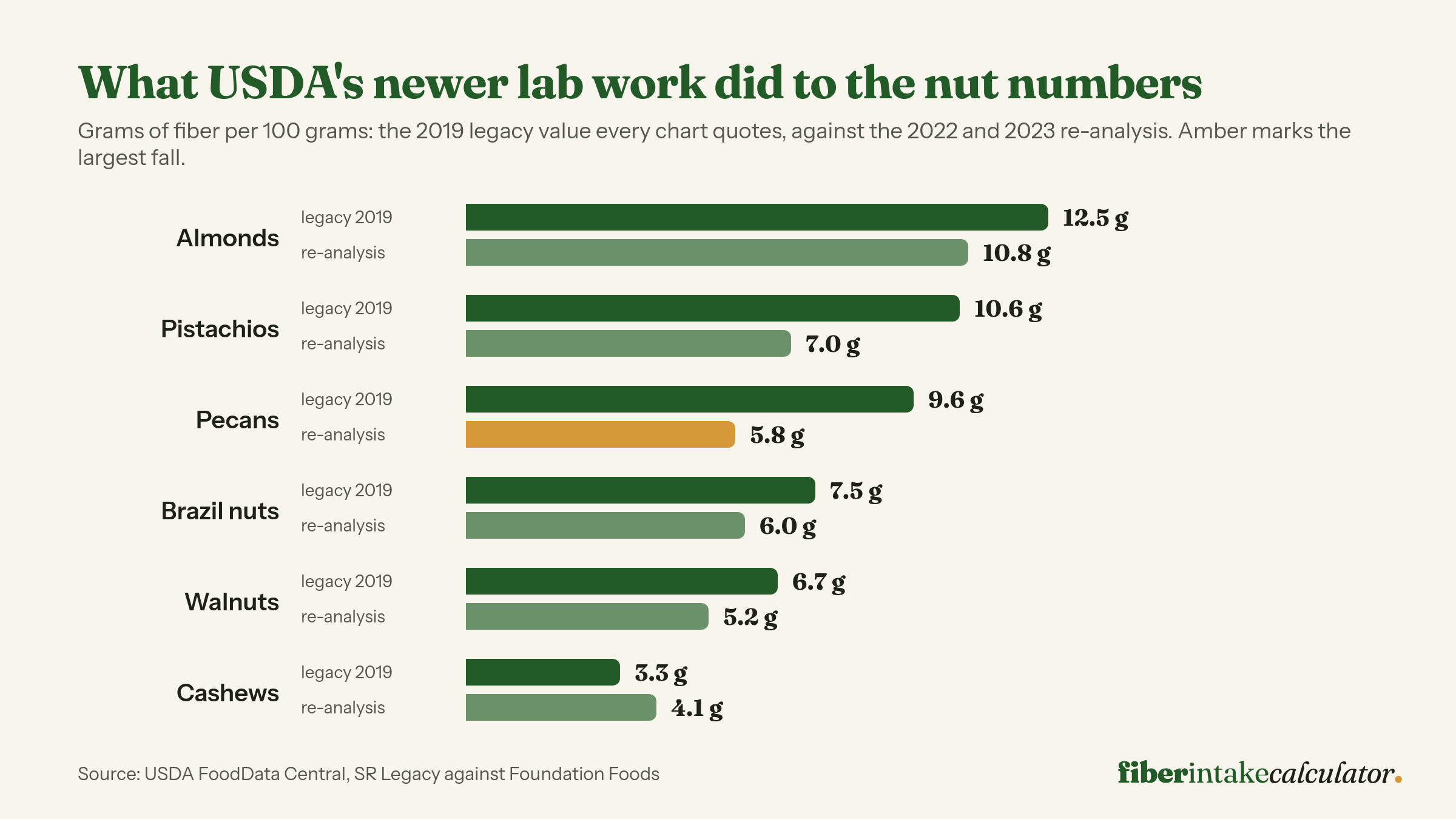
| Nut or seed | Legacy, per 100 g | Re-analysed | Change |
|---|---|---|---|
| Pecans | 9.6 g | 5.8 g | -40% |
| Pistachios, raw | 10.6 g | 7.0 g | -34% |
| Walnuts, English | 6.7 g | 5.2 g | -22% |
| Brazil nuts | 7.5 g | 6.0 g | -20% |
| Sunflower kernels | 8.6 g | 7.2 g | -16% |
| Pumpkin kernels | 6.0 g | 5.1 g | -15% |
| Almonds, raw | 12.5 g | 10.8 g | -14% |
| Hazelnuts | 9.7 g | 8.4 g | -13% |
| Macadamia nuts | 8.6 g | 7.6 g | -12% |
| Pine nuts, common | 3.7 g | 3.9 g | +6% |
| Cashews, raw | 3.3 g | 4.1 g | +24% |
Read that carefully before you rewrite anything. These are separate analyses of separate samples, not the same nuts measured twice, so the honest conclusion is that the true figure sits somewhere in the band rather than that fiber left the nut. Growing region, variety and laboratory method all move the result, which is the same caution our methodology page applies to apples.
What it does mean is practical. A handful of pecans is somewhere between 1.6 and 2.7 grams of fiber, not a confident 2.7. On a food this far down the list, that band is most of the number. Nobody printing a nut chart mentions it.
Per calorie, nuts are the most expensive fiber you can buy
A handful of almonds is 164 calories and 3.5 grams of fiber. That ratio is the thing nut lists never show, and it decides whether this group is worth the room in your day.
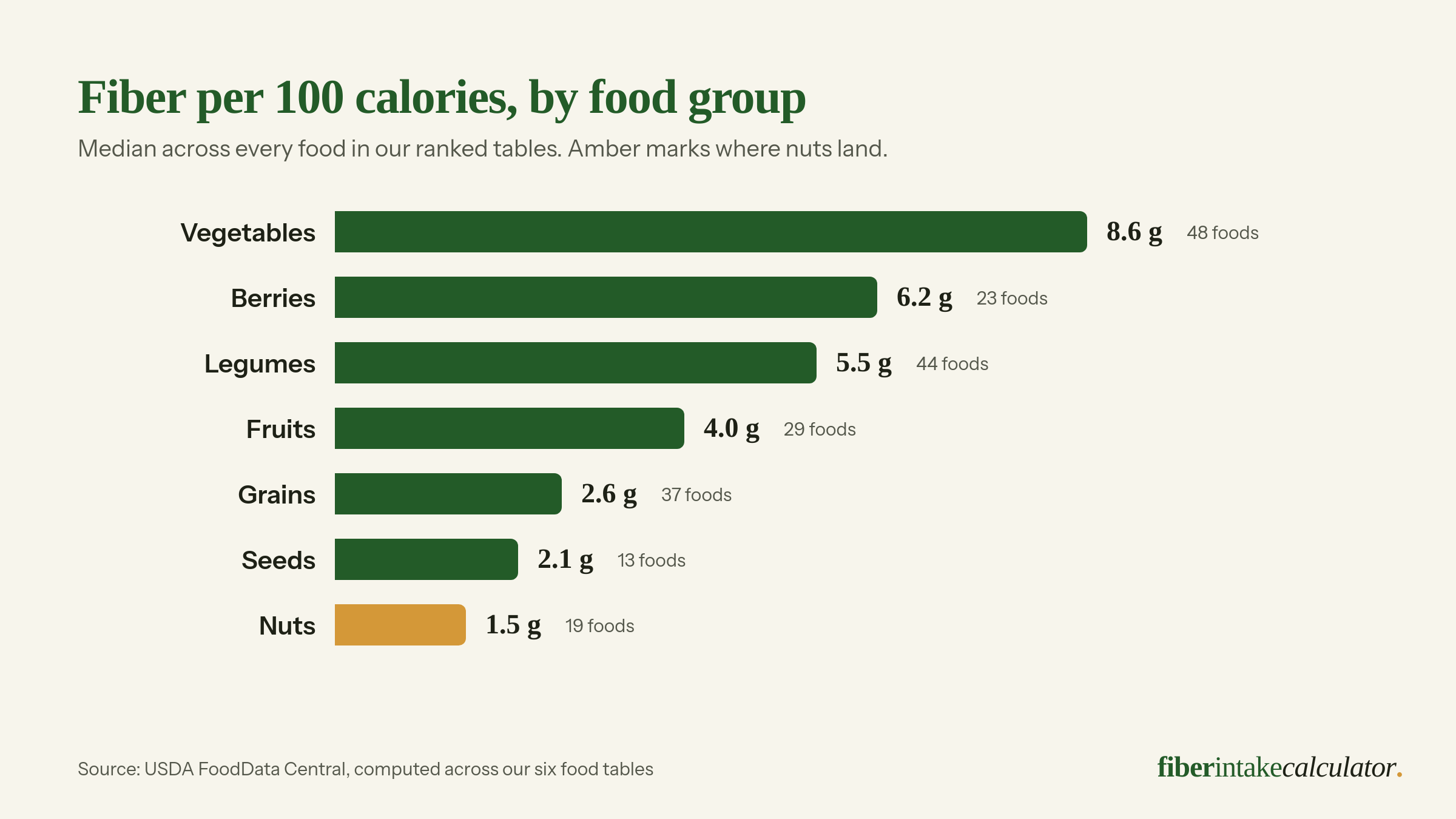
Across the six food tables on this site, nuts have the lowest median fiber per 100 calories of any group we rank: 1.5 grams, against 8.6 for vegetables, 6.2 for berries and 5.5 for legumes. Seeds do better at 2.1 grams, and chia alone reaches 7.1 grams, which is the only figure in the whole group that beats the legume median.
The arithmetic of a single-food day makes it concrete.
| To reach 38 g of fiber from one food | How much | Calories |
|---|---|---|
| Chia seeds | 3.9 oz | 537 |
| Lentils, cooked | 2.4 cups | 560 |
| Almonds | 10.7 oz | 1,760 |
| Cashews | 40.6 oz | 6,370 |
Nobody eats any of those, which is the point: the column tells you what each food can afford to contribute. Chia and lentils can carry a target. Almonds can decorate one. Cashews cannot do either, and that is before noting that 40 ounces of cashews is two and a half pounds of nut and more than three days of calories.
This is why the group barely appears in the day-plans on our legume ranking, where navy beans reach 19.1 grams a cooked cup, and why it is the first thing to go when calories are capped, as the target arithmetic on our page about fiber while losing weight works through.
It is also the reason nuts and seeds matter so much in one specific case. When carbohydrate rather than calories is the constraint, the ratio that counts flips, and this group goes from worst to first. Our high-fiber low-carb ranking puts ground flaxseed at the top of 44 foods on fiber per gram of net carbohydrate, ahead of every vegetable and every berry.
The labels that quietly swap one food for another
Pumpkin seeds are the big one. Three smaller swaps run through the same lists.
Two different pine nuts. USDA holds common pine nuts at 3.7 grams per 100 grams and pinyon pine nuts at 10.7 grams. Pinyon is the North American nut; the jars in most supermarkets are Mediterranean or Chinese species. The “pine nuts, 3 grams an ounce” figure in circulation is the pinyon record. The common jar gives 1.0 gram an ounce, a third as much.
A spoon of ground flaxseed holds less seed than a spoon of whole. USDA carries both tablespoon weights on the same record: whole flaxseed is 10.3 grams a tablespoon, ground is 7 grams. So a tablespoon of whole seed is 2.8 grams of fiber and a tablespoon of ground is 1.9 grams. Grinding costs nothing per gram and about a third per spoonful, because ground seed does not pack. Measure by weight if the difference matters to your total. Flaxseed is also the clearest case in this group of fiber that is mostly the bulking kind, 61% insoluble by the measured splits on our insoluble fiber page.
Nut butter is not the nut. A tablespoon of almond butter carries 1.6 grams of fiber for 98 calories, against 2.2 grams per 100 calories for whole almonds and 1.7 for the butter. The butter is not stripped of fiber; it is simply denser, so the same calories buy slightly less.
Peanuts are not nuts at all. They are legumes, and they behave like the thin end of that family rather than the thick end: 2.4 grams an ounce dry roasted, against 15.8 grams for a cup of boiled peanuts in the same USDA release.
What a realistic day of nuts and seeds is worth
Adults need 25 grams a day for women and 38 grams for men aged 19 to 50, per the Institute of Medicine reference intakes, falling to 21 and 30 grams after 50. Get your own number from the fiber calculator if you do not have one.
Here is a day built the way someone who likes this group would actually build it.
| A day of nuts and seeds | Fiber | Calories |
|---|---|---|
| Chia, 1 oz into oats or yogurt | 9.8 g | 138 |
| Pumpkin seeds, 1 oz whole in shell | 5.2 g | 126 |
| Almonds, 1 oz handful | 3.5 g | 164 |
| Flaxseed, 1 tbsp ground | 1.9 g | 37 |
| Total | 20.4 g | 465 |
That is 82% of a 25 gram target and 54% of a 38 gram one, for 465 calories. It is a good day, and it rests on two spoonfuls of seed: take the chia row out and the other three come to 10.6 grams.
The same 20.4 grams from legumes costs about 300 calories. So this group is worth having, and worth having second. The straightforward way to use it is as the topping layer on a meal that already carries fiber, which is what the oat and bran bowls on our high-fiber breakfast page are built to take.
It also beats most things sold as a fiber snack. A plain ounce of almonds delivers 2.2 grams of fiber per 100 calories, against 1.4 grams for a KIND Fruit and Nut bar and 1.8 for a Larabar, from the branded figures on our high-fiber snacks ranking. The bars that beat a handful of nuts are the ones built on added chicory root fiber, not on the nuts inside them.
One caution on ramping up. Added fiber only improved stool frequency above 10 grams a day held for four weeks or more, pooled across 16 randomized trials, and reaching that from this group means a large volume of fat and calories alongside it. The dose evidence, and what happens when people climb too fast, is on our page about fiber for constipation.
Every nut and seed, ranked
Sort by any column. The form column is the one other lists leave out: in-shell and hulled seeds, raw and roasted nuts, and whole and ground flaxseed are separate USDA records, and mixing them silently is how a bag of pepitas inherits an in-shell number. The fiber per 100 calories column is where the group’s real standing shows. The % of your target column uses the result you saved in the calculator, or the FDA Daily Value of 28 g until you have one. Every figure traces to USDA FoodData Central or to the Institute of Medicine intakes, both listed on our sources page, and the whole group sits inside the master high-fiber foods chart.
| Nut or seed | Fiber per serving (g) | Serving | Form | Calories | Fiber per 100 calories (g) | % of your target |
|---|---|---|---|---|---|---|
| Chia seeds | 9.8 | 1 oz, about 2 tbsp (28 g) | Seed | 138 | 7.1 | – |
| Coconut meat, fresh | 7.2 | 1 cup shredded (80 g) | Nut | 283 | 2.5 | – |
| Pumpkin seeds, whole in shell | 5.2 | 1 oz, 85 seeds (28 g) | Seed | 126 | 4.1 | – |
| Sesame seed kernels, toasted | 4.8 | 1 oz (28 g) | Seed | 161 | 3 | – |
| Coconut, dried unsweetened | 4.6 | 1 oz (28 g) | Nut | 187 | 2.5 | – |
| Almonds, raw | 3.5 | 1 oz, 23 kernels (28 g) | Nut | 164 | 2.2 | – |
| Almonds, dry roasted | 3.1 | 1 oz, 22 kernels (28 g) | Nut | 170 | 1.8 | – |
| Sunflower kernels, dry roasted | 3.1 | 1 oz (28 g) | Seed | 165 | 1.9 | – |
| Pistachios, raw | 3 | 1 oz, 49 kernels (28 g) | Nut | 159 | 1.9 | – |
| Pine nuts, pinyon | 3 | 1 oz (28 g) | Nut | 178 | 1.7 | – |
| Pistachios, dry roasted | 2.9 | 1 oz, 49 kernels (28 g) | Nut | 162 | 1.8 | – |
| Flaxseed, whole | 2.8 | 1 tbsp whole (10.3 g) | Seed | 55 | 5.1 | – |
| Hazelnuts | 2.7 | 1 oz, 21 kernels (28 g) | Nut | 178 | 1.5 | – |
| Pecans | 2.7 | 1 oz, 19 halves (28 g) | Nut | 196 | 1.4 | – |
| Mixed nuts, dry roasted | 2.6 | 1 oz (28 g) | Nut | 168 | 1.5 | – |
| Macadamia nuts | 2.4 | 1 oz, 10 to 12 kernels (28 g) | Nut | 204 | 1.2 | – |
| Peanuts, dry roasted | 2.4 | 1 oz (28 g) | Nut | 166 | 1.4 | – |
| Sunflower kernels, raw | 2.4 | 1 oz (28 g) | Seed | 166 | 1.5 | – |
| Brazil nuts | 2.1 | 1 oz, 6 kernels (28 g) | Nut | 187 | 1.1 | – |
| Walnuts, English | 1.9 | 1 oz, 14 halves (28 g) | Nut | 185 | 1 | – |
| Flaxseed, ground | 1.9 | 1 tbsp ground (7 g) | Seed | 37 | 5.1 | – |
| Pumpkin seed kernels, roasted | 1.8 | 1 oz (28 g) | Seed | 163 | 1.1 | – |
| Pumpkin seed kernels, raw | 1.7 | 1 oz (28 g) | Seed | 158 | 1.1 | – |
| Poppy seed | 1.7 | 1 tbsp (8.8 g) | Seed | 46 | 3.7 | – |
| Almond butter | 1.6 | 1 tbsp (16 g) | Nut | 98 | 1.7 | – |
| Chestnuts, roasted | 1.4 | 1 oz (28 g) | Nut | 69 | 2.1 | – |
| Tahini | 1.4 | 1 tbsp (15 g) | Seed | 89 | 1.6 | – |
| Hemp seeds, hulled | 1.2 | 3 tbsp (30 g) | Seed | 166 | 0.7 | – |
| Sesame seeds, whole | 1.1 | 1 tbsp (9 g) | Seed | 52 | 2.1 | – |
| Pine nuts, common | 1 | 1 oz, 167 kernels (28 g) | Nut | 191 | 0.5 | – |
| Cashews, raw | 0.9 | 1 oz (28 g) | Nut | 157 | 0.6 | – |
| Cashews, dry roasted | 0.9 | 1 oz (28 g) | Nut | 163 | 0.5 | – |
Fiber per serving is USDA FoodData Central's per-100-gram value multiplied by a household portion weight carried on the same record, read October 2026. The form column names which record each row comes from, because in-shell and hulled seeds, raw and roasted nuts, and whole and ground flaxseed are analysed separately and the numbers differ. USDA's newer Foundation Foods analyses of several of these foods come in lower than the SR Legacy values used here; the page sets out both. See the methodology page for how figures are sourced and refreshed.
Frequently asked questions
Which seeds are highest in fiber?
Chia, by a distance. One ounce, about 2 tablespoons, carries 9.8 grams of fiber per USDA data, which is nearly twice the next seed on the list. Whole pumpkin seeds eaten in their shells come second at 5.2 grams an ounce, then toasted sesame kernels at 4.8 grams. Flaxseed is denser per gram than any of them at 27.3 grams per 100 grams, but a tablespoon of it is only 10 grams, so it delivers 2.8 grams at a time.
Which nuts have the most fiber?
Almonds, at 3.5 grams per ounce of 23 kernels, ahead of pistachios at 3.0 grams and hazelnuts and pecans at 2.7 grams. Cashews are last of the common nuts at 0.9 grams an ounce, a quarter of the almond figure. Those are USDA's long-standing values. The agency's newer laboratory work, published in 2022 and 2023, measured most of these nuts lower, pecans by 40% and pistachios by 34%, so treat the published figures as the top of a range.
Do pumpkin seeds have a lot of fiber?
It depends entirely on whether the shell is still on. USDA holds two records: whole roasted pumpkin seeds eaten in their white shells carry 18.4 grams of fiber per 100 grams, and the green hulled kernels sold as pepitas carry 6.5 grams. Per ounce that is 5.2 grams against 1.8 grams. The 5 grams quoted in most lists is the in-shell number, and the bag in most kitchens is the hulled one.
Are nuts good for your bowels?
They are useful food, but they are an inefficient way to move fiber. Pooled across 16 randomized trials, added fiber only improved stool frequency above 10 grams a day sustained for at least four weeks. Reaching 10 grams from almonds alone takes nearly 3 ounces and 470 calories, where a cup of cooked lentils gets you past it for 230. Nuts are a topping on that dose, not the dose.
How much fiber can I realistically get from nuts and seeds in a day?
About 20 grams, if seeds carry it. An ounce of chia, an ounce of whole pumpkin seeds, an ounce of almonds and a tablespoon of ground flaxseed come to 20.4 grams for 465 calories, which is 82% of a 25 gram target and 54% of a 38 gram one. Take the chia out and the same habit gives 10.6 grams. Seeds are what make the group work.
Built and maintained by the FiberIntake team, with data from USDA FoodData Central and peer-reviewed sources. Figures are checked against the cited source before publish. About this site →