High-Fiber Snacks, Ranked From Label Data
Last updated: September 8, 2026
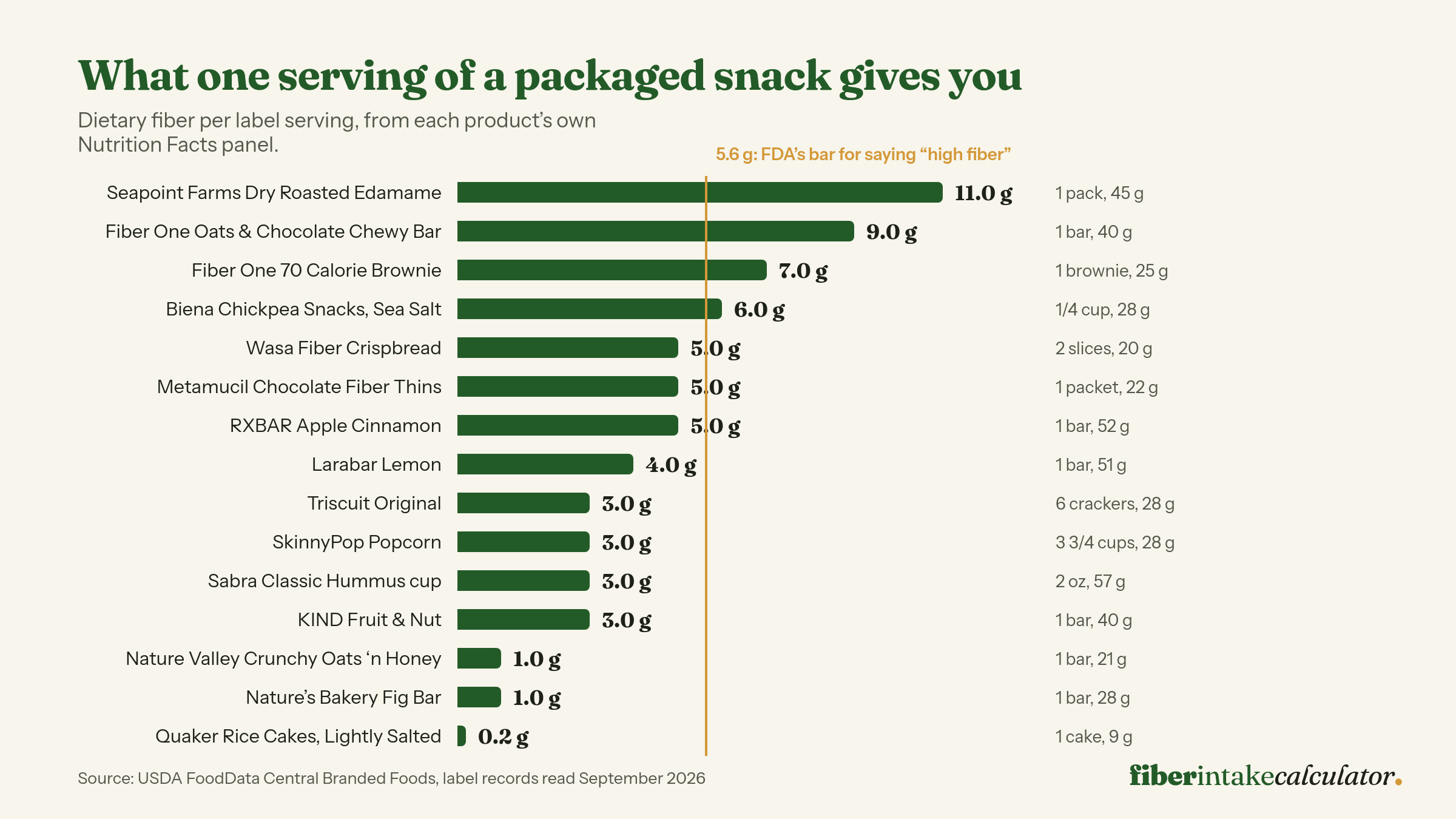
A 45 gram pack of dry roasted edamame carries 11.0 grams of fiber, the most of any packaged snack here. Only 4 of the 15 packaged snacks on this page carry enough fiber to legally call themselves high fiber, which FDA sets at 5.6 grams per serving.
Every packaged number below is that product’s own Nutrition Facts panel, as the manufacturer filed it in USDA FoodData Central, read in September 2026. Every whole-food number is USDA’s composition data times USDA’s own portion weight. No snack list in the search results above this page prints a label number, a serving weight, or how many servings are in the bag.
Four of these fifteen can legally say “high fiber”
The words on the front of the box are regulated. Under 21 CFR 101.54, a food may say high, rich in, or excellent source of a nutrient when one reference serving carries 20% or more of the Daily Value. Good source, contains and provides need 10 to 19%.
The Daily Value for dietary fiber is 28 grams. That makes the two bars concrete:
| What the box may say | Share of the Daily Value | Fiber per serving |
|---|---|---|
| High fiber, excellent source | 20% or more | 5.6 g and up |
| Good source, contains, provides | 10 to 19% | 2.8 to 5.5 g |
| No fiber claim allowed | under 10% | below 2.8 g |
Four products clear 5.6 grams: the edamame pack at 11.0 grams, the Fiber One chewy bar at 9.0 grams, the Fiber One brownie at 7.0 grams and a serving of Biena chickpea snacks at 6.0 grams. Eight more land in good-source territory. Three carry too little fiber to say anything at all.
The one number to carry into a store. 5.6 grams. Below that, a snack is not high in fiber no matter what the front of the package suggests, and a claim printed on a food that is not low in total fat has to show the fat number right next to it.
Two widely quoted charts still use 5 grams and 2.5 grams for these bars, including a dietitian-authored page ranking in the top five for this search. Those were 20% and 10% of the old 25 gram Daily Value, retired when the Nutrition Facts panel was revised. The thresholds moved up by about 12%.
The bag is not the serving
A serving is a unit the manufacturer chooses. The bag is the unit you eat.
Three of the products here quietly split a single snack into two servings, so the fiber figure on the panel is half of what the package holds:
| Product | Label serving | Fiber per serving | Servings per pack | Fiber per pack |
|---|---|---|---|---|
| Biena Chickpea Snacks, Sea Salt | 1/4 cup (28 g) | 6.0 g | 2 | 12.0 g |
| Nature Valley Crunchy Oats 'n Honey | 1 bar (21 g) | 1.0 g | 2 | 2.0 g |
| Nature's Bakery Fig Bar | 1 bar (28 g) | 1.0 g | 2 | 2.0 g |
The Biena bag works in your favor: a 2 ounce bag is 12.0 grams of fiber for 260 calories, which is more fiber than any single-serve packaged snack here. The two granola-style packs work the other way. Nobody opens a Nature Valley pouch and eats one bar.
Rule of thumb. Multiply the panel figure by the servings per container before you compare anything. Bars sold in sealed pairs and small bags with a quarter-cup serving size are where the gap is widest.
Where a packaged snack’s fiber comes from
Ingredients are listed in descending order by weight, under 21 CFR 101.4. That makes the first few words on a label the most honest part of the package.
| Product | Fiber per serving | What the fiber is, in label order |
|---|---|---|
| Fiber One 70 Calorie Brownie | 7.0 g | Chicory root extract (first ingredient), sugarcane fiber, polydextrose |
| Fiber One Oats and Chocolate Chewy Bar | 9.0 g | Chicory root extract (first ingredient), whole grain oats |
| Metamucil Chocolate Fiber Thins | 5.0 g | Inulin, oat hull fiber, then psyllium husk |
| KIND Fruit & Nut | 3.0 g | Mixed nuts, flax seeds, chicory root fiber |
| Nature's Bakery Fig Bar | 1.0 g | Fig paste, rolled oats, citrus fiber, oat fiber |
| Triscuit Original | 3.0 g | Whole grain wheat, and nothing else that carries fiber |
| RXBAR Apple Cinnamon | 5.0 g | Dates, almonds, cashews, apples |
| Biena Chickpea Snacks | 6.0 g | Chickpeas |
Both Fiber One products lead with chicory root extract. That is isolated inulin, and it is the reason a 25 gram brownie can carry more fiber than a medium apple.
It counts. FDA’s definition of dietary fiber covers fiber intrinsic to plants plus specific isolated fibers shown to have a physiological benefit. Seven are written into 21 CFR 101.9: beta-glucan, psyllium husk, cellulose, guar gum, pectin, locust bean gum and hydroxypropylmethylcellulose. In June 2018 FDA named eight more it intends to add, inulin and polydextrose among them, and manufacturers have declared them since.
Counting and working are different questions. Inulin ferments quickly and does not hold water through the colon, so it raises a daily total without doing much for regularity. The fibers that do that work are gel-forming and fermentation-resistant, which is the whole argument on our fiber supplement comparison, and the split between the two types is set out on our soluble fiber page.
One label detail worth knowing: the Metamucil Fiber Thins packet is sold on psyllium, but inulin and oat hull fiber both sit ahead of psyllium husk in the ingredient list, so there is more of each of those in the packet by weight.
Breakfast cereal boxes carry the same tells and one extra trap. Our high-fiber cereal ranking prints the serving weight beside every panel figure, because those weights run from 30 g to 65 g and make the per-serving numbers everyone quotes uncomparable.
Per calorie, a cup of raspberries beats every box here
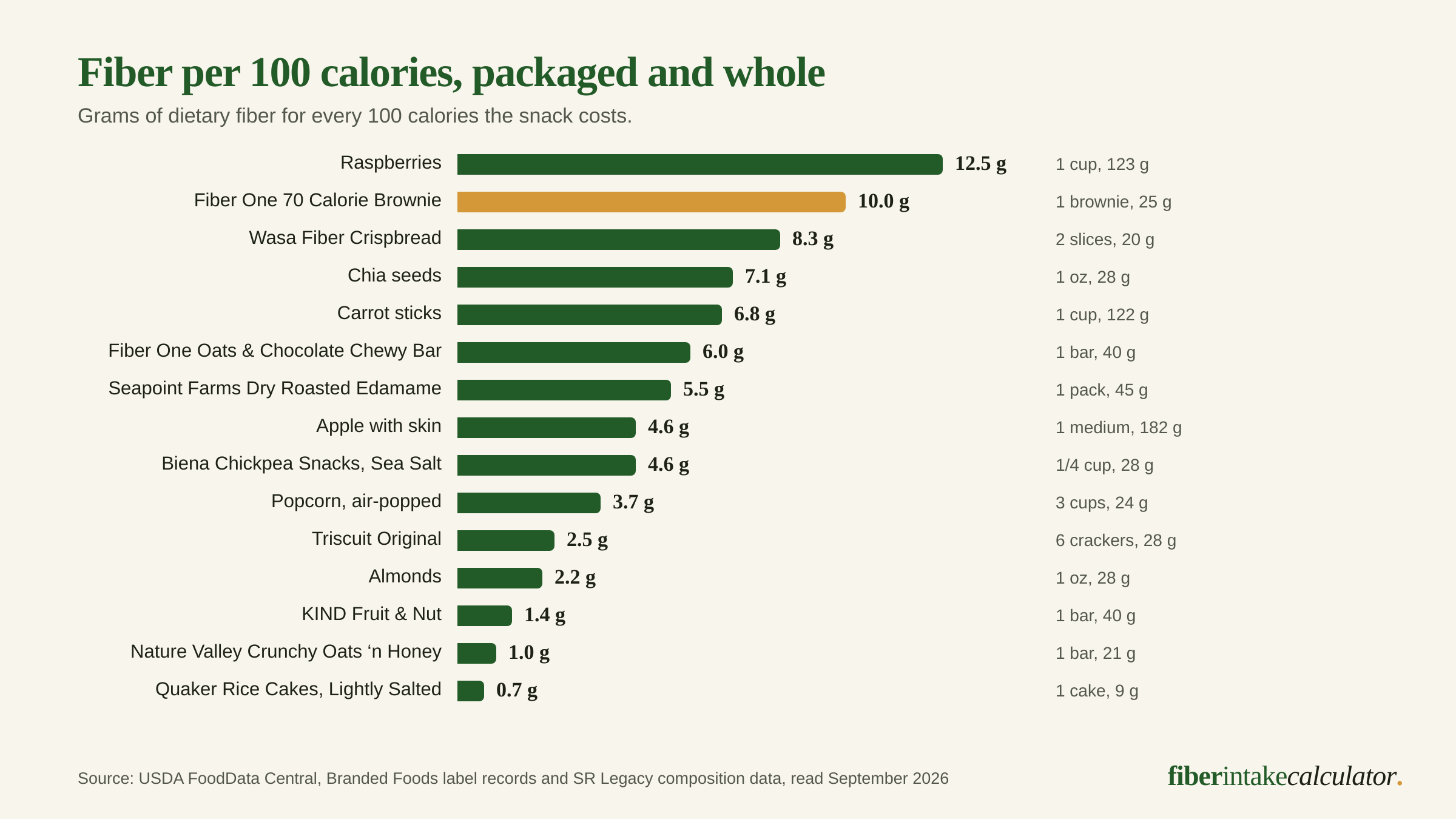
A snack is discretionary. It is the part of the day where calories are easiest to spend and hardest to account for, so the useful measure is fiber per calorie, not fiber per serving.
| Snack | Portion | Fiber | Calories | Fiber per 100 kcal |
|---|---|---|---|---|
| Raspberries | 1 cup (123 g) | 8.0 g | 64 | 12.5 g |
| Fiber One 70 Calorie Brownie | 1 brownie (25 g) | 7.0 g | 70 | 10.0 g |
| Wasa Fiber Crispbread | 2 slices (20 g) | 5.0 g | 60 | 8.3 g |
| Chia seeds | 1 oz (28 g) | 9.8 g | 138 | 7.1 g |
| Carrot sticks | 1 cup (122 g) | 3.4 g | 50 | 6.8 g |
| Fiber One Oats and Chocolate Chewy Bar | 1 bar (40 g) | 9.0 g | 150 | 6.0 g |
| Seapoint Farms Dry Roasted Edamame | 1 pack (45 g) | 11.0 g | 200 | 5.5 g |
| Metamucil Chocolate Fiber Thins | 1 packet (22 g) | 5.0 g | 100 | 5.0 g |
| Apple with skin | 1 medium (182 g) | 4.4 g | 95 | 4.6 g |
| Biena Chickpea Snacks, Sea Salt | 1/4 cup (28 g) | 6.0 g | 130 | 4.6 g |
| Edamame, cooked from frozen | 1 cup (155 g) | 8.1 g | 188 | 4.3 g |
| Dried figs | 3 figs (25 g) | 2.5 g | 63 | 3.9 g |
| Popcorn, air-popped | 3 cups (24 g) | 3.5 g | 93 | 3.7 g |
| Prunes | 5 prunes (48 g) | 3.4 g | 114 | 3.0 g |
| Triscuit Original | 6 crackers (28 g) | 3.0 g | 120 | 2.5 g |
| RXBAR Apple Cinnamon | 1 bar (52 g) | 5.0 g | 210 | 2.4 g |
| Medjool dates | 2 dates (48 g) | 3.2 g | 133 | 2.4 g |
| Hummus | 1/4 cup (61 g) | 3.4 g | 146 | 2.3 g |
| Almonds | 1 oz, 23 kernels (28 g) | 3.5 g | 164 | 2.2 g |
| Sabra Classic Hummus cup | 2 oz (57 g) | 3.0 g | 150 | 2.0 g |
| SkinnyPop Popcorn | 3 3/4 cups (28 g) | 3.0 g | 150 | 2.0 g |
| Pistachios, dry roasted | 1 oz, 49 kernels (28 g) | 2.9 g | 162 | 1.8 g |
| Larabar Lemon | 1 bar (51 g) | 4.0 g | 220 | 1.8 g |
| KIND Fruit & Nut | 1 bar (40 g) | 3.0 g | 210 | 1.4 g |
| Nature Valley Crunchy Oats 'n Honey | 1 bar (21 g) | 1.0 g | 100 | 1.0 g |
| Nature's Bakery Fig Bar | 1 bar (28 g) | 1.0 g | 100 | 1.0 g |
| Peanut butter | 2 tbsp (32 g) | 1.6 g | 191 | 0.8 g |
| Quaker Rice Cakes, Lightly Salted | 1 cake (9 g) | 0.2 g | 35 | 0.7 g |
Nuts are the surprise at the bottom. Almonds and pistachios appear on every high-fiber snack list, and per ounce they are respectable at 3.5 and 2.9 grams. Per calorie they are among the weakest choices on this page, because an ounce of nuts is 160 calories of fat. The same logic drives the food rankings on our fiber and weight loss page, and the full group sits on our high-fiber nuts and seeds ranking, where 32 rows put nuts last of every food group per calorie and chia alone well ahead of the rest.
Fruit runs the other way. Raspberries hold the top spot here by a wide margin, and the rest of the fruit ordering is on the high-fiber fruits chart.
Nuts and popcorn carry one other result worth knowing, and it is not about fiber content. Both sat for decades on the list of foods to avoid with diverticular disease. When that was finally tested in 47,228 men, popcorn twice a week or more tracked with 28% fewer episodes of diverticulitis, and nuts with 20% fewer on an interval just touching no effect, which is covered on our fiber and diverticulitis page.
What the summary above these results gets wrong
Google’s AI Overview for this search offers a set of ranges. Two of them check out against USDA data and one does not.
| The claim above | Computed from USDA data |
|---|---|
| One cup of raspberries has 8 grams | 8.0 g, correct |
| Three cups of popcorn give 3 to 4 grams | 3.5 g, correct |
| Half a cup of carrots with 2 tbsp of hummus gives 4 to 5 grams | 3.4 g |
The carrot plate is the interesting miss. Half a cup of carrot strips is 61 grams and holds 1.7 grams of fiber. Two tablespoons of hummus is 30 grams and holds 1.7 grams. That is 3.4 grams on the plate, about a third short of the 5 grams at the top of the range, and the error comes from nobody attaching a weight to the words “half a cup”. The high-fiber vegetables chart has the same problem in more detail.
Two snacks close most of the gap
Adults need 25 grams of fiber a day for women and 38 grams for men aged 19 to 50 under the Institute of Medicine reference intakes. Those drop to 21 and 30 grams after 50. Get your own number from the fiber calculator first, because the size of your gap decides whether a 3 gram snack is worth the calories.
Most days need about 10 grams from snacking to close a typical shortfall. Three ways to get there:
| Two snacks | Fiber | Calories |
|---|---|---|
| 1 cup raspberries + 2 oz bag roasted chickpeas | 20.0 g | 324 |
| 1 pack dry roasted edamame + 1 medium apple | 15.4 g | 295 |
| 3 cups air-popped popcorn + 1 oz almonds | 7.0 g | 257 |
The third row is the one most people actually eat, and it is the weakest of the three by a factor of two at almost the same calorie cost. That is the whole case for reading the panel rather than the front of the box.
None of this needs a specialty product. The single densest thing you can put in a bowl is still food: a cup of cooked lentils carries 15.6 grams, which is more than any snack on this page, as the full high-fiber foods chart shows. Our methodology page sets out the serving basis used here, and every label record, regulation and USDA release is listed on our sources page.
Frequently asked questions
What snack has the most fiber?
Counting whole packages, a 2 ounce bag of Biena chickpea snacks leads at 12.0 grams, then a 45 gram pack of Seapoint Farms dry roasted edamame at 11.0 grams and a Fiber One Oats and Chocolate chewy bar at 9.0 grams. Among whole foods, an ounce of chia seeds gives 9.8 grams and a cup of raspberries 8.0 grams for only 64 calories.
How much fiber does a snack need before it can say high fiber?
5.6 grams per serving. FDA lets a food use the words high, rich in, or excellent source of fiber when it carries 20% or more of the Daily Value per reference amount, and the Daily Value for dietary fiber is 28 grams. Good source, contains, or provides needs 10 to 19%, which is 2.8 to 5.5 grams. Some published charts still use the pre-2016 thresholds of 5 grams and 2.5 grams, based on the old 25 gram Daily Value.
Does the fiber in a Fiber One brownie count the same as fiber from fruit?
On the label, yes. The first ingredient in a Fiber One 70 Calorie brownie is chicory root extract, an isolated inulin that FDA counts as dietary fiber, so the 7.0 grams is a real declared number. What inulin does in the body is different from what wheat bran or psyllium does. Inulin ferments early in the colon and does not add stool bulk, which is why it is a poor choice for regularity and a reasonable one for raising a daily total.
Are fiber bars better than fruit and nuts?
Per calorie, mostly not. A KIND Fruit and Nut bar carries 1.4 grams of fiber per 100 calories and a Larabar 1.8 grams, against 12.5 grams for a cup of raspberries, 6.8 grams for a cup of carrot sticks and 4.6 grams for a medium apple. The bars that do win per calorie are the ones built on added fiber: a Fiber One 70 Calorie brownie gives 10.0 grams per 100 calories.
How many high-fiber snacks do I need to close my daily gap?
Usually two. Adults need 25 grams a day for women and 38 grams for men aged 19 to 50 under the Institute of Medicine reference intakes, and most people eat about half that. A cup of raspberries and a 2 ounce bag of roasted chickpeas is 20.0 grams for 324 calories, which covers the shortfall for most people in two snack occasions.
Built and maintained by the FiberIntake team, with data from USDA FoodData Central and peer-reviewed sources. Figures are checked against the cited source before publish. About this site →