A High-Fiber Diet for Diverticulitis, Measured Two Ways
Last updated: September 22, 2026
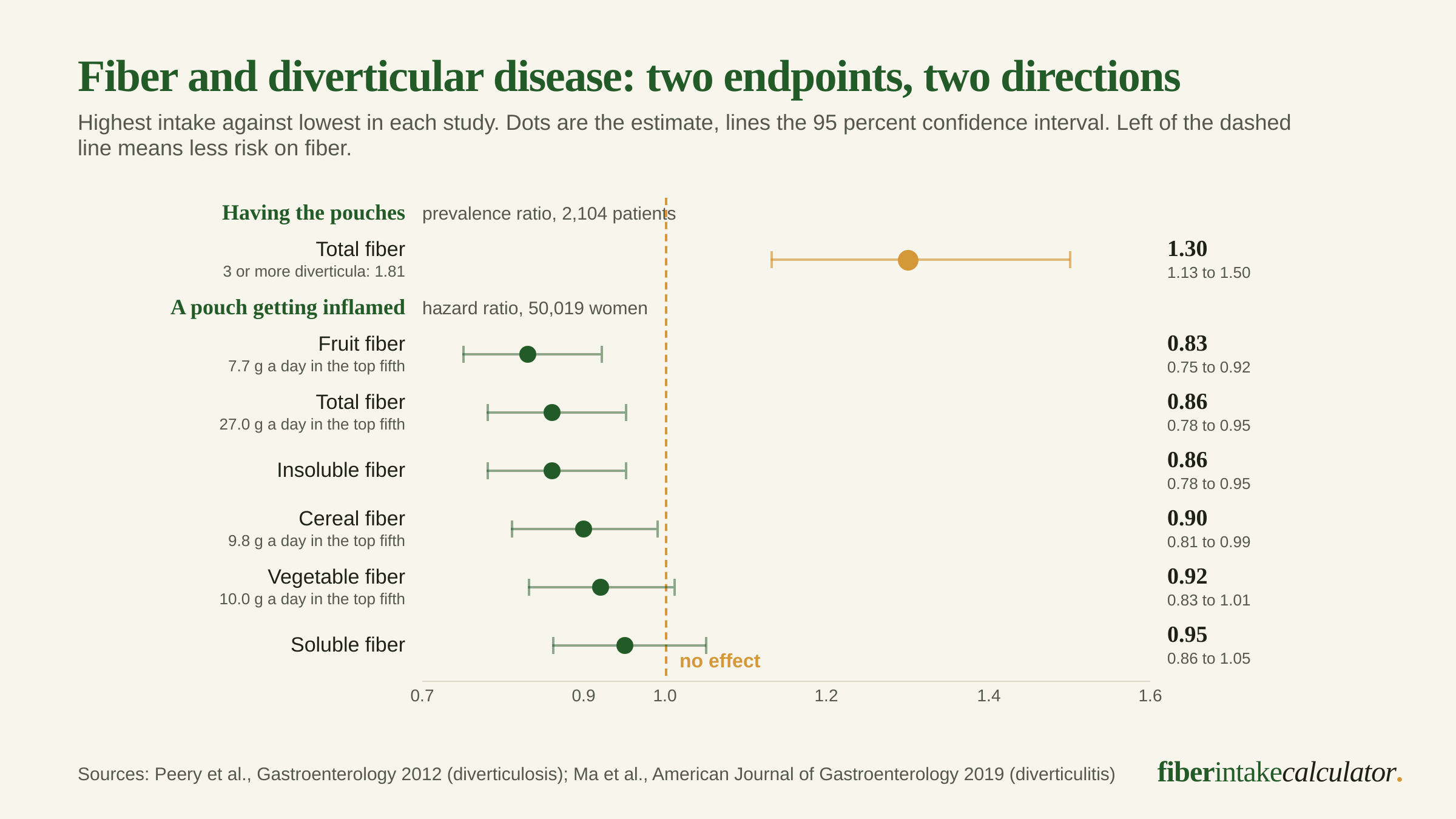
A high-fiber diet does two different things here, and one of them is not what the advice implies. Among 50,019 women followed for 24 years, the highest fifth of fiber intake carried a 14 percent lower risk of diverticulitis (HR 0.86, 95% CI 0.78 to 0.95). In a separate study of 2,104 colonoscopy patients, the quartile eating the most fiber had a 30 percent higher prevalence of the pouches themselves (PR 1.30, 95% CI 1.13 to 1.50).
Both findings can be true because they measure different things. Fiber has not been shown to stop diverticula forming. It lowers the odds that the diverticula you already have become inflamed.
That split is missing from every page ranking for this search, including the pages that cite the study which found it. This one carries the effect sizes for each endpoint, which fiber source actually carried the signal, what the protective intake looks like in food, and what the current practice update says the clear liquid phase is for. Every clinical figure names its study and is listed in full on our sources page. Every food figure comes from USDA FoodData Central, read in September 2026.
Three questions, three different answers
Almost all confusion on this topic comes from one word doing three jobs. “Diverticular disease” covers having the pouches, having one become inflamed, and being in the middle of that inflammation right now. Fiber has a different answer for each.
| The question | What the evidence shows | Best estimate | Study |
|---|---|---|---|
| Does fiber stop the pouches forming? Diverticulosis | No, and the association ran the other way | PR 1.30 1.13 to 1.50 | Peery 2012, 2,104 colonoscopy patients |
| Does fiber lower the odds a pouch gets inflamed? Diverticulitis | Yes, modestly, and the source of the fiber matters | HR 0.86 0.78 to 0.95 | Ma 2019, 50,019 women, 4,343 cases |
| Should you eat fiber during an active flare? Acute diverticulitis | No, and the stated reason is comfort rather than healing | No trial evidence of benefit either way | AGA practice update 2021 |
The one thing to carry away. Fiber is not a treatment for having diverticula, and it is not a treatment for a flare. It is a long-run reduction in how often the pouches you already have get inflamed.
Almost every page on this search answers the middle question while appearing to answer the first. That is why “eat more fiber to prevent diverticulosis” and “high fiber does not prevent diverticulosis” both circulate, and why both have a real study behind them.
Fiber did not stop the pouches forming
This is the finding that ranks on page one of this search and appears in none of the pages above it.
The study recruited 2,104 patients having an outpatient colonoscopy at the University of North Carolina, across three waves between 1998 and 2010. Diverticula were recorded from the colonoscopy reports by assistants blinded to diet. Diet came from validated food frequency questionnaires with 100 to 124 items, collected by phone within 12 weeks, by interviewers blinded to the colonoscopy result. 878 patients had diverticulosis, 1,226 did not.
| Exposure, highest quartile against lowest | Prevalence ratio | 95% confidence interval | Reading |
|---|---|---|---|
| Total fiber | 1.30 | 1.13 to 1.50 | Higher prevalence, P for trend .004 |
| Fiber from grains | 1.25 | 1.09 to 1.45 | Higher prevalence |
| Soluble fiber | 1.24 | 1.07 to 1.42 | Higher prevalence |
| Insoluble fiber | 1.24 | 1.08 to 1.42 | Higher prevalence |
| Total fat | 0.97 | 0.84 to 1.12 | No association |
| Red meat | 1.04 | 0.90 to 1.19 | No association |
| Physical activity | 1.02 | 0.89 to 1.18 | No association |
The association was dose dependent, and it got stronger with more pouches. Restricted to patients with three or more diverticula, total fiber carried a prevalence ratio of 1.81 (95% CI 1.30 to 2.52), with insoluble fiber at 1.64 and soluble at 1.74. Bean fiber and fruit and vegetable fiber showed no association with having many pouches.
Two other results in the same study overturn the mechanism the food advice rests on. Constipation was not a risk factor. Compared with people having fewer than seven bowel movements a week, those with more than fifteen had a 70 percent higher prevalence (PR 1.70, 95% CI 1.24 to 2.34), with a significant trend across the categories. That is the reverse of the standard story, in which low fiber causes constipation, constipation raises colonic pressure, and pressure herniates the wall.
The authors take apart that story directly. It began with Painter and Burkitt in the late 1960s, from the observation that diverticulosis was rare in native Africans presumed to eat more fiber, without accounting for life expectancy differences or the actual diversity of African diets. The pressure model also fails to explain right-sided diverticula, which occur where the bowel is wide and strong contraction is not seen.
Read this as one study on one endpoint. It is cross-sectional, so it cannot show that fiber causes pouches. Mean fiber intake was in fact identical in cases and controls, 18.8 grams a day in both, and the effect appears only at the extremes of intake. The authors' own reading is that the risk factors for developing diverticula and for developing complications are probably different, which is exactly what the next section shows.
Fiber did lower the odds a pouch got inflamed
The diverticulitis evidence is prospective, much larger, and points the other way.
The Nurses’ Health Study followed 50,019 women aged 43 to 70, free of diverticulitis at baseline in 1990, through 2014. Diet came from a validated 131-item questionnaire repeated every four years. The endpoint was diverticulitis requiring antibiotics or hospitalisation, and 88 percent of cases were confirmed in a review of 107 medical records. Over 1,106,402 person-years, there were 4,343 cases.
Comparing the top fifth of total fiber intake with the bottom fifth, the multivariable hazard ratio was 0.86 (95% CI 0.78 to 0.95), with a significant trend. Those quintile medians were 27.0 grams a day against 13.0. Grouped by a round threshold instead, women eating 25 grams a day or more had a 13 percent lower risk than women eating under 18 grams (HR 0.87, 95% CI 0.79 to 0.96).
A second analysis in 2025 pooled three cohorts, 179,564 participants and 10,299 cases over about 20 years of follow-up, and landed on the same number: HR 0.86 (95% CI 0.80 to 0.92) for the extreme fiber quintiles.
Now the part that belongs next to those figures and never appears with them. In the Nurses’ Health Study the incidence rate was 387 cases per 100,000 person-years in the lowest fiber quintile and 376 in the highest. The unadjusted difference is 11 fewer cases per 100,000 person-years.
Both numbers describe the same result. A 14 percent relative reduction is real and consistent across cohorts. In absolute terms it is roughly 11 cases per 100,000 person-years, because diverticulitis is uncommon to begin with. Fiber is worth eating for many reasons at once, and our fiber calculator works out your own daily number; expecting a single condition to visibly respond to it is the wrong frame.
One caveat the authors raise about their own result: the hazard ratios reached significance only in the highest quintile against the lowest, with the middle quintiles flat, which suggests a threshold rather than a smooth dose response.
Which fiber, and the order is not the usual one
The same cohort broke fiber down by food source. The ranking it produced is close to the reverse of the ranking every food list on this subject uses.
| Fiber source | Hazard ratio, top fifth vs bottom | 95% confidence interval | P for trend | Median intake in the top fifth |
|---|---|---|---|---|
| Fruit fiber | 0.83 | 0.75 to 0.92 | <0.001 | 7.7 g a day |
| Total fiber | 0.86 | 0.78 to 0.95 | 0.002 | 27.0 g a day |
| Insoluble fiber | 0.86 | 0.78 to 0.95 | 0.004 | not reported |
| Cereal fiber | 0.90 | 0.81 to 0.99 | 0.03 | 9.8 g a day |
| Vegetable fiber | 0.92 | 0.83 to 1.01 | 0.31 | 10.0 g a day |
| Soluble fiber | 0.95 | 0.86 to 1.05 | 0.57 | not reported |
Vegetable fiber is the striking row. Women in the top fifth ate more vegetable fiber than fruit fiber, 10.0 grams a day against 7.7, and it showed no measurable association. The age-adjusted estimate was significant and it disappeared once other risk factors were accounted for.
Individual foods sharpen it further.
| Food, per extra daily serving | Hazard ratio | 95% confidence interval | Reading |
|---|---|---|---|
| Apples or pears | 0.85 | 0.76 to 0.96 | Lower risk, P = 0.009 |
| Prunes | 0.83 | 0.69 to 0.99 | Lower risk, P = 0.04 |
| Whole fruit, any | 0.95 | 0.92 to 0.98 | Lower risk, P < 0.001 |
| Beans or lentils | 0.78 | 0.61 to 1.01 | Trend only, P = 0.06 |
| Vegetables, any | 1.00 | 0.98 to 1.02 | No association |
| Fruit juice | 1.04 | 0.99 to 1.08 | No association |
| Potato chips | 1.13 | 0.96 to 1.32 | No association |
| Baked or mashed potatoes | 1.20 | 1.07 to 1.36 | Higher risk, P = 0.003 |
Three things fall out of that table. Whole fruit counts and fruit juice does not, which matches the fruit fiber result and matches what happens to fiber when fruit is juiced: our high-fiber fruits ranking puts a raw apple at 4.4 grams and a cup of apple juice at 0.5. Beans and lentils trend the right way without reaching significance, which is a weaker result than the food lists that open with legumes imply, though our beans and legumes page shows why they still do the heavy lifting on total intake. And baked or mashed potatoes were associated with higher risk after adjusting for fiber, while chips and fries were not, which is a finding worth holding loosely given how odd its shape is.
Hold the whole ranking loosely, in fact. Food frequency questionnaires measure individual vegetables badly: the validation correlations ran from 0.25 for kale and chard up to 0.73 for lettuce, median 0.46, against 0.76 for individual fruits. Some of vegetable fiber’s missing signal may be measurement rather than biology. The soluble and insoluble split carries its own warning from the authors, because how a lab divides the two depends on the method used, which is the same caveat on our soluble fiber and insoluble fiber pages.
What the protective intake looks like in food
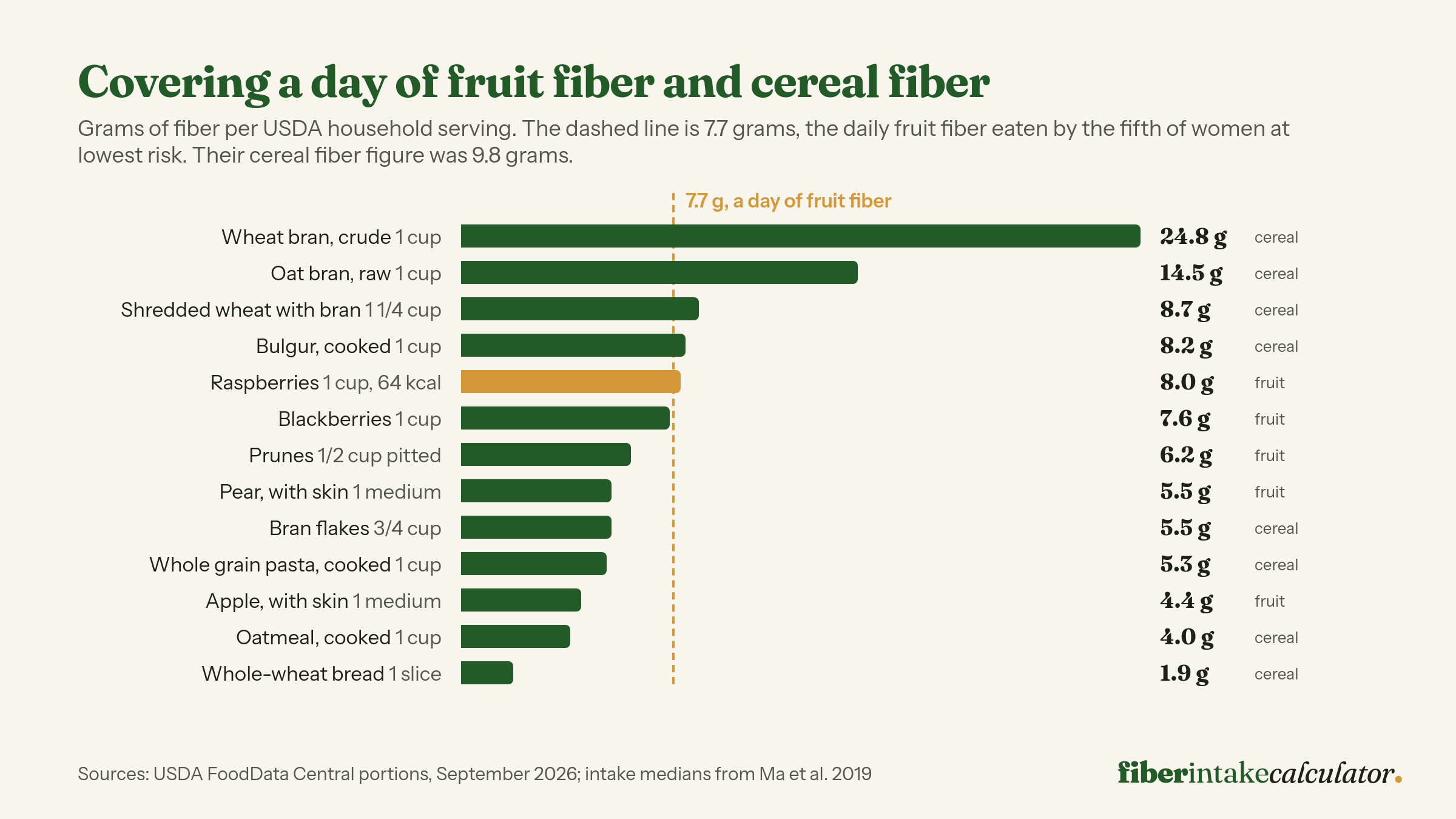
Two targets come out of the cohort, and they are more useful than a single total because they are the two sources that carried a signal: 7.7 grams a day of fruit fiber and 9.8 grams a day of cereal fiber. Here is what ordinary servings deliver, using USDA household portions.
| Food | USDA serving | Fiber | Calories | Counts toward |
|---|---|---|---|---|
| Wheat bran, crude | 1 cup (58 g) | 24.8 g | 125 | Cereal fiber |
| Oat bran, raw | 1 cup (94 g) | 14.5 g | 231 | Cereal fiber |
| Shredded wheat with bran | 1 1/4 cup (59 g) | 8.7 g | 200 | Cereal fiber |
| Bulgur, cooked | 1 cup (182 g) | 8.2 g | 151 | Cereal fiber |
| Raspberries | 1 cup (123 g) | 8.0 g | 64 | Fruit fiber |
| Blackberries | 1 cup (144 g) | 7.6 g | 62 | Fruit fiber |
| Prunes | 1/2 cup pitted (87 g) | 6.2 g | 209 | Fruit fiber |
| Pear, with skin | 1 medium (178 g) | 5.5 g | 101 | Fruit fiber |
| Bran flakes | 3/4 cup (30 g) | 5.5 g | 98 | Cereal fiber |
| Whole grain pasta, cooked | 1 cup spaghetti (116 g) | 5.3 g | 184 | Cereal fiber |
| Apple, with skin | 1 medium (182 g) | 4.4 g | 95 | Fruit fiber |
| Oatmeal, cooked | 1 cup (234 g) | 4.0 g | 166 | Cereal fiber |
| Whole-wheat bread | 1 slice (32 g) | 1.9 g | 81 | Cereal fiber |
A cup of raspberries clears a whole day of fruit fiber for 64 calories. A bowl of bran cereal and a bowl of oatmeal clear the cereal target between them. The two together are a breakfast and a snack, not a diet overhaul, and our high-fiber cereal ranking works through the serving-size rules that make cereal boxes hard to compare directly.
Two servings of apples or pears is the other reading of the fruit result, since apples and pears were tested as servings rather than as grams of fiber. On USDA portions that is 8.8 grams from two medium apples, or 11.0 from two pears.
Ramp it over weeks. Every source on this subject says the same thing, and the general recommendation is unchanged by any of the above: 14 grams of fiber per 1,000 calories, so 28 grams on a 2,000 calorie diet. Our page on pushing fiber intake high covers what going too fast costs, and the full high-fiber foods chart ranks 42 foods if you want to build the day differently.
During a flare, the clear liquid phase is about comfort
Here the most-cited pages and the most recent practice update say different things, and the difference is worth stating plainly.
The AGA clinical practice update’s fifth piece of best practice advice is that a clear liquid diet is advised during the acute phase of uncomplicated diverticulitis, with the diet advancing as symptoms improve. Then it explains why.
While a small study suggests that a liquid diet is not necessary in the acute phase of diverticulitis, many patients report greater comfort on a clear liquid diet. It is reasonable to advise a clear diet during the acute phase of uncomplicated diverticulitis with the goal of patient comfort. Some patients want to advance their diet more quickly and that is also acceptable.
The goal named there is comfort. Popular pages give a mechanism instead, describing the low fiber phase as letting the colon rest, recover or heal from the flare. That mechanism is not what the practice update claims, and there is no trial showing that bowel rest changes how a flare resolves.
This matters in one practical direction. If you are eating clear liquids because you believe solid food will worsen the inflammation, the evidence does not support that belief, and the update says advancing faster is acceptable. If you are eating clear liquids because everything else hurts, that is the actual reason the advice exists.
The step back toward normal eating usually runs through a low-fiber diet, which has its own gram target that almost nobody prints: under 10 grams a day. That page carries the figure and a ranked table of what the allowed foods actually cost, because the published food lists leave the numbers out.
The other occasion that puts people on the same diet is a colonoscopy, and many readers of this page will be booked for one. The food rules are identical and the timing is where the published advice falls apart, so we set out the evidence and a day-by-day plan on the low-fiber diet before a colonoscopy.
The rule to hold onto is the follow-up rule. The same statement says that a patient unable to advance their diet after three to five days should follow up immediately. A flare that will not let you eat after five days is a reason to call someone, not a reason to wait it out.
Two related points from the same document, both of which change what a flare means. Antibiotics can be used selectively rather than routinely in immunocompetent patients with mild uncomplicated disease, on a meta-analysis of nine studies and 2,505 patients that found no difference in resolution time, readmission, progression or surgery. And the risk of progressing from uncomplicated to complicated disease is 5 percent.
The fiber question does not belong in the flare at all. It belongs to the months after it.
Nuts, seeds, corn and popcorn
The old instruction to avoid these foods came from a mechanical idea: that hard fragments lodge in a pouch or abrade it. It was never tested until 2008, and the test found the opposite of what it looked for.
The Health Professionals Follow-up Study followed 47,228 men aged 40 to 75 from 1986 to 2004, none with known diverticular disease at baseline. Over 730,446 person-years there were 801 cases of diverticulitis and 383 of diverticular bleeding.
| Eaten at least twice a week, against less than once a month | Diverticulitis | 95% confidence interval | Diverticular bleeding |
|---|---|---|---|
| Popcorn | 0.72 | 0.56 to 0.92 | 0.82 |
| Nuts | 0.80 | 0.63 to 1.01 | 1.08 |
| Corn | 1.13 | 0.83 to 1.54 | 1.07 |
Popcorn twice a week or more carried a 28 percent lower risk of diverticulitis (HR 0.72, 95% CI 0.56 to 0.92, P for trend 0.007). Nuts came in at 0.80 with an interval just touching 1.01 and a significant trend. Corn showed nothing. Neither did any of the three for diverticular bleeding. The authors note the hazard ratios did not follow a clean dose response across categories, so the direction is better supported than the size.
The practice update carries the same conclusion and extends it: nut, corn and popcorn consumption is not associated with increased risk, and neither is eating fruits with small seeds such as strawberries and blueberries.
Nothing on the avoid list has evidence behind it. Popcorn was the single most protective food tested in that study, and it sits on almost every "foods to avoid with diverticulitis" list still in circulation. Popcorn is also one of the weakest fiber-per-serving foods at 1.2 grams a cup, so it earns its place here as a myth correction rather than as a strategy, and our high-fiber snacks ranking has the denser options.
Where fiber sits among the things that move the risk
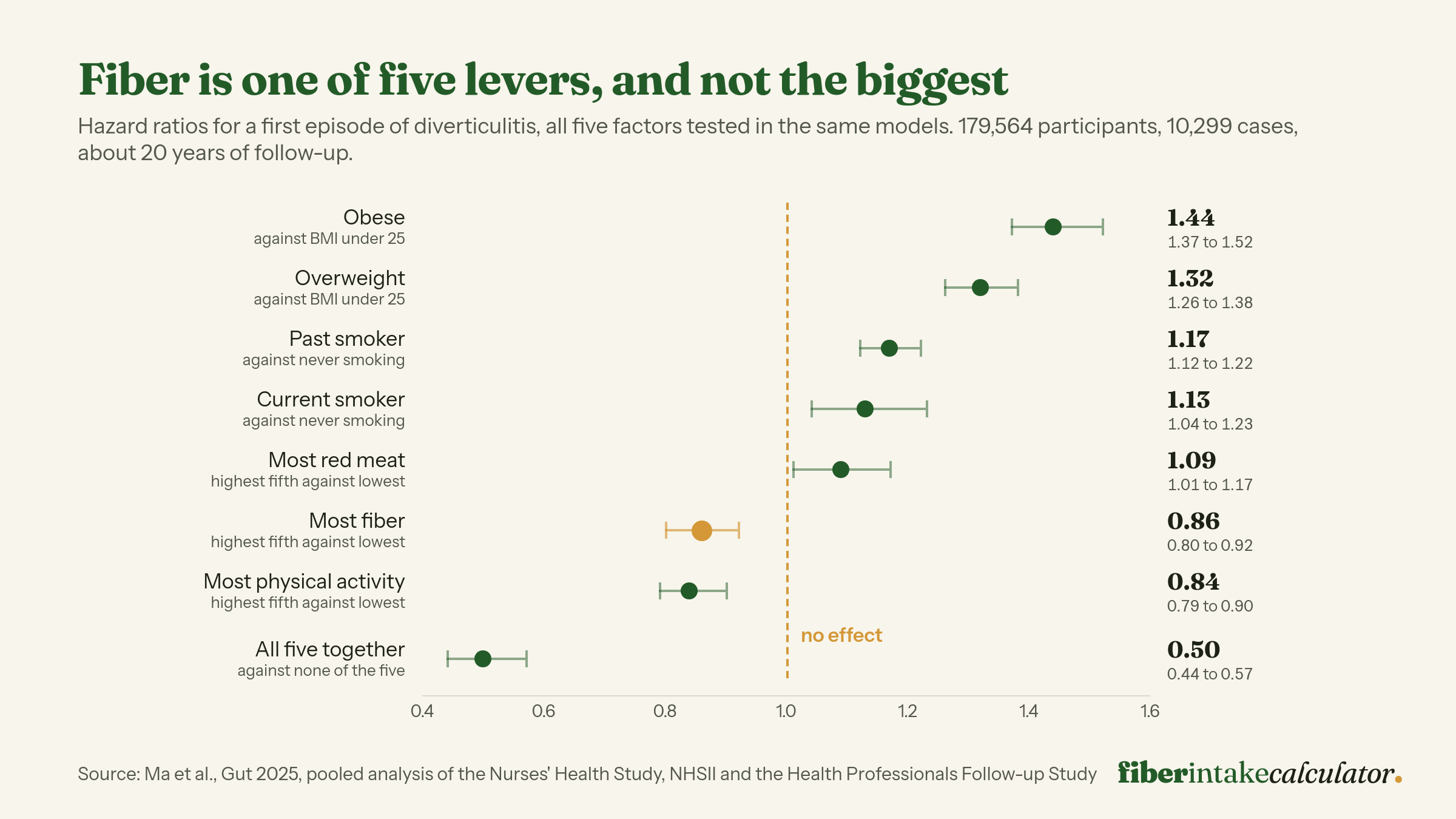
The 2025 pooled analysis tested fiber next to four other modifiable factors in the same models, which is the only way to see how much of the risk fiber is actually carrying.
| Factor | Hazard ratio | 95% confidence interval |
|---|---|---|
| Obese, against BMI under 25 | 1.44 | 1.37 to 1.52 |
| Overweight, against BMI under 25 | 1.32 | 1.26 to 1.38 |
| Past smoker, against never | 1.17 | 1.12 to 1.22 |
| Current smoker, against never | 1.13 | 1.04 to 1.23 |
| Red meat, highest fifth against lowest | 1.09 | 1.01 to 1.17 |
| Fiber, highest fifth against lowest | 0.86 | 0.80 to 0.92 |
| Physical activity, highest fifth against lowest | 0.84 | 0.79 to 0.90 |
| All five low-risk factors, against none | 0.50 | 0.44 to 0.57 |
Fiber is one lever of five, and not the largest one. Body weight is. Each additional low-risk factor cut the risk by about 12 percent (HR 0.88 per point, 95% CI 0.86 to 0.89), and all five together halved it. If weight is the factor in play for you, our page on fiber and weight loss covers where fiber helps there and where it does not.
The same analysis measured genetic risk, and this is the number no consumer page on this subject prints. A polygenic risk score carried a hazard ratio of 1.58 per standard deviation (95% CI 1.52 to 1.65), rising to 1.81 in participants under 60. The practice update puts it plainly: approximately 50 percent of the risk for diverticulitis is attributable to genetic factors, with twin and sibling studies at 40 to 50 percent, sibling risk three times the general population, and more than 30 susceptibility loci identified.
Half the risk is inherited, and the diet still works anyway. Comparing four or five low-risk factors against none, the hazard ratio was 0.63 in the lowest third of genetic risk, 0.48 in the middle and 0.50 in the highest, with no interaction between the two. Across genetic risk categories, a healthy lifestyle was estimated to prevent 23 to 42 percent of cases. Genetics set the starting point, not the slope.
Two more lines from the practice update belong here because they are about what not to bother with. A fiber supplement is not a replacement for a high-quality diet, which is worth reading alongside our fiber supplement comparison and its label arithmetic. And patients with a history of diverticulitis should not be treated with 5-aminosalicylic acid, probiotics or rifaximin to prevent recurrence, on a meta-analysis of seven trials for the first and insufficient evidence for the other two.
When this stops being a diet question
Fiber belongs to the quiet months. Three situations are not fiber questions at all, and the current guidance is specific about them.
An active flare needs a diagnosis, not a plan. Diverticulitis is diagnosed on imaging, and the practice update notes that computed tomography is often necessary. It also notes that colon cancer is occasionally misdiagnosed as diverticulitis. New abdominal pain with fever is not something to manage from a food list.
The first episode is the dangerous one. Complications occur more often with a first presentation than with later ones. In one population study of 386 patients with complicated diverticulitis, 286 of them, 74 percent, had no prior history of diverticulitis at all. About 8 percent of people with a first episode have a recurrence within a year and 20 percent within ten years.
Bleeding is a separate problem with a separate answer. Diverticular bleeding and diverticulitis have different risk factors, and none of the three foods tested in the 2008 study was associated with bleeding in either direction. Rectal bleeding needs examining rather than dieting, which is also the position of our page on fiber and hemorrhoids.
See a clinician before changing anything if this is active. Abdominal pain with fever, bleeding, or an inability to keep food down are all reasons to be examined rather than to adjust a diet. The advice on this page is about lowering the long-run chance of an episode, in someone who is currently well.
For what it is worth, the recurrence-prevention advice in the practice update is a short list and fiber is one line on it: consume a high-quality diet, achieve or maintain a normal body mass index, be routinely physically active, do not smoke, and avoid regular use of non-steroidal anti-inflammatory drugs twice a week or more, except aspirin prescribed for cardiovascular protection.
So the honest summary of a high-fiber diet for diverticulitis is this. It does not prevent the pouches and has never been shown to, and one colonoscopy study found high intake associated with having more of them. It does track with roughly 14 percent fewer episodes of inflammation at the top of intake, worth about 11 cases per 100,000 person-years, with fruit fiber carrying the strongest signal and vegetable fiber none. During a flare it is set aside for comfort rather than for healing. And about half the risk was set before any of this, which is a reason to take the modifiable half seriously rather than a reason to give up on it. How we handle figures that disagree across sources is set out on our methodology page, and every study above is listed on our sources page. The two-endpoint split here is the clearest case of a wider pattern, which our overview of fiber across specific conditions lays out with the effect size and tested dose for each one.
Frequently asked questions
What is the best fiber for diverticulitis?
Fruit fiber, on the only cohort that ranked the sources. In 50,019 women followed for 24 years, the highest fifth of fruit fiber intake carried a hazard ratio of 0.83 for diverticulitis (95% CI 0.75 to 0.92, P for trend below 0.001). Cereal fiber came next at 0.90 (0.81 to 0.99), and vegetable fiber showed nothing measurable at 0.92 (0.83 to 1.01, P for trend 0.31). Insoluble fiber outperformed soluble, 0.86 against 0.95. Apples or pears and prunes were the two individual fruits with significant results, at 0.85 and 0.83 per daily serving (Ma et al., 2019). The AGA practice update adds one line worth keeping: a fiber supplement is not a replacement for a high-quality diet.
Can too much fiber cause a diverticulitis flare?
No cohort has found high fiber intake raising the risk of diverticulitis, and three large ones found it lowering that risk. The worry is not baseless, though, because it attaches to a different endpoint. In 2,104 colonoscopy patients, the quartile eating the most fiber had a higher prevalence of diverticula, not a lower one (prevalence ratio 1.30, 95% CI 1.13 to 1.50), and the association got stronger in people with three or more pouches (Peery et al., 2012). Having pouches and having one become inflamed are two different outcomes, and fiber tracks with them in opposite directions.
How much fiber should I eat with diverticulitis?
The intake where the measured benefit appeared was 25 grams a day. Compared with women eating under 18 grams a day, those eating 25 grams or more had a 13 percent lower risk of incident diverticulitis (hazard ratio 0.87, 95% CI 0.79 to 0.96). The protected top quintile had a median intake of 27 grams a day. As a general basis the Dietary Guidelines for Americans use 14 grams of fiber per 1,000 calories, which is 28 grams on a 2,000 calorie diet. Every source on this subject also says to add fiber over weeks rather than days.
What calms a flare-up of diverticulitis?
An acute flare is a medical problem rather than a diet problem, and the diet part of it is smaller than most pages suggest. The AGA clinical practice update advises a clear liquid diet during the acute phase of uncomplicated diverticulitis, and states the goal is patient comfort. It also notes that a small study suggests a liquid diet is not necessary, and that patients who want to advance their diet more quickly can. The rule to hold onto is the follow-up one: if you cannot advance your diet after three to five days, contact your clinician immediately.
Can you ever get rid of diverticulosis?
No. Diverticula are permanent structural pouches in the colon wall, and nothing in the diet literature reverses them. Prevalence reaches about 60 percent by age 70. This is the reason the fiber question needs splitting: fiber has not been shown to prevent or remove the pouches, and in one colonoscopy study high intake was associated with having more of them. What the cohort evidence supports is a lower chance that existing pouches become inflamed.
Built and maintained by the FiberIntake team, with data from USDA FoodData Central and peer-reviewed sources. Figures are checked against the cited source before publish. About this site →