The Low-Fiber Diet Before a Colonoscopy, Day by Day
Last updated: September 20, 2026
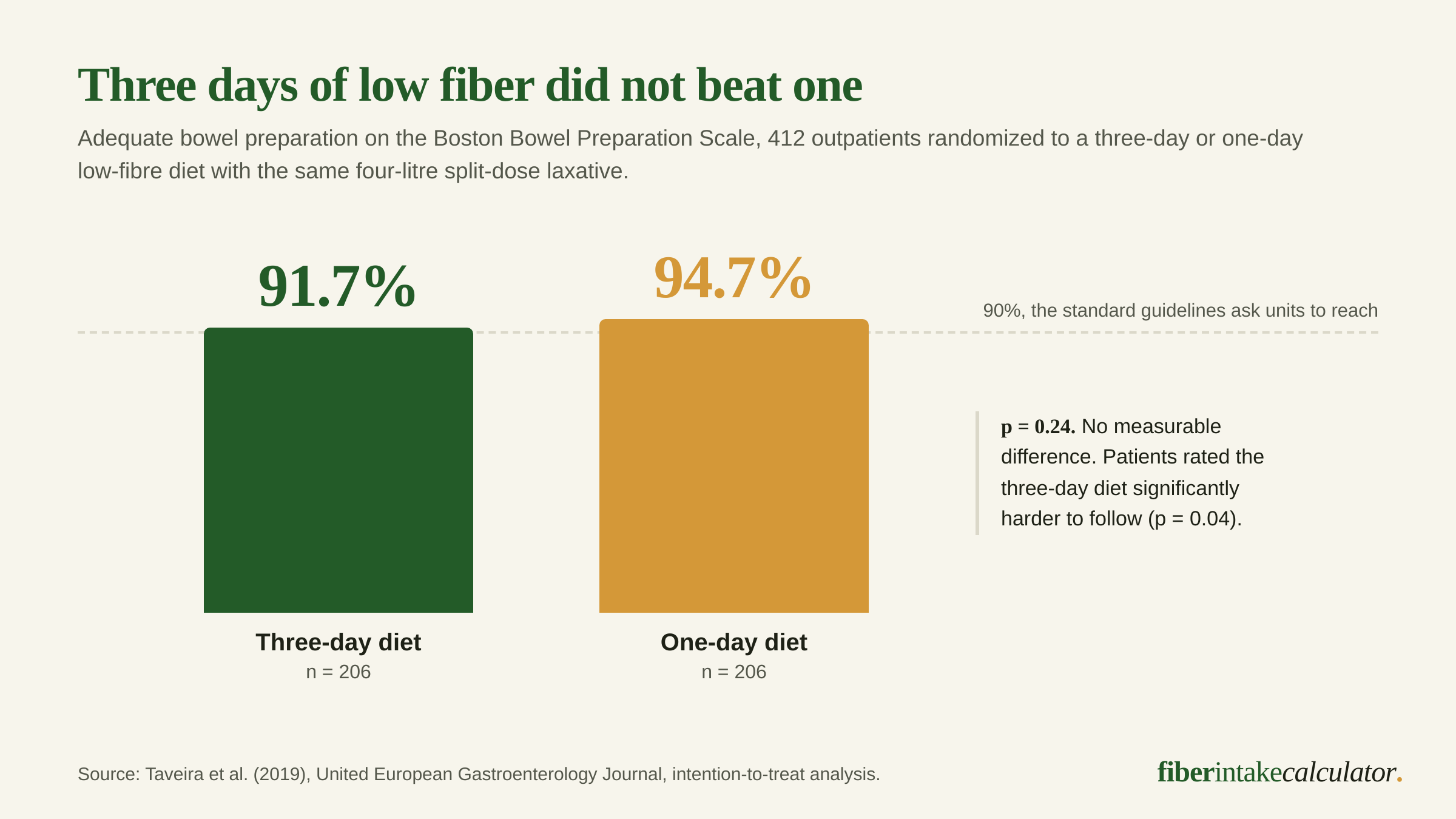
A low-fiber diet before a colonoscopy means under 10 grams of fiber a day, and the evidence says one day of it is enough. In a randomized trial of 412 outpatients, three days of the diet produced adequate bowel preparation in 91.7 percent of patients against 94.7 percent after a single day (p = 0.24), and patients rated the longer version significantly harder to follow.
Google’s AI Overview tells you to start 3 to 5 days out. So do most of the pages under it. None of them cites a trial, and none of them prints a gram figure.
This page gives you both. Below: what the two randomized trials actually found, a day-by-day plan that works whatever number your endoscopy unit gave you, a full prep day priced against USDA FoodData Central at 7.8 grams, and the ranked list of what genuinely predicts a failed preparation. Full references are on our sources page.
Read this first. Your endoscopy unit's instructions beat everything on this page. Prep protocols are matched to the specific laxative you were prescribed, and the unit knows which one that is. What follows is the evidence behind the instructions and the arithmetic nobody hands you with them.
How many days before a colonoscopy should you start?
There is no agreement, and the spread is wide enough to change your week. Here is what the pages ranking for this question currently tell people, against what the trials found.
| Source | Start the low-fiber diet | Evidence cited |
|---|---|---|
| Google's AI Overview | 3 to 5 days before | None |
| VA Cheyenne health care | 5 days before | None |
| Blue Cross Blue Shield of Michigan | 3 to 5 days before | None |
| Harvard Health Publishing | 3 days before | None |
| Gastro Group of Rochester | 3 days before | None |
| Guy's and St Thomas' NHS Foundation Trust | 3 days before | None |
| European Society of Gastrointestinal Endoscopy | 1 day before | Moderate quality of evidence |
| Taveira and colleagues, randomized trial, 412 patients | 1 day is enough | 3 days gave no measurable benefit |
The trial is worth reading properly because it was designed to prove the opposite. The team expected the longer diet to cut inadequate preparations from 15 percent to 5 percent, and powered the study to detect that. Every patient took the same four-litre polyethylene glycol laxative in split doses. The only thing that differed was whether the low-fibre diet ran for three days or one.
Nothing separated the two groups. Adequate preparation on the Boston Bowel Preparation Scale was 91.7 percent after three days and 94.7 percent after one (p = 0.24). In the per-protocol analysis of 400 patients it was 93.5 percent against 96.5 percent (p = 0.16). Mean overall scores were 7.56 and 7.83 out of 9. Adenoma detection was 39.8 percent against 34.9 percent, caecal intubation 95.1 percent against 98.1 percent, withdrawal time 8.4 minutes against 8.5.
One thing did separate them. Asked how hard the diet was to perform on a scale of 1 to 10, patients on three days gave a median of 3 and patients on one day gave a median of 2 (p = 0.04). The longer diet was harder and bought nothing.
That trial is not alone. Its authors report a second randomized trial reaching the same non-superiority result (82.7 percent against 85.6 percent), and an observational study of three days of prep meals in which only the day immediately before the colonoscopy showed a significant effect on preparation scores. The observational team’s own conclusion was that multi-day dietary instructions can confuse patients without adding value.
So why do units still say five days? Because transit is slower in some people, because a longer run-in gives a margin for slips, and because prep instructions get rewritten rarely. It is a reasonable belt-and-braces call rather than an evidence-based one. Follow the number you were given. Just know that if you slip on day five, the trial evidence says it is very unlikely to matter.
The day-by-day plan
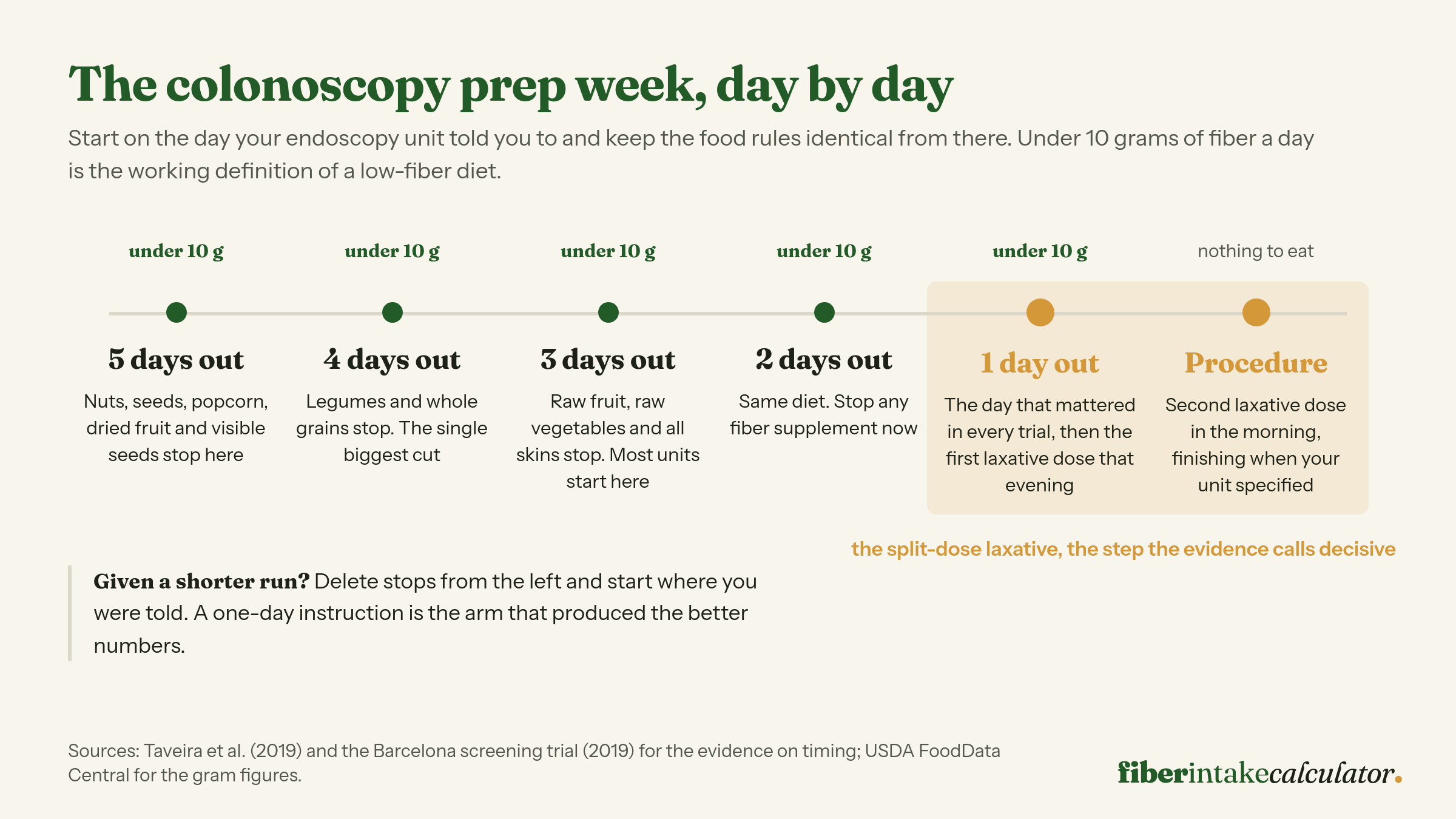
The plan below works whatever day count you were given. Find the day your unit told you to start, begin there, and keep the food rules identical from that point to the end.
| When | What changes | Fiber for the day |
|---|---|---|
| 5 days out | Stop nuts, seeds, popcorn, dried fruit and anything with visible seeds. These are the slowest-moving items and the easiest to forget you ate. | Under 10 g |
| 4 days out | Stop legumes and whole grains. Beans, lentils, brown rice, oats, whole-wheat bread and pasta. This is the single biggest cut on the list. | Under 10 g |
| 3 days out | Stop raw fruit and vegetables, and all skins. Cooked, canned and peeled versions stay in. Most units start here. | Under 10 g |
| 2 days out | Hold the same diet. Stop any fiber supplement now if you take one, and check your unit's instructions on iron tablets. | Under 10 g |
| 1 day out | The day that matters most in every trial. Low fiber all day, or clear liquids if your unit requires it, then the first laxative dose that evening. | Under 10 g |
| Procedure day | Second laxative dose in the morning, finishing the number of hours before your appointment that your unit specified. Nothing to eat. | None |
If your unit gave you a shorter run, delete rows from the top. A one-day instruction means you do everything in the “1 day out” row and eat normally until then, which is exactly what the trial arm with the better numbers did.
The two laxative doses are the part to get right. Everything in the next three sections is about the food, and the food is the easier half.
A prep day that comes to 7.8 grams
Every figure below is from USDA FoodData Central, read in September 2026, at USDA’s own household serving weights. This is a full five-meal day, not a hungry one.
| Meal | What is on it | Fiber | Running total |
|---|---|---|---|
| Breakfast | Two slices white toast with butter, one boiled egg, a cup of orange juice without pulp | 2.3 g | 2.3 g |
| Midmorning | A cup of plain yogurt | 0 g | 2.3 g |
| Lunch | A cup of chopped roasted chicken breast, a cup of white rice, half a cup of cooked carrots | 2.9 g | 5.2 g |
| Afternoon | Five saltines and a slice of cheddar | 0.4 g | 5.6 g |
| Dinner | A baked cod fillet, a cup of plain cooked pasta, a glass of milk | 2.2 g | 7.8 g |
Note where the grams come from. Four of the five meals are built around meat, fish, eggs and dairy, which carry no fiber at all. The entire 7.8 grams comes from six plant items: the toast, the juice, the rice, the carrots, the crackers and the pasta.
Now the trap. Put a cup of plain canned tomato sauce on that pasta and the day goes to 11.5 grams, over the ceiling, from one ingredient nobody thinks of as fiber. Tomato sauce is 3.7 grams a cup per USDA records and it sits on the allowed side of almost every prep handout.
The rule that actually works. Animal foods are free. Meat, poultry, fish, eggs, milk, yogurt and cheese contain no fiber, so they never count against the day. Every gram you eat comes from a plant, and the ones that catch people out are sauces, juices with pulp, and the second helping of an allowed vegetable.
The gram figure for every allowed food, with its serving weight so you can halve a portion, is in the sortable table on our low-fiber diet page. Breakfast cereal is the one aisle worth checking by hand, because crisp rice is 0.2 grams a serving and bran flakes are 5.5 grams: our cereal ranking shows the spread, read from the bottom for this purpose.
What to stop eating first, and what it saves you
The order in the day-by-day plan is not arbitrary. It drops the densest foods first, so the biggest cut happens on the first day you change anything.
| Food | Serving | Fiber removed |
|---|---|---|
| Lentils, cooked | 1 cup | 15.6 g |
| Raspberries | 1 cup | 8.0 g |
| Broccoli, cooked | 1 cup chopped | 5.1 g |
| Whole-wheat pasta, cooked | 1 cup | 4.6 g |
| Apple with the skin on | 1 medium | 4.4 g |
| Oatmeal, cooked | 1 cup | 4.0 g |
| Sweet corn, cooked | 1 cup kernels | 3.6 g |
| Almonds | 1 oz, 23 kernels | 3.5 g |
| Popcorn, air-popped | 3 cups | 3.5 g |
| Brown rice, cooked | 1 cup | 3.2 g |
| Whole-wheat bread | 1 slice | 1.9 g |
One cup of lentils is a day and a half of a 10 gram ceiling in a single side dish, which is why legumes come off the plate before anything else. The full range across the category is on our beans and legumes ranking, and the grain swaps are on the whole grains ranking.
Skins, seeds, bran and stalks go first for a physical reason. They are where insoluble fiber concentrates, and insoluble fiber is the fraction that does not dissolve and adds bulk. That is exactly the material a preparation is trying to clear.
What actually predicts a failed prep
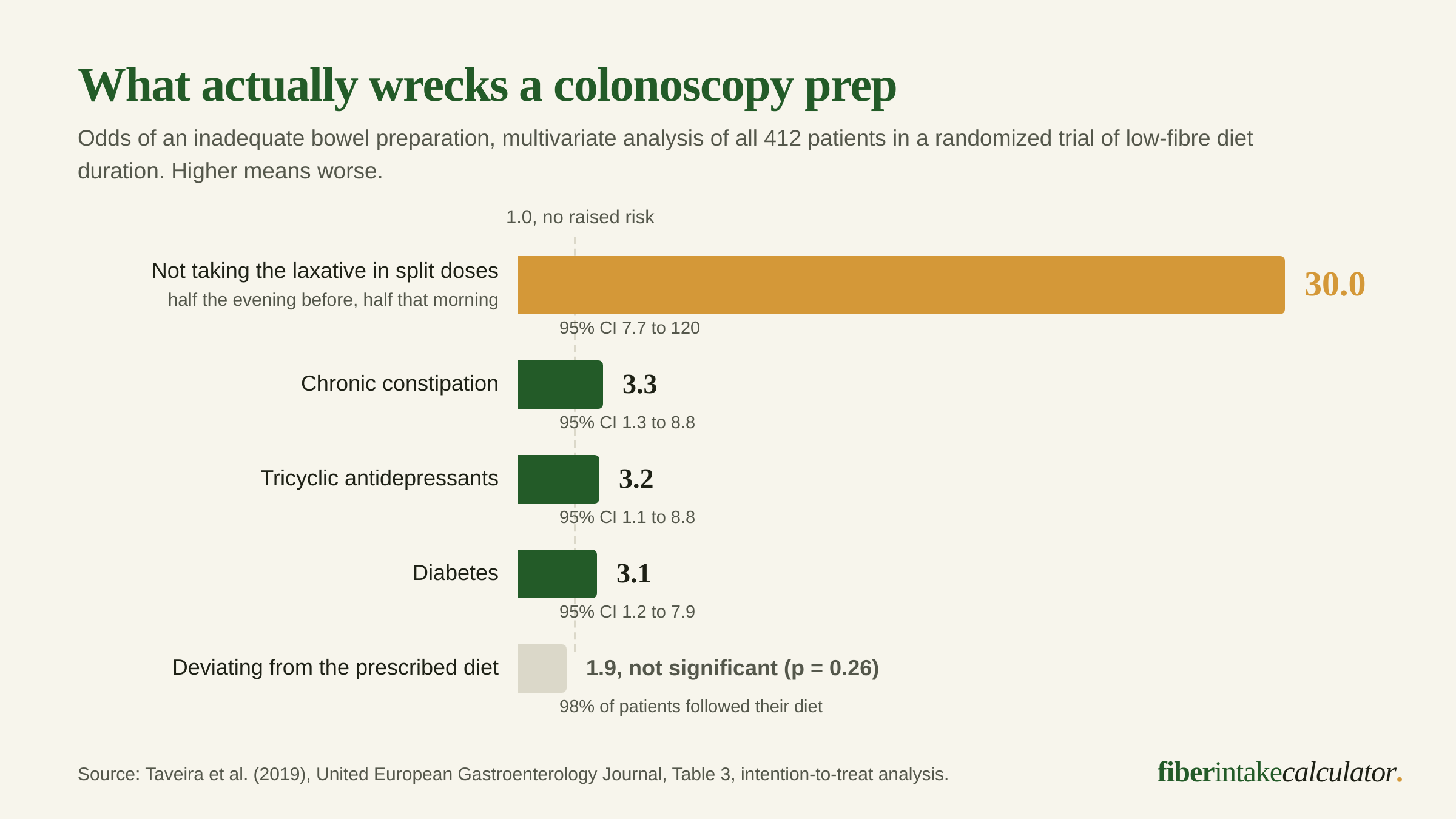
The same trial ran a multivariate analysis across all 412 patients to find what separated the adequate preparations from the inadequate ones. The answer is not the menu.
| Factor | Odds of an inadequate prep | 95% confidence interval |
|---|---|---|
| Not taking the laxative in split doses | 30.0 | 7.7 to 120 |
| Chronic constipation | 3.3 | 1.3 to 8.8 |
| Tricyclic antidepressants | 3.2 | 1.1 to 8.8 |
| Diabetes | 3.1 | 1.2 to 7.9 |
| Deviating from the prescribed diet | Not significant | p = 0.26 |
Missing the split dose was an order of magnitude more dangerous than everything else measured. Split dosing means half the laxative on the evening before and half on the morning of the procedure, finishing the number of hours ahead that your unit specified. Taking it all the night before is the single most reliable way to end up rescheduled.
Read the last row with its limit in plain view. Adherence to the prescribed diet was 98.5 percent and 98.1 percent in the two arms, so what that analysis tested was small deviations inside a trial where almost everyone ate a low-fiber day. It is not evidence that skipping the diet is fine. It is evidence that the anxiety most people carry about a stray slice of wholemeal toast is aimed at the wrong part of the protocol.
If chronic constipation is on your list, mention it when you book. It tripled the odds here, and it is the one risk factor on the table that can be addressed in advance. Our page on fiber for constipation covers what the trials show, and the conversation to have is with the unit rather than with your diet in prep week.
Is the clear-liquid day better than a low-fiber day?
Most prep instructions end the solid food a day before the procedure and switch you to broth, clear juice and jelly. It is treated as the stricter, safer finish. One trial tested that directly.
Researchers in a Barcelona screening programme randomized 276 participants to either a clear-liquid day or a full low-fiber day before the colonoscopy, with the same four-litre split-dose laxative in both arms. The low-fiber diet was built to provide up to 2,000 calories across five meals while keeping mean fiber under 10 grams, rather than the 1,000 to 1,200 calorie diets used in earlier studies.
| Outcome, day before the colonoscopy | Clear liquids | Low-fiber diet |
|---|---|---|
| Adequate bowel preparation | 89.1% | 95.7% |
| Hunger score | Higher | Lower (p = 0.006) |
| Fluid-intake perception | Higher | Lower (p = 0.04) |
| Finished at least 3 litres of laxative | Fewer patients | More patients (p = 0.04) |
The low-fiber arm was not merely non-inferior. It was statistically superior on the primary outcome (p = 0.04). The likely mechanism sits in the last row: people who were not starving drank more of the laxative, and drinking the laxative is the thing that works.
Two limits before you act on this. It was a single centre, and the participants were healthy screening attendees rather than symptomatic patients. And your unit’s protocol is built around the specific laxative it prescribes, so the instruction sheet still wins. This is a reason to ask, not a reason to improvise.
Coming back up afterwards
You can eat after the procedure. Climbing back to a normal intake over several days rather than in one meal is the part worth planning, because a gut that has had almost no fiber for a week responds to a sudden bowl of lentils with gas and cramping.
Raise fluids alongside the fiber. Your own daily target is the number to climb toward, and the fiber calculator gives it from your age, sex and calories. The high-fiber food chart is the same USDA data as the tables above, read from the other end.
If you are on a low-fiber diet for a reason other than this procedure, the gram definitions and the full allowed-food table are on our low-fiber diet page, and fiber and diverticulitis covers the other common occasion for eating this way. How every figure here was sourced is on our methodology page.
Frequently asked questions
How many days before a colonoscopy should I start a low-fiber diet?
Follow the number your endoscopy unit gave you, which is usually somewhere between one and five days. If nobody gave you one, the evidence supports the day before. A randomized trial of 412 outpatients compared a three-day low-fibre diet with a one-day diet, with the same four-litre split-dose laxative in both arms, and found adequate bowel preparation in 91.7 percent on three days against 94.7 percent on one day (p = 0.24). Patients rated the three-day diet significantly harder to follow (p = 0.04). The guideline position the trial cites is one day at moderate evidence, with no substantial data for extending it.
What should I avoid 3 days before a colonoscopy?
Nuts, seeds, legumes, whole grains, raw fruit and vegetables, skins, popcorn and dried fruit. These are the highest-fiber things most people eat, so dropping them removes most of your daily total in one move. Per USDA records a cup of cooked lentils carries 15.6 grams, a cup of raspberries 8.0 grams, a cup of cooked broccoli 5.1 grams and three cups of air-popped popcorn 3.5 grams. Everything from an animal carries none at all.
What happens if I don't follow a low-fiber diet before a colonoscopy?
The clearest answer available comes with a caveat, so read both parts. In the 412-patient trial, the factors that predicted an inadequate preparation were not taking the laxative in split doses (odds ratio 30, 95 percent CI 7.7 to 120), chronic constipation (3.3), tricyclic antidepressants (3.2) and diabetes (3.1). Deviating from the prescribed diet did not reach statistical significance (odds ratio 1.9, 95 percent CI 0.6 to 5.8, p = 0.26). The caveat is that 98 percent of patients in that trial followed their diet, so this compares small deviations, not skipping the diet. Follow the diet, and treat the laxative timing as the part you cannot get wrong.
Can I eat a hamburger 2 days before my colonoscopy?
The beef and cheese carry no fiber at all. The bun and the toppings are the whole question. A plain white bun is close to two slices of white bread, which USDA records put at about 1.6 grams. Skip the lettuce, tomato, onion and pickle, which are raw vegetables with skins and seeds, and skip fries with the skin on. A whole-wheat bun roughly doubles the bread figure. Check your unit's instructions, because some ask for no solid food at all on the final day.
Can I eat pizza on a low-fiber diet for colonoscopy?
A plain cheese pizza on a white-flour base is close to the allowed list, since the cheese carries no fiber and refined flour carries little. What takes it over is the toppings and the sauce. A cup of plain canned tomato sauce alone is 3.7 grams per USDA records, which is more than a third of a 10 gram day, and vegetable toppings, mushrooms and crushed red pepper all add more. If you want pizza during the low-fiber days, keep it plain and keep it early in the run.
Do I have to drink only clear liquids the day before?
Only if your unit says so, and the evidence does not favour it. A randomized trial of 276 screening participants compared a clear-liquid day with a normocaloric low-fiber day, with the same four-litre split-dose laxative in both arms. Adequate bowel preparation was 89.1 percent on clear liquids against 95.7 percent on the low-fiber diet (p = 0.04), so the low-fiber day was not only as good but better. Patients on it reported less hunger (p = 0.006), and more of them finished at least three litres of the laxative (p = 0.04). Your unit's protocol still wins, because it is matched to the laxative it prescribes.
When can I eat normally again after a colonoscopy?
You can eat after the procedure, and the sensible approach is to climb back rather than jump. Going straight from a week of white rice to a bowl of lentils invites gas and cramping, because your gut has had almost no fiber to work on. Add it back over several days and raise fluids alongside it. Your own daily target is the number to climb toward, not a generic one.
Built and maintained by the FiberIntake team, with data from USDA FoodData Central and peer-reviewed sources. Figures are checked against the cited source before publish. About this site →