A Low-Fiber Diet, Counted in Grams
Last updated: September 20, 2026
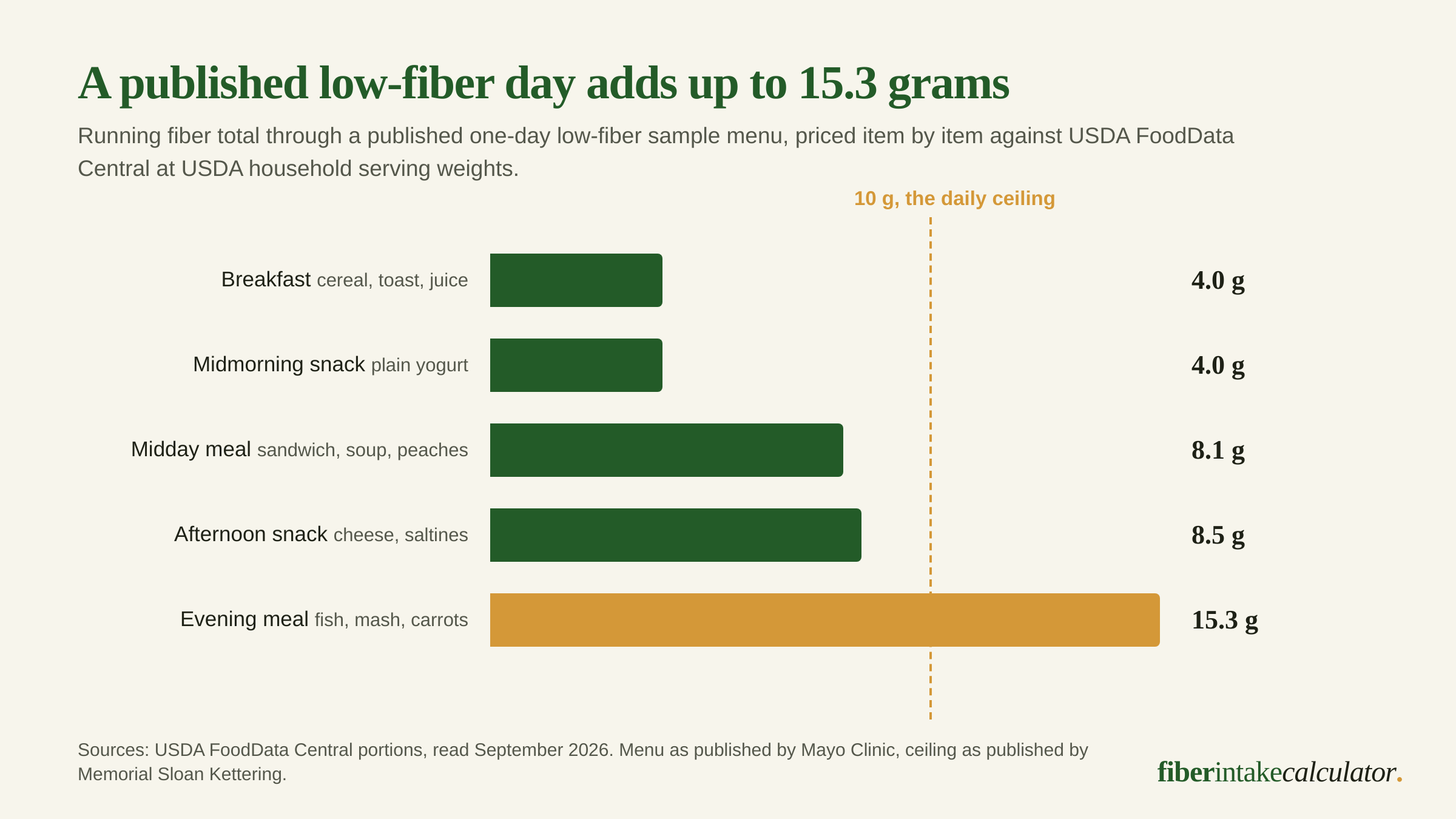
A low-fiber diet means under 10 grams of fiber a day, which is roughly a third of what a typical adult target works out to. That number comes from Memorial Sloan Kettering’s patient instructions and from a 2015 review that proposed it as the formal definition.
Almost no page that prescribes this diet prints the number. So we took the one-day sample menu Mayo Clinic publishes with its low-fiber guidance and priced every item against USDA FoodData Central at USDA’s own serving weights. It came to 15.3 grams.
That is not a trick. It is what happens when a food list is qualitative and the portions are normal. This page gives you the gram figures the lists leave out: what the ceiling actually is, which allowed foods cost the most, and five swaps that take that same menu down to 8.1 grams. Every food figure is USDA FoodData Central, read in September 2026, with record numbers on our sources page.
How many grams is a low-fiber diet?
There is no single answer in circulation, and the disagreement is easy to miss because each page states its own figure confidently.
| Source | Daily limit | Per meal | Per serving |
|---|---|---|---|
| Memorial Sloan Kettering patient instructions | Under 10 g | Under 3 g | Under 2 g |
| Advances in Nutrition review, 2015 | 10 g maximum | Not stated | Not stated |
| Academy of Nutrition and Dietetics, fiber-restricted therapy | 13 g | Not stated | Not stated |
| MedlinePlus | 10 to 15 g | Not stated | Under 2 g |
| Mayo Clinic | Not stated | Not stated | 1 to 2 g |
| National Cancer Institute | Not stated | Not stated | Not stated |
The review’s reasoning is worth knowing, because it explains why the number is so unevenly reported. Its authors went looking for a quantitative definition and found that only two clinical studies had ever set one, both at under 10 grams a day. Everything else defined the diet by listing foods. They proposed 10 grams as the working definition and that is the figure with the most support behind it.
The one thing to carry away. If nobody gave you a number, use 10 grams a day and 2 grams a serving. If somebody did give you a number, theirs wins. The gap between the published ceilings is about one and a half cups of mashed potato, so it is worth one question at your appointment.
We priced a published low-fiber day and it came to 15.3 grams
The sample menu below is Mayo Clinic’s, reproduced as published. Every item on it is on Mayo’s own allowed list. We looked up each one in USDA FoodData Central and multiplied its fiber content by USDA’s household serving weight.
| Eating occasion | What is on it | Fiber | Against a 3 g meal rule |
|---|---|---|---|
| Breakfast | Corn flakes with milk, white toast with creamy peanut butter and jelly, orange juice, coffee | 4.0 g | Over |
| Midmorning snack | Plain yogurt, water | 0 g | Fine |
| Midday meal | Turkey sandwich on white bread with mayonnaise, tomato soup, canned peaches, milk | 4.1 g | Over |
| Afternoon snack | Cheese slices, five saltines, water | 0.4 g | Fine |
| Evening meal | Baked fish, mashed potatoes with butter, cooked carrots, applesauce, milk | 6.8 g | Over |
| Day total | Every item from an approved list | 15.3 g | Over a 10 g ceiling by half |
Three of the five eating occasions break the 3 gram per meal rule that Memorial Sloan Kettering publishes. The two snacks are the only ones that pass, and they pass because they are made of dairy and refined flour, which carry almost nothing.
The evening meal alone is 6.8 grams, most of it from three foods that every low-fiber list allows: a cup of mashed potato at 3.1 grams, half a cup of cooked carrots at 2.3 grams, and half a cup of applesauce at 1.3 grams.
The allowed foods, ranked by fiber per serving
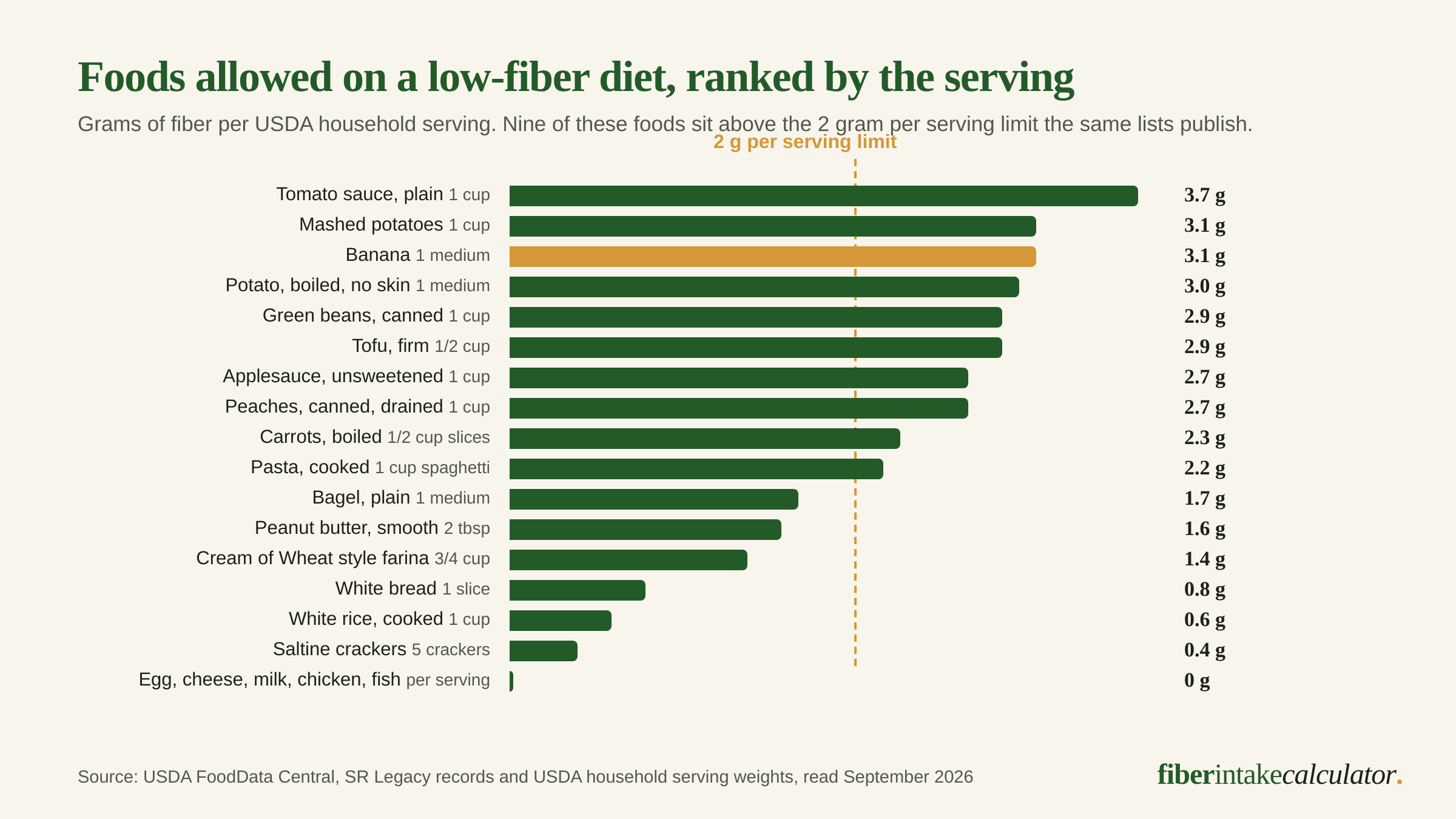
Nine foods that appear on standard low-fiber food lists carry more than 2 grams a serving, which is the per-serving limit those same lists publish. Four of them are named explicitly in the food-list summaries most people read first: bananas, applesauce, cooked carrots and potatoes.
This is not an argument that the lists are wrong. It is an argument that a list without numbers cannot be followed to a gram target. A cup of plain tomato sauce carries 3.7 grams, which is more than a third of a 10 gram day, and it appears on the allowed side of every table we read.
The rule that actually works. Animal foods are free. Meat, fish, poultry, eggs, milk, yogurt and cheese contain no fiber at all, so they never count against your total. Every gram you eat comes from a plant, and the ones that cost the most are the vegetables and fruit you were told you could keep.
The full sortable table sits at the bottom of this page with the serving weight beside each food, so you can halve a portion and halve the figure.
Five swaps that take the same day to 8 grams
Nothing here leaves the allowed list. These are substitutions within it, chosen for grams saved per unit of disruption.
| Swap this | For this | Saves |
|---|---|---|
| Mashed potatoes, 1 cup (3.1 g) | White rice, 1 cup (0.6 g) | 2.6 g |
| Creamy peanut butter, 2 tbsp (1.6 g) | Butter or cream cheese (0 g) | 1.6 g |
| Applesauce, 1/2 cup (1.3 g) | Gelatin or sorbet (0 g) | 1.3 g |
| Cooked carrots, 1/2 cup (2.3 g) | Cooked carrots, 1/4 cup (1.2 g) | 1.2 g |
| Corn flakes, 1 cup (0.8 g) | Crisp rice cereal, 1 1/4 cup (0.2 g) | 0.5 g |
| Same day, five changes | 15.3 g to 8.1 g | |
Two of these are portion changes rather than food changes, which is the point. The published lists are mostly correct about which foods to pick. What they leave out is that a cup of an allowed food and a quarter cup of the same food are different diets.
Cereal is where this bites hardest, because the fiber range inside a single supermarket aisle is enormous. Crisp rice is 0.2 grams a serving and bran flakes are 5.5 grams, and both are breakfast cereal. Our cereal ranking shows the whole spread, read from the bottom for this purpose.
What to avoid, and by how much
The avoid list is short and it is mostly the food this site otherwise recommends. The contrasts below are the same food in its two forms, from USDA records.
| What you are asked to avoid | Fiber | The allowed version | Fiber |
|---|---|---|---|
| Whole-wheat bread, 1 slice | 1.9 g | White bread, 1 slice | 0.8 g |
| Brown rice, 1 cup cooked | 3.2 g | White rice, 1 cup cooked | 0.6 g |
| Bran flakes, 3/4 cup | 5.5 g | Crisp rice cereal, 1 1/4 cup | 0.2 g |
| Apple with skin, 1 medium | 4.4 g | Apple without skin, 1 medium | 2.1 g |
Legumes are the category to be strictest about, because they are far denser than anything else on the plate. A cup of cooked lentils carries 15.6 grams, which is a day and a half of a low-fiber diet in one side dish. The full range is on our beans and legumes ranking, and the whole grains ranking covers the grain side.
The reason skins, seeds, bran and stalks go first is that they are where insoluble fiber concentrates. Insoluble fiber is the type that adds bulk and does not dissolve, which is exactly the property the diet is trying to remove.
Why “low residue” is no longer the right term
You will see this diet called a low-residue diet, often on the same page that calls it low fiber. The two are treated as synonyms in practice, and one of them has been retired.
The Academy of Nutrition and Dietetics removed the low-residue diet from its Nutrition Care Manual after 2011. The reason was that residue has no scientifically acceptable definition and there is no method for estimating how much of it a given food produces. Food is not the only thing that ends up as residue, and no criteria existed for separating low from medium from high.
The 2015 review that documented this recommends replacing the term: a low-residue diet should be called a low-fiber diet, defined as a maximum of 10 grams of fiber a day. If your handout says low residue, read it as low fiber and apply the gram figure.
How long you stay on it
Short, in every indication where anyone has measured.
For colonoscopy preparation, the European Society of Gastrointestinal Endoscopy recommends a low-fiber diet on the day preceding the procedure, at moderate quality of evidence. Two randomized trials have since tested whether longer helps, and neither found that it does: in 412 outpatients, three days of the diet gave adequate bowel preparation in 91.7 percent against 94.7 percent after one day, and patients rated the longer version harder to follow. Many endoscopy units still prescribe three to five days. Our page on the low-fiber diet before a colonoscopy sets out the day-by-day plan and what the trials found about what actually ruins a preparation.
The evidence for the restriction itself is consistent. Across nine trials, low-fiber and low-residue arms matched or beat clear-liquid arms on the quality of the cleansing, and patients tolerated them better and complied with them more. In one prospective study of 804 patients, how low-residue the two days of meals were correlated with the cleansing score (r = -0.475, P = 0.001).
For a flare of inflammatory bowel disease or diverticulitis the diet runs days, not weeks, and fiber is increased systematically once the acute phase resolves. The review’s figure for returning to normal after diverticular symptoms settle is 20 to 30 grams a day. Our page on fiber and diverticulitis covers what the current practice update says the restricted phase is actually for, which is not what most pages claim.
Coming off it. Add fiber back over two to three weeks rather than in one meal, and raise fluid at the same time. Your own target is the number to aim at, not a generic one. The fiber calculator gives it from your age, sex and calories, and the high-fiber food chart is the same USDA data as the table on this page, read from the other end.
Will it make you constipated?
This is the most common worry about the diet and the evidence points the other way than most people expect.
A study of 63 patients with idiopathic constipation asked all of them to stop eating fiber for two weeks, then let them settle at whatever intake they found tolerable. At six months, 41 were eating no fiber, 16 were on a reduced intake, and 6 had gone back to a high-fiber diet for personal or religious reasons.
| At six months | No fiber (n=41) | Reduced fiber (n=16) | High fiber (n=6) |
|---|---|---|---|
| Bowel movement interval, before | 3.75 days | 4.19 days | 6.83 days |
| Bowel movement interval, after | 1.0 day | 1.9 days | 6.83 days |
| Reporting bloating | 0% | 31.3% | 100% |
| Reporting straining | 0% | 43.8% | 100% |
All three differences reached statistical significance. Read it with its limits in plain view: 63 patients, no control group, and the groups at six months formed by patient choice rather than by randomisation. People who felt better off fiber are the people who stayed off it.
It is still the only trial anyone has run on the question, and it is a real counterweight to the assumption that less fiber always means more constipation. Our page on fiber for constipation covers the evidence pointing the other way, which is larger and applies to most people most of the time.
The same review reports a controlled trial of 204 patients with irritable bowel syndrome placed on 10 grams of fiber a day for four weeks, in which about 49 percent reported a substantial improvement in symptoms. Alternating bowel habit and diarrhoea responded best.
The full food table
Sorted by fiber per serving, highest first, with USDA’s serving weight beside each food so you can scale a portion. Sort by any column. Animal foods sit at zero and never count against your daily total.
| Food | Fiber per serving (g) | Serving | Group |
|---|---|---|---|
| Tomato sauce, canned, plain | 3.7 | 1 cup (245 g) | Vegetables |
| Mashed potatoes, milk and butter added | 3.1 | 1 cup (210 g) | Vegetables |
| Banana | 3.1 | 1 medium, 7 inch (118 g) | Fruit |
| Potato, boiled without skin | 3 | 1 medium (167 g) | Vegetables |
| Green beans, canned, drained | 2.9 | 1 cup (153 g) | Vegetables |
| Tofu, firm | 2.9 | 1/2 cup (126 g) | Protein |
| Applesauce, unsweetened | 2.7 | 1 cup (244 g) | Fruit |
| Peaches, canned in syrup, drained | 2.7 | 1 cup (222 g) | Fruit |
| Carrots, boiled, drained | 2.3 | 1/2 cup slices (78 g) | Vegetables |
| Pasta, cooked, enriched | 2.2 | 1 cup spaghetti (124 g) | Grains |
| Bagel, plain, enriched | 1.7 | 1 medium bagel (105 g) | Grains |
| Peanut butter, smooth | 1.6 | 2 tbsp (32 g) | Protein |
| Cantaloupe, cubed | 1.4 | 1 cup cubes (160 g) | Fruit |
| Cream of Wheat style farina, cooked | 1.4 | 3/4 cup cooked (179 g) | Grains |
| Corn flakes | 0.8 | 1 cup (28 g) | Grains |
| White bread | 0.8 | 1 slice (29 g) | Grains |
| Orange juice, chilled | 0.7 | 1 cup (249 g) | Drinks |
| Watermelon, diced | 0.6 | 1 cup diced (152 g) | Fruit |
| White rice, enriched, cooked | 0.6 | 1 cup (186 g) | Grains |
| Grape juice, unsweetened | 0.5 | 1 cup (253 g) | Drinks |
| Saltine crackers | 0.4 | 5 crackers (15 g) | Grains |
| Crisp rice cereal | 0.2 | 1 1/4 cup (33 g) | Grains |
| Egg, hard boiled | 0 | 1 large (50 g) | Protein |
| Chicken breast, roasted, no skin | 0 | 1 cup chopped (140 g) | Protein |
| Cod, cooked | 0 | 1 fillet (180 g) | Protein |
| Yogurt, plain, whole milk | 0 | 1 cup (245 g) | Dairy |
| Milk, whole | 0 | 1 cup (244 g) | Dairy |
| Cheddar cheese | 0 | 1 slice, 1 oz (28 g) | Dairy |
Fiber per serving is the USDA FoodData Central per-100-gram value multiplied by USDA own household serving weight, read September 2026. Serving weights are printed next to each serving so you can scale a portion up or down. See the methodology page for how figures are sourced and refreshed.
Frequently asked questions
How many grams of fiber is a low-fiber diet?
Under 10 grams a day is the figure with the clearest backing. Memorial Sloan Kettering's patient instructions set three limits at once: less than 10 grams a day, less than 3 grams a meal, and less than 2 grams a serving. A 2015 review in Advances in Nutrition proposed the same 10 gram daily maximum as the formal definition, after finding that the two clinical studies which had bothered to quantify the diet both used under 10 grams. MedlinePlus gives a looser 10 to 15 grams a day. Ask whoever prescribed the diet which figure they mean, because the difference between 10 and 15 grams is about one cup of mashed potato.
What can you eat on a low-fiber diet?
Anything from an animal carries no fiber at all: meat, poultry, fish, eggs, milk, yogurt and cheese are unrestricted unless your clinician says otherwise. On the plant side you eat the refined version and the peeled version: white bread, white rice, plain pasta, saltines, crisp rice cereal, canned or well-cooked vegetables without skins or seeds, canned fruit, and juice without pulp. White rice at 0.6 grams a cup and saltines at 0.4 grams for five are the lowest-fiber filling foods on the list, per USDA records.
What foods are low in fiber for a colonoscopy?
The same refined and peeled foods, with the timing being the part people get wrong. The European Society of Gastrointestinal Endoscopy recommends a low-fiber diet on the day before the procedure, and the two randomized trials that have since tested longer versions found no benefit: in 412 outpatients, three days of the diet gave adequate bowel preparation in 91.7 percent against 94.7 percent after a single day. Across nine earlier trials, low-fiber arms cleaned the colon as well as or better than clear-liquid arms and patients tolerated them better. Follow the instructions your endoscopy unit gave you, since prep protocols differ by the laxative used.
Can I eat a hamburger on a low-fiber diet?
The beef, cheese and sauce carry no fiber. The bun is the whole question. A plain white bun is close to two slices of white bread, which USDA puts at about 1.6 grams, so a burger on a white bun costs you roughly 1.6 grams. A whole-wheat bun roughly doubles that. Skip lettuce, tomato slices, onion and pickles, which are raw vegetables with skins and seeds, and skip a side of fries with the skin on.
How long do you stay on a low-fiber diet?
As briefly as the reason for it allows, and only for as long as your clinician says. For colonoscopy prep it is typically the single day before. For a flare of inflammatory bowel disease or diverticulitis it runs days rather than weeks, and fiber is added back systematically once the acute phase settles. The diet restricts most plant foods at once, so it is hard to meet nutritional needs on it for long, and anyone who needs to stay on it for an extended period should be seen by a registered dietitian.
Will a low-fiber diet make me constipated?
Not necessarily, and one study found the opposite. In 63 patients with idiopathic constipation who stopped eating fiber for two weeks, the 41 who were still off fiber at six months had gone from one bowel movement every 3.75 days to one every day. None of them reported bloating or straining, against 100 percent of the patients who kept eating a high-fiber diet. It was a small study with no control group and self-selected groups at six months, so it is a signal rather than a settled finding. Drink plenty of fluid either way, because low fiber plus low fluid is what actually backs people up.
Built and maintained by the FiberIntake team, with data from USDA FoodData Central and peer-reviewed sources. Figures are checked against the cited source before publish. About this site →