High-Fiber Cereal, Ranked From Label Data
Last updated: September 10, 2026
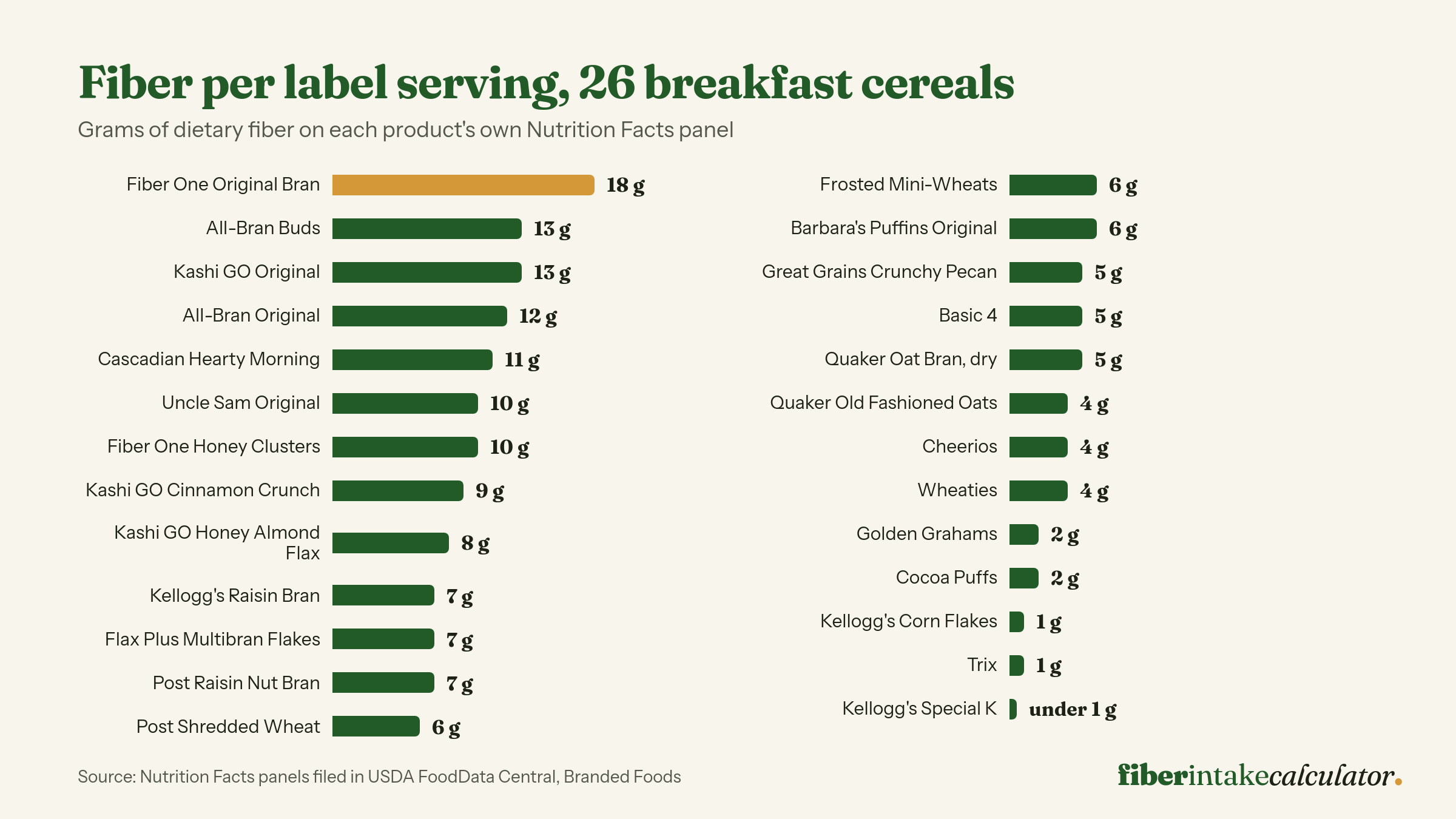
Fiber One Original Bran carries 18 grams of fiber in a 2/3 cup serving, the most of any national cereal here. Behind it, the label servings stop being comparable: the 26 boxes on this page measure anywhere from 30 grams to 65 grams of cereal per serving.
Every figure below is that product’s own Nutrition Facts panel, as the manufacturer filed it in USDA FoodData Central, read in September 2026. No cereal list in the search results above this page prints a serving weight in grams, and neither does the summary at the top.
Fiber One leads at 18 grams a serving
| Cereal | Label serving | Weight | Fiber | Calories | Total sugars | Fiber per 100 g |
|---|---|---|---|---|---|---|
| Fiber One Original Bran | 2/3 cup | 40 g | 18 g | 90 | 0 g | 45.0 g |
| Kellogg's All-Bran Buds | 1/3 cup | 30 g | 13 g | 80 | 8 g | 42.5 g |
| Kashi GO Original | 1 1/4 cups | 58 g | 13 g | 180 | 8 g | 22.1 g |
| Kellogg's All-Bran Original | 2/3 cup | 41 g | 12 g | 120 | 9 g | 29.9 g |
| Cascadian Farm Hearty Morning | 1 serving | 64 g | 11 g | 220 | 10 g | 17.2 g |
| Uncle Sam Original | 3/4 cup | 60 g | 10 g | 220 | 1 g | 16.7 g |
| Fiber One Honey Clusters | 1 cup | 54 g | 10 g | 170 | 9 g | 18.5 g |
| Kashi GO Cinnamon Crunch | 3/4 cup | 53 g | 9 g | 190 | 12 g | 16.3 g |
| Kashi GO Honey Almond Flax Crunch | 3/4 cup | 52 g | 8 g | 200 | 12 g | 15.6 g |
| Kellogg's Raisin Bran | 1 cup | 59 g | 7 g | 190 | 17 g | 12.3 g |
| Nature's Path Flax Plus Multibran Flakes | 1 cup | 40 g | 7 g | 150 | 5 g | 17.5 g |
| Post Raisin Nut Bran | 1 cup | 65 g | 7 g | 240 | 19 g | 10.8 g |
| Post Shredded Wheat Original | 1 cup | 49 g | 6 g | 170 | 0 g | 12.2 g |
| Kellogg's Frosted Mini-Wheats | 25 biscuits | 60 g | 6 g | 210 | 12 g | 9.7 g |
| Barbara's Puffins Original | 1 cup | 40 g | 6 g | 130 | 6 g | 15.0 g |
| Post Great Grains Crunchy Pecan | 3/4 cup | 55 g | 5 g | 210 | 8 g | 9.1 g |
| General Mills Basic 4 | 1 cup | 55 g | 5 g | 200 | 12 g | 9.1 g |
| Quaker Oat Bran, dry | 1/2 cup | 40 g | 5 g | 140 | 1 g | 12.5 g |
| Quaker Old Fashioned Oats, dry | 1/2 cup | 40 g | 4 g | 150 | 1 g | 10.0 g |
| Cheerios | 1 1/2 cups | 39 g | 4 g | 140 | 2 g | 10.3 g |
| Wheaties | 1 cup | 38 g | 4 g | 130 | 5 g | 10.5 g |
| Golden Grahams | 1 cup | 40 g | 2 g | 150 | 12 g | 5.0 g |
| Cocoa Puffs | 1 serving | 36 g | 2 g | 140 | 12 g | 5.6 g |
| Kellogg's Corn Flakes | 1 1/2 cups | 42 g | 1 g | 150 | 4 g | 3.3 g |
| Trix | 1 1/4 cups | 39 g | 1 g | 160 | 12 g | 2.6 g |
| Kellogg's Special K | 1 1/4 cups | 39 g | under 1 g | 150 | 5 g | 1.4 g |
Two things jump out of the weight column. Fiber One reaches 18 grams out of 40 grams of cereal, which means the box is 45% fiber by weight. And Kashi GO Original matches All-Bran Buds at 13 grams only because its serving is nearly twice as heavy.
Read the weight, not the cup. Two cereals with the same gram figure on the front are only comparable if the number in brackets after the household measure is the same. On this page it never is.
Every box measures a different amount of cereal
A cereal maker does not pick the serving size. It is set by weight, in a federal table.
Under 21 CFR 101.12, the reference amount for a ready-to-eat cereal depends on how much a cup of it weighs:
| What a cup of the cereal weighs | Reference amount |
|---|---|
| Under 20 g per cup, such as plain puffed grains | 15 g |
| 20 g or more but under 43 g per cup, and any cereal carrying 28 g or more of fiber per 100 g | 40 g |
| 43 g or more per cup, and biscuit types | 60 g |
| Hot cereals, plain dry | 40 g |
The label then expresses that weight as the closest common household measure. That is the whole explanation for the cup fractions on the shelf: a third of a cup on one box and a cup and a half on another are both attempts to land near the same weight of cereal.
It also decides what “high fiber” costs a manufacturer. The claim needs 5.6 grams per reference amount, 20% of the 28 gram Daily Value under 21 CFR 101.54. On a 40 gram reference that is a density of 14 grams of fiber per 100 grams; on a 60 gram reference it is 9.3 grams per 100 grams. The last column of the ranking above is the one to read against those two numbers.
So the useful question is what a cup actually holds. Dividing each label serving by its own household measure answers it:
| Cereal | Label serving | One level cup weighs | Fiber per level cup |
|---|---|---|---|
| Kellogg's All-Bran Buds | 1/3 cup, 30 g | 90 g | 38.3 g |
| Fiber One Original Bran | 2/3 cup, 40 g | 60 g | 27.0 g |
| Kellogg's All-Bran Original | 2/3 cup, 41 g | 62 g | 18.4 g |
| Uncle Sam Original | 3/4 cup, 60 g | 80 g | 13.4 g |
| Kashi GO Cinnamon Crunch | 3/4 cup, 53 g | 71 g | 11.5 g |
| Kashi GO Honey Almond Flax Crunch | 3/4 cup, 52 g | 69 g | 10.8 g |
| Kashi GO Original | 1 1/4 cups, 58 g | 46 g | 10.3 g |
| Quaker Oat Bran, dry | 1/2 cup, 40 g | 80 g | 10.0 g |
| Fiber One Honey Clusters | 1 cup, 54 g | 54 g | 10.0 g |
| Quaker Old Fashioned Oats, dry | 1/2 cup, 40 g | 80 g | 8.0 g |
| Kellogg's Raisin Bran | 1 cup, 59 g | 59 g | 7.3 g |
| Nature's Path Flax Plus Multibran Flakes | 1 cup, 40 g | 40 g | 7.0 g |
| Post Raisin Nut Bran | 1 cup, 65 g | 65 g | 7.0 g |
| Post Great Grains Crunchy Pecan | 3/4 cup, 55 g | 73 g | 6.7 g |
| Post Shredded Wheat Original | 1 cup, 49 g | 49 g | 6.0 g |
| Barbara's Puffins Original | 1 cup, 40 g | 40 g | 6.0 g |
| General Mills Basic 4 | 1 cup, 55 g | 55 g | 5.0 g |
| Wheaties | 1 cup, 38 g | 38 g | 4.0 g |
| Cheerios | 1 1/2 cups, 39 g | 26 g | 2.7 g |
| Golden Grahams | 1 cup, 40 g | 40 g | 2.0 g |
| Kellogg's Corn Flakes | 1 1/2 cups, 42 g | 28 g | 0.9 g |
| Trix | 1 1/4 cups, 39 g | 31 g | 0.8 g |
| Kellogg's Special K | 1 1/4 cups, 39 g | 31 g | 0.4 g |
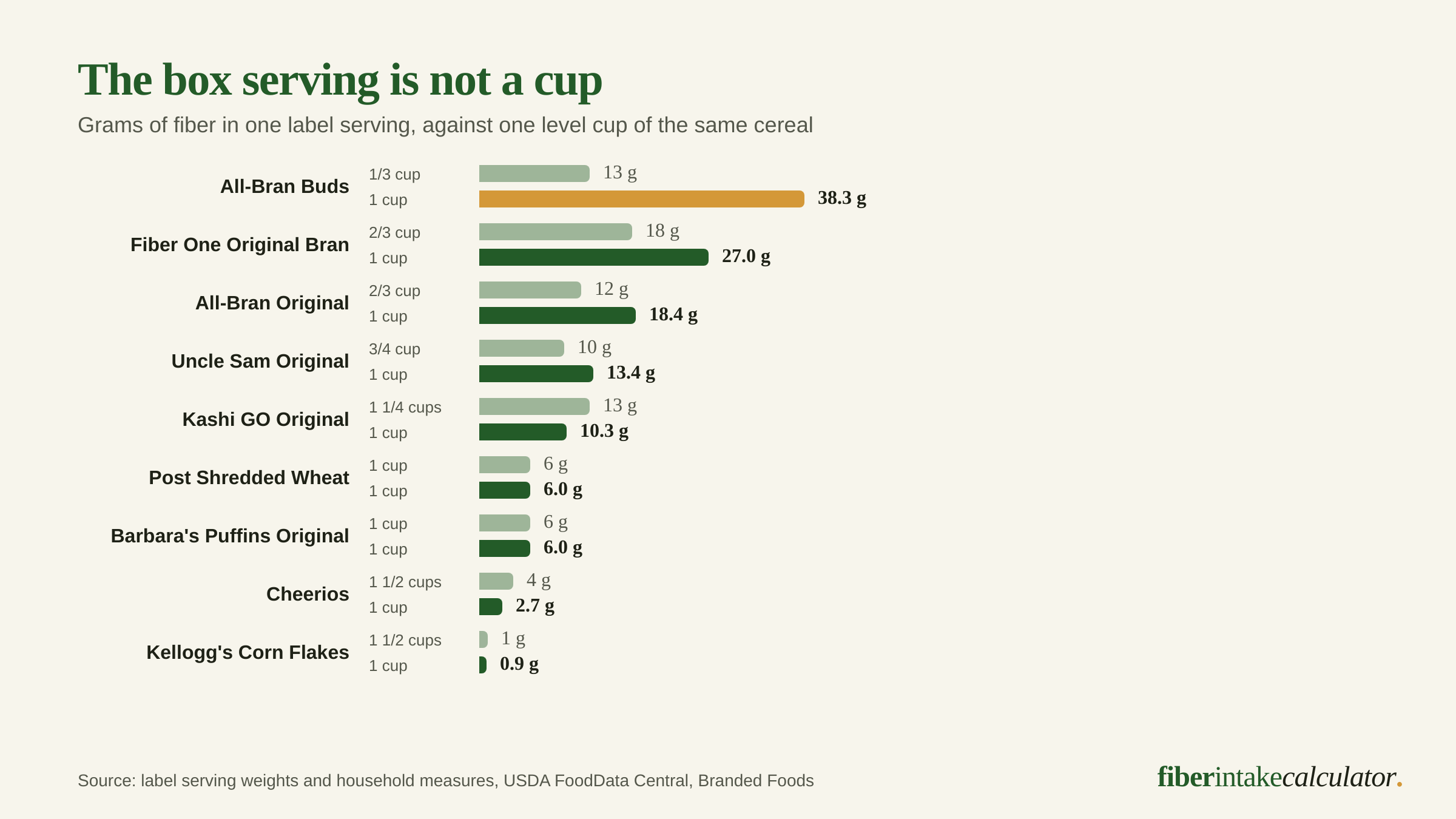
A level cup of All-Bran Buds weighs 90 grams. A level cup of Cheerios weighs 26 grams. That is the same measuring cup holding three and a half times as much food, and it is why the per-serving ranking above misleads.
Two reversals matter. All-Bran Buds and Kashi GO Original tie at 13 grams a serving, and by the cup Buds carries nearly four times as much fiber. Cheerios and Barbara’s Puffins look two grams apart on the box, and by the cup Puffins carries more than twice as much.
Cascadian Farm Hearty Morning, Frosted Mini-Wheats and Cocoa Puffs are absent from this table because their labels do not state a cup measure, so there is nothing honest to divide.
Rule of thumb. Bran cereals are dense and flakes are airy. If you pour by eye rather than by scale, a bran cereal delivers far more than the box suggests and a light flake delivers far less.
Per calorie the ranking changes again
Breakfast is a calorie budget, so the other honest normaliser is fiber per 100 calories.
| Cereal | Fiber | Calories | Fiber per 100 kcal |
|---|---|---|---|
| Fiber One Original Bran | 18 g | 90 | 20.0 g |
| Kellogg's All-Bran Buds | 13 g | 80 | 16.3 g |
| Kellogg's All-Bran Original | 12 g | 120 | 10.0 g |
| Kashi GO Original | 13 g | 180 | 7.2 g |
| Fiber One Honey Clusters | 10 g | 170 | 5.9 g |
| Cascadian Farm Hearty Morning | 11 g | 220 | 5.0 g |
| Kashi GO Cinnamon Crunch | 9 g | 190 | 4.7 g |
| Nature's Path Flax Plus Multibran Flakes | 7 g | 150 | 4.7 g |
| Barbara's Puffins Original | 6 g | 130 | 4.6 g |
| Uncle Sam Original | 10 g | 220 | 4.5 g |
| Kashi GO Honey Almond Flax Crunch | 8 g | 200 | 4.0 g |
| Kellogg's Raisin Bran | 7 g | 190 | 3.7 g |
| Quaker Oat Bran, dry | 5 g | 140 | 3.6 g |
| Post Shredded Wheat Original | 6 g | 170 | 3.5 g |
| Wheaties | 4 g | 130 | 3.1 g |
| Post Raisin Nut Bran | 7 g | 240 | 2.9 g |
| Kellogg's Frosted Mini-Wheats | 6 g | 210 | 2.9 g |
| Cheerios | 4 g | 140 | 2.9 g |
| Quaker Old Fashioned Oats, dry | 4 g | 150 | 2.7 g |
| General Mills Basic 4 | 5 g | 200 | 2.5 g |
| Post Great Grains Crunchy Pecan | 5 g | 210 | 2.4 g |
| Cocoa Puffs | 2 g | 140 | 1.4 g |
| Golden Grahams | 2 g | 150 | 1.3 g |
| Kellogg's Corn Flakes | 1 g | 150 | 0.7 g |
| Trix | 1 g | 160 | 0.6 g |
| Kellogg's Special K | under 1 g | 150 | 0.3 g |
Uncle Sam is the clearest casualty. It sits sixth on the box at 10 grams and tenth here, because that 10 grams comes with 220 calories of wheat kernels and flaxseed. Barbara’s Puffins runs the opposite way: 6 grams looks unremarkable until you notice it costs 130 calories, which puts it ahead of Uncle Sam per calorie.
The same reordering happens across the high-fiber vegetables chart, where a cup of cooked turnip greens beats a baked potato by seven times per calorie, and it is the reason the fiber and weight loss page ranks foods this way rather than by serving.
The sugar that comes with the fiber
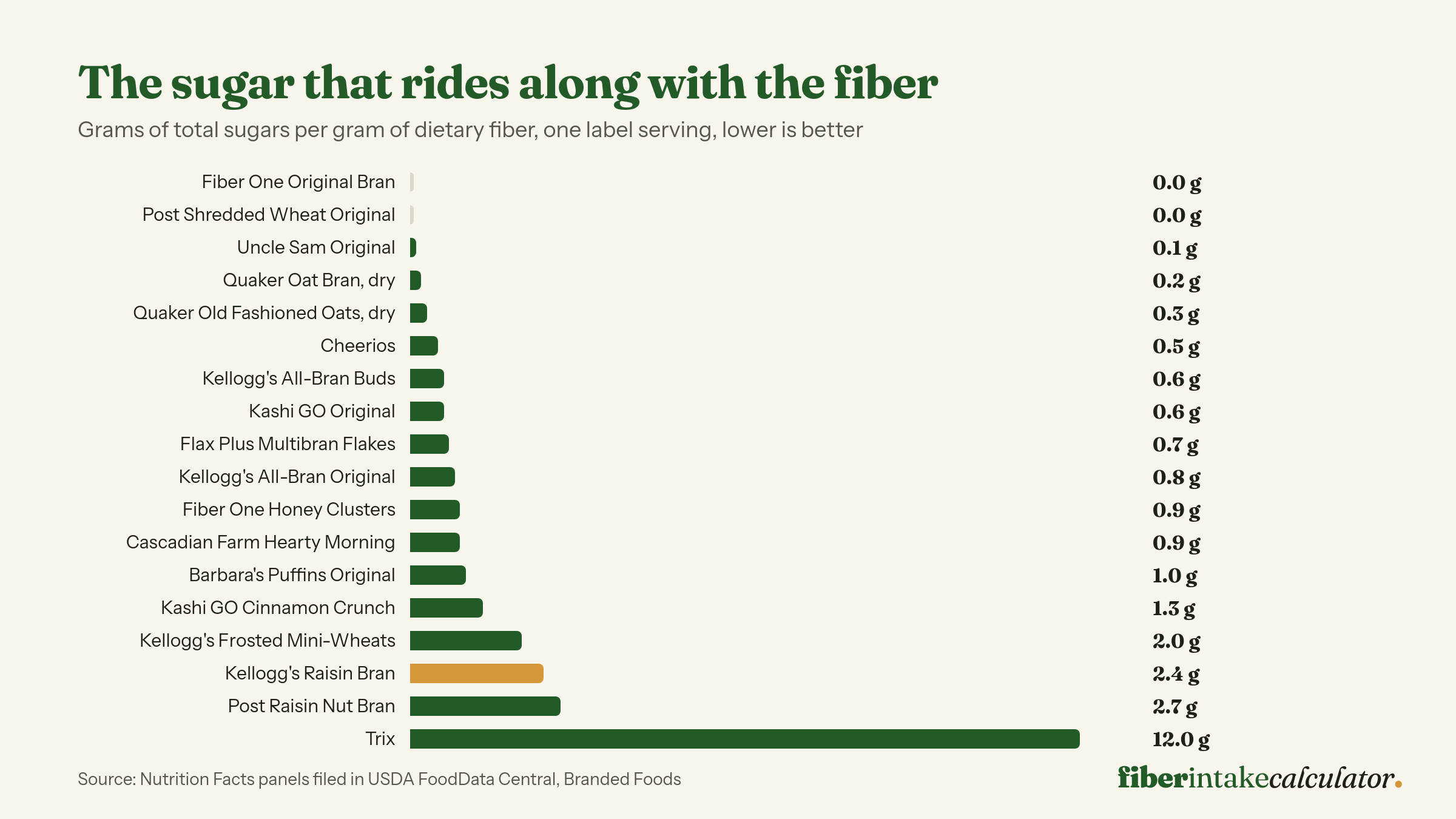
“High fiber cereal low sugar” is the search people run next, and the two rarely arrive together. Dividing each label’s total sugars by its fiber gives one number for the trade. Special K is left out because its fiber is under a gram, which makes the ratio meaningless.
| Cereal | Fiber | Total sugars | Sugar per gram of fiber |
|---|---|---|---|
| Fiber One Original Bran | 18 g | 0 g | 0.0 g |
| Post Shredded Wheat Original | 6 g | 0 g | 0.0 g |
| Uncle Sam Original | 10 g | 1 g | 0.1 g |
| Quaker Oat Bran, dry | 5 g | 1 g | 0.2 g |
| Quaker Old Fashioned Oats, dry | 4 g | 1 g | 0.3 g |
| Cheerios | 4 g | 2 g | 0.5 g |
| Kellogg's All-Bran Buds | 13 g | 8 g | 0.6 g |
| Kashi GO Original | 13 g | 8 g | 0.6 g |
| Nature's Path Flax Plus Multibran Flakes | 7 g | 5 g | 0.7 g |
| Kellogg's All-Bran Original | 12 g | 9 g | 0.8 g |
| Fiber One Honey Clusters | 10 g | 9 g | 0.9 g |
| Cascadian Farm Hearty Morning | 11 g | 10 g | 0.9 g |
| Barbara's Puffins Original | 6 g | 6 g | 1.0 g |
| Wheaties | 4 g | 5 g | 1.3 g |
| Kashi GO Cinnamon Crunch | 9 g | 12 g | 1.3 g |
| Kashi GO Honey Almond Flax Crunch | 8 g | 12 g | 1.5 g |
| Post Great Grains Crunchy Pecan | 5 g | 8 g | 1.6 g |
| Kellogg's Frosted Mini-Wheats | 6 g | 12 g | 2.0 g |
| General Mills Basic 4 | 5 g | 12 g | 2.4 g |
| Kellogg's Raisin Bran | 7 g | 17 g | 2.4 g |
| Post Raisin Nut Bran | 7 g | 19 g | 2.7 g |
| Kellogg's Corn Flakes | 1 g | 4 g | 4.0 g |
| Cocoa Puffs | 2 g | 12 g | 6.0 g |
| Golden Grahams | 2 g | 12 g | 6.0 g |
| Trix | 1 g | 12 g | 12.0 g |
Raisin Bran is the one worth pausing on. It is the cereal most people picture when they think “healthy breakfast”, and it brings 17 grams of sugar to 7 grams of fiber. Some of that is the raisins, but sugar and brown sugar syrup are both in the ingredient list ahead of the 2% line.
The bran cereals are not innocent either. All-Bran Buds is 27% sugar by weight, 8 grams in a 30 gram serving, with sugar as its second ingredient. All-Bran Original is 21%.
The one number to carry into a store. Under one gram of sugar per gram of fiber. Twelve of the 25 cereals here manage it. The five cleanest are Fiber One, Post Shredded Wheat, Uncle Sam, Quaker Oat Bran and plain oats, and four of those five have four ingredients or fewer.
Fiber One reaches zero sugar a different way: sucralose is the last ingredient on its list. That is a real trade rather than a free win, and it is the same trade the high-fiber snacks ranking finds inside the Fiber One bars and brownies, where added inulin does the fiber work.
The plainest cereals on this page are just grain, which raises the obvious question of what the grain itself is worth. A half cup of dry rolled oats carries 4.1 grams of fiber in USDA’s generic record, and a cooked cup of bulgur carries 8.2 grams, more than every box here except the bran ones. Our ranking of high-fiber whole grains runs those numbers against the same 140 gram reference amount the labels use.
Where a cereal’s fiber actually comes from
Ingredients are listed in descending order by weight under 21 CFR 101.4, which makes the first few words on a box the most honest part of the package.
| Cereal | Fiber | What the fiber is, in label order |
|---|---|---|
| Post Shredded Wheat Original | 6 g | Whole grain wheat, and nothing else at all |
| Quaker Oat Bran, dry | 5 g | Oat bran, and nothing else at all |
| Uncle Sam Original | 10 g | Whole grain wheat, flax seed, barley malt, salt |
| Kellogg's All-Bran Original | 12 g | Wheat bran, sugar, malt flavor, salt |
| Kellogg's All-Bran Buds | 13 g | Wheat bran, sugar, psyllium seed husk, oat fiber |
| Fiber One Original Bran | 18 g | Whole grain wheat, corn bran, then modified wheat starch, guar gum and cellulose gum |
| Cascadian Farm Hearty Morning | 11 g | Whole grain wheat, whole grain oats, rice, cane sugar, then wheat bran and oat fiber |
| Kashi GO Cinnamon Crunch | 9 g | Seven-grain blend, soy flakes, brown rice syrup, cane sugar, chicory root fiber |
| Kellogg's Raisin Bran | 7 g | Whole grain wheat, raisins, wheat bran, sugar, brown sugar syrup |
Three patterns run through that list.
The purest cereals are the shortest. Post Shredded Wheat and Quaker Oat Bran each declare a single ingredient, and both land mid-table on fiber precisely because nothing has been concentrated or added.
The bran cereals concentrate. Wheat bran is the first ingredient in both All-Bran products, which is how a 30 gram portion reaches 13 grams of fiber. USDA records crude wheat bran at 42.8 grams of fiber per 100 grams, which is why it heads every list of insoluble fiber foods. All-Bran Buds then adds psyllium seed husk third, the same gel-forming fiber that anchors our fiber supplement comparison, and oat fiber fourth.
Grain fiber is also the one subtype with a measured association in the largest study of hemorrhoid risk factors, ahead of bean fiber and fruit and vegetable fiber, which is covered with the trial evidence on our fiber for hemorrhoids page.
The crunchy cereals add isolated fiber. Chicory root fiber sits fifth on both Kashi GO Crunch labels, ahead of the oats. That counts as dietary fiber on the panel and behaves differently in the gut from bran, which is the distinction set out on our soluble fiber page.
Fiber One is the interesting middle case. Its cereal is built on whole grain wheat and corn bran, not on chicory root, with guar gum and cellulose gum behind them. The Fiber One bars and brownies are the opposite, and lead with chicory root extract.
What the summary above these results gets wrong
Google’s AI Overview for this search hands its product block to Shopping listings rather than labels. Three of its claims are checkable against the filed panels.
| The claim above | What the filed label says |
|---|---|
| All-Bran Buds has about 17 to 19.5 g of fiber per serving | 13 g per 1/3 cup (30 g) |
| Fiber One Original Bran delivers around 14 to 27 g per serving | 18 g per 2/3 cup (40 g) |
| Cascadian Farm Hearty Morning offers 11 g of fiber | 11 g, correct |
The All-Bran Buds figure is the real miss. Getting 17 grams out of that box takes 40 grams of cereal, a third more than the labeled serving, and the summary presents it as what one serving gives you. The Fiber One range is not wrong so much as unanchored: 14 grams is roughly half a cup and 27 grams is a full cup, and neither is the serving on the panel.
Both errors have the same root as the missing weights everywhere else on this SERP. Once nobody says how much cereal a number refers to, the number can mean anything. The high-fiber snacks ranking hit the identical problem with a half cup of carrots and two tablespoons of hummus.
One bowl against your daily number
Adults need 25 grams of fiber a day for women and 38 grams for men aged 19 to 50 under the Institute of Medicine reference intakes. Those drop to 21 and 30 grams after 50. Get your own figure from the fiber calculator first, because it decides whether a 6 gram bowl is a good start or a rounding error.
What one breakfast can do:
| Bowl | Fiber | Calories | Share of a 25 g target |
|---|---|---|---|
| Fiber One Original Bran, 2/3 cup, with 1 cup raspberries | 26.0 g | 154 | 104% |
| All-Bran Buds, 1/3 cup, with 1 cup blackberries | 20.6 g | 142 | 82% |
| Post Shredded Wheat, 1 cup, with 1 cup raspberries | 14.0 g | 234 | 56% |
| Kashi GO Original, 1 1/4 cups, plain | 13.0 g | 180 | 52% |
| Cheerios, 1 1/2 cups, plain | 4.0 g | 140 | 16% |
The first row is the whole argument for a bran cereal. A 2/3 cup serving plus a cup of raspberries covers a woman’s entire daily target for 154 calories, which no other breakfast in common circulation manages. The berry figures come from the high-fiber fruits chart.
The gap between the first row and the last is 22 grams of fiber for 14 extra calories. Very little else in a supermarket offers a swap that lopsided.
A box is not the only way to get there. Our ranking of high-fiber breakfast foods computes the same kind of bowl from whole foods instead, and puts an ounce of chia seeds at 9.8 grams and half a cup of dry oat bran at 7.2 grams, both ahead of every cereal here except the bran boxes.
Cereal fiber is also one of only two fiber sources with a measured result against diverticulitis. In 50,019 women, the highest fifth of cereal fiber intake, a median of 9.8 grams a day, carried a hazard ratio of 0.90, behind fruit fiber at 0.83 and ahead of vegetable fiber, which showed nothing. A single bowl from the top of this table covers most of that 9.8 grams, and our fiber and diverticulitis page has the rest of the ranking.
One caution that applies to the top of every table here. Going from a Cheerios bowl to an All-Bran Buds bowl is a jump of more than 10 grams in one meal, and that is enough to cause gas and cramping for a week or two. Halve the portion, mix it into your usual cereal, and drink more water while you adjust.
The rest of the day still has to come from food. A cup of cooked lentils carries 15.6 grams on its own, as the full high-fiber foods chart shows, and a cup of cooked navy beans carries 19.1 grams, the most of any legume in our ranking of legumes high in fiber. Our methodology page sets out the serving basis used here, and every label record and regulation is listed on our sources page.
Frequently asked questions
Which cereal has the most fiber?
Fiber One Original Bran, at 18 grams per 2/3 cup serving, which is the highest of the 26 national cereals here and more than any single cup of cooked legumes. Kellogg's All-Bran Buds and Kashi GO Original tie for second at 13 grams, but those servings are not the same size: All-Bran Buds is a 30 gram third of a cup and Kashi GO is a 58 gram cup and a quarter. Measured by the level cup, All-Bran Buds wins outright at 38.3 grams.
Why is the serving size different on every cereal box?
Because federal rules set it by weight, not by bowl. Under 21 CFR 101.12 a ready-to-eat cereal gets a reference amount of 15 grams if a cup weighs under 20 grams, 40 grams if a cup weighs 20 to 43 grams, and 60 grams if a cup weighs 43 grams or more. High-fiber cereals carrying 28 grams or more of fiber per 100 grams are named in the 40 gram row. The box then prints that weight as the nearest household measure, which is why All-Bran Buds says 1/3 cup and Corn Flakes says 1 1/2 cups.
Is high-fiber cereal high in sugar?
Some of the highest-fiber ones are. All-Bran Buds carries 8 grams of sugar in a 30 gram serving, which is 27% of the box by weight, and sugar is its second ingredient. All-Bran Original is 9 grams in 41 grams. The exceptions are real though: Fiber One Original Bran declares no sugar at all and uses sucralose instead, Post Shredded Wheat has one ingredient and no sugar, and Uncle Sam carries 1 gram alongside 10 grams of fiber.
Is oatmeal higher in fiber than breakfast cereal?
It sits mid-table. Half a cup of dry Quaker Old Fashioned Oats carries 4 grams of fiber for 150 calories, about the same as a bowl of Cheerios and well behind any bran cereal. Oat bran is the stronger version at 5 grams per half cup dry. What oats have that most flakes do not is beta-glucan, the soluble fiber behind the cholesterol claim, which is a different job from the bulking that wheat bran does.
How much fiber does a cereal need before the box can say high fiber?
5.6 grams per reference amount, which is 20% of the 28 gram Daily Value under 21 CFR 101.54. Because the reference amount for cereal is set by weight, that translates to different densities: a light cereal on a 40 gram reference needs 14 grams of fiber per 100 grams, and a heavy or biscuit-type cereal on a 60 gram reference needs 9.3 grams per 100 grams. The fiber per 100 grams column below is the honest way to check.
Built and maintained by the FiberIntake team, with data from USDA FoodData Central and peer-reviewed sources. Figures are checked against the cited source before publish. About this site →