High-Fiber Vegetables, Ranked Cooked and Raw
Last updated: September 8, 2026
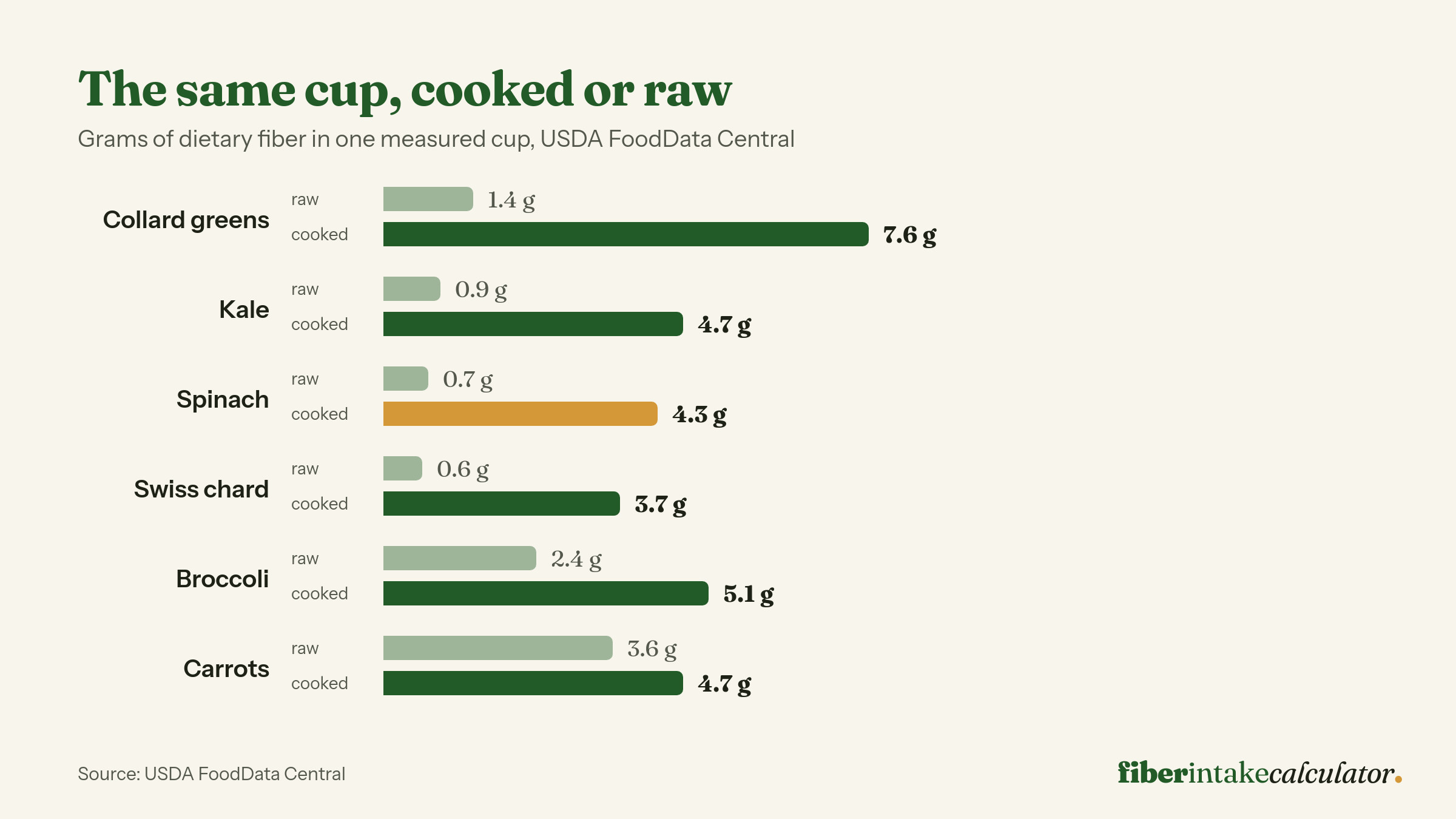
Cooked artichoke hearts hold the most fiber per cup of any common vegetable, at 9.6 grams, followed by cooked green peas at 8.8 grams and cooked collard greens at 7.6 grams. Whether a vegetable is cooked moves its number more than which vegetable it is: the same cup holds 0.7 grams of spinach fiber raw and 4.3 grams cooked.
Every figure here is computed from USDA FoodData Central: fiber per 100 grams, multiplied by USDA’s own household serving weight, with the cooked or raw state named on every row. No other vegetable list does that, which is why several values here differ from the ones in circulation.
Cooking a leafy green multiplies its fiber per cup
Cooking does not create fiber. It removes the air. Raw spinach carries 2.2 grams of fiber per 100 grams and cooked spinach 2.4 grams, so the food barely changes. The measuring cup does.
A cup of raw spinach weighs 30 grams. A cup of cooked spinach weighs 180 grams, because it is roughly six cups of leaves collapsed down. Greens are the extreme case:
| Vegetable | 1 cup raw | 1 cup cooked |
|---|---|---|
| Collard greens | 1.4 g (36 g) | 7.6 g (190 g) |
| Kale | 0.9 g (21 g) | 4.7 g (118 g) |
| Spinach | 0.7 g (30 g) | 4.3 g (180 g) |
| Swiss chard | 0.6 g (36 g) | 3.7 g (175 g) |
| Broccoli | 2.4 g (91 g) | 5.1 g (156 g) |
| Carrots | 3.6 g (128 g) | 4.7 g (156 g) |
Rule of thumb. For leafy greens, a cooked cup is worth five to six raw cups. For firm vegetables like broccoli and carrots, cooking buys you about a third more fiber per cup, not five times.
Parsnips run the other way. Raw, they hold 4.9 grams of fiber per 100 grams; boiled, 3.6 grams, because they take on water rather than losing it. A cup of raw parsnip slices gives 6.5 grams against 5.6 grams cooked.
None of this is an argument for eating salad plain and cold. It is an argument for reading any fiber chart that does not say “cooked” with suspicion, including the ones in the search results above this page. Our methodology page sets out the serving basis used here.
Grains run the same trick in reverse. A cup of dry hulled barley holds 31.8 grams of fiber and a cooked cup holds roughly 6.6, which is how a figure five times too large ends up quoted as fact; our whole grains ranking traces that one to its USDA record.
Why fiber charts disagree about Brussels sprouts
Search for high-fiber vegetables and you will be told a cup of cooked Brussels sprouts has 6.4 grams of fiber. USDA has three separate sprout records, and they do not agree:
| USDA record | Fiber per 100 g | Per cup |
|---|---|---|
| Frozen, then boiled | 4.1 g | 6.4 g (155 g) |
| Fresh, boiled | 2.6 g | 4.1 g (156 g) |
| Raw | 3.8 g | 3.3 g (88 g) |
The 6.4 gram figure is the frozen one. Nobody quoting it says so, and the gap between it and fresh boiled sprouts is 55% for what looks like the same bowl. Mayo Clinic’s own chart splits the difference at 4.5 grams.
The one thing to remember. A gram figure without a preparation attached is half a number. Frozen, fresh, boiled and raw are four different foods in USDA's data, and the spread between them is larger than the spread between most vegetables.
This is the same pattern that shows up in fruit, where a peeled apple and an apple with skin are separate records with a 46% gap. The high-fiber fruits chart puts numbers on that one.
The skin is where a potato keeps its fiber
USDA measures a baked potato in three parts. The flesh holds 1.5 grams of fiber per 100 grams. The skin holds 7.9 grams, more than five times as much.
A medium potato baked with the skin on gives 3.6 grams. Peel it at the table and you are eating the 1.5 gram part. That single habit is worth more than swapping the potato for something fashionable.
Sweet potatoes are recorded flesh-only, so USDA has no whole-with-skin figure to quote. The flesh alone gives 6.6 grams per cup, which already beats most vegetables on this page.
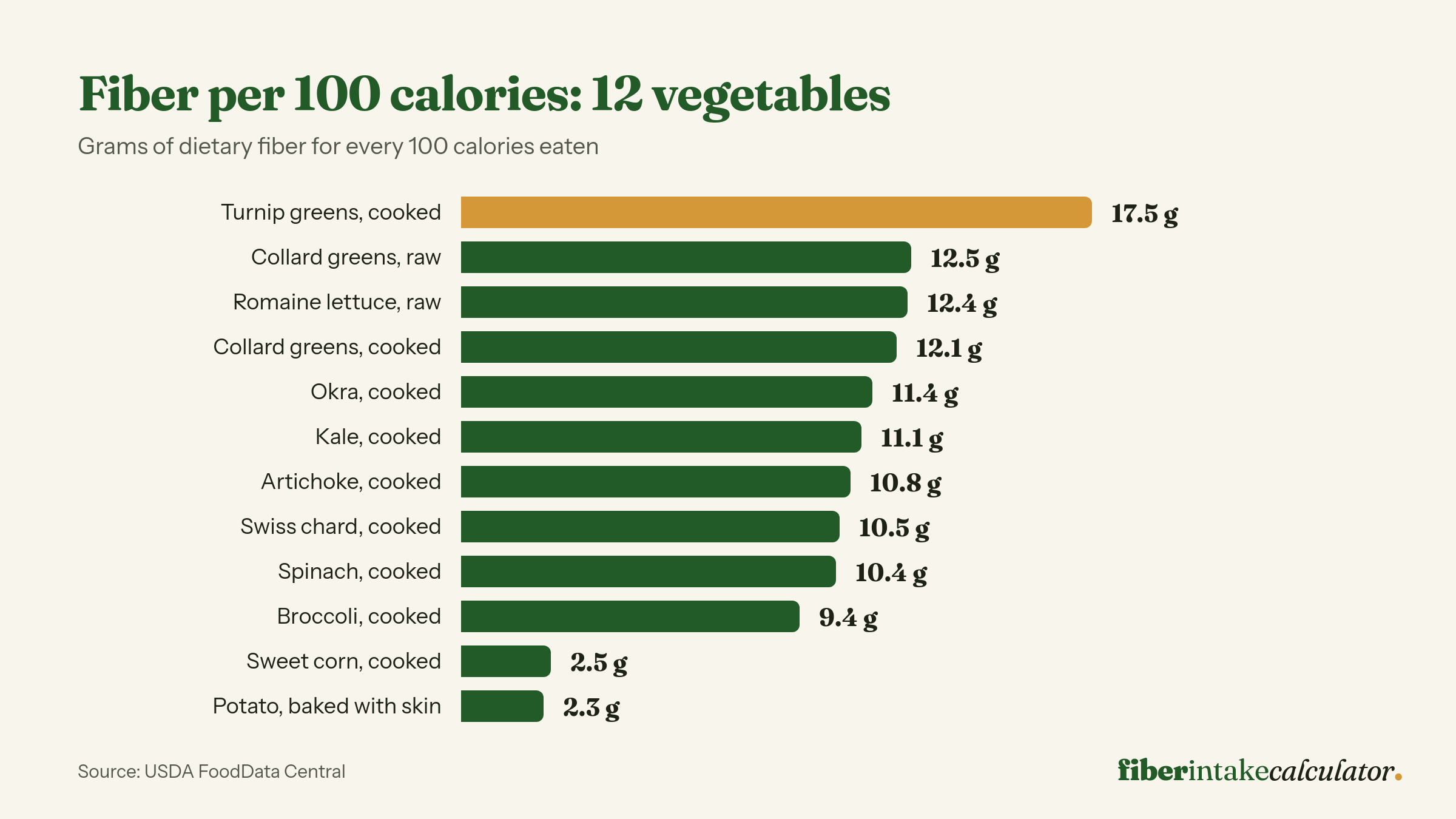
That chart is the other way to read a vegetable. Cooked turnip greens deliver 17.5 grams of fiber per 100 calories. A baked potato delivers 2.3 grams. Both are vegetables, and they are not doing the same job. If you are eating to a calorie budget, that column is the one that matters, and it is the same logic behind our page on fiber and weight loss.
Carrots are the vegetable that survives this test best as a snack. A cup of raw sticks carries 3.4 grams for 50 calories, which is 6.8 grams per 100 calories, and puts plain carrots above most of the boxed products in our ranking of high-fiber snacks.
A big salad is a small amount of fiber
Raw salad vegetables are mostly water, so a bowl that fills a plate barely moves your total. Here is a generous one:
| A large raw salad | Fiber |
|---|---|
| Romaine lettuce, 3 cups shredded | 3.0 g |
| Tomato, 1 cup chopped | 2.2 g |
| Cucumber with peel, 1 cup slices | 0.5 g |
| White mushrooms, 1 cup sliced | 0.7 g |
| Total (495 g of food) | 6.4 g |
One cup of cooked collard greens, 190 grams, gives 7.6 grams. Less than half the weight, more fiber.
Salad is worth eating for other reasons. It is just not where vegetable fiber comes from, and the soluble fiber that feeds gut bacteria and binds cholesterol sits in cell walls and pulp, which is exactly the part a lettuce leaf has least of.
The gap is widest for anyone counting carbohydrate, where the salad bowl is the only vegetable most food lists name. Reaching 10 grams of fiber takes 15.2 cups of raw spinach against 1.3 cups of cooked collard greens, and the rest of that arithmetic sits on our ranking of high-fiber low-carb foods.
How far vegetables alone get you
Adults need 25 grams a day for women and 38 grams for men aged 19 to 50, per the Institute of Medicine reference intakes. Those fall to 21 and 30 grams after 50. Get your own number from the fiber calculator if you do not have one.
A day with vegetables at every meal:
| A day of vegetables | Fiber |
|---|---|
| Green salad (romaine, tomato, cucumber) | 3.7 g |
| Potato, baked with skin, 1 medium | 3.6 g |
| Broccoli, 1 cup cooked | 5.1 g |
| Carrots, 1 cup cooked slices | 4.7 g |
| Total | 17.1 g |
That is 68% of a 25 gram target and 45% of a 38 gram one, from more vegetables than most people eat in a day.
One cup of cooked lentils adds 15.6 grams by itself, and a cup of cooked navy beans adds 19.1. That is the argument the full high-fiber foods chart makes: vegetables are the volume, legumes are the arithmetic. Our ranking of legumes high in fiber puts a number on all 44 of them. A supplement closes even less of the gap, as the doses in our fiber supplement comparison show.
Every vegetable, ranked cooked and raw
Sort by any column. Rows carry their preparation in the name, so cooked and raw versions of the same vegetable sit in the list as the different foods they are. The % of your target column uses the result you saved in the calculator, or the FDA Daily Value of 28 g until you have one. Every figure traces to USDA FoodData Central or to the Institute of Medicine intakes, both listed on our sources page.
| Vegetable | Fiber per serving (g) | Serving | Fiber per 100 calories (g) | % of your target |
|---|---|---|---|---|
| Artichoke hearts, cooked | 9.6 | 1 cup (168 g) | 10.8 | – |
| Green peas, cooked | 8.8 | 1 cup (160 g) | 6.5 | – |
| Green peas, raw | 8.3 | 1 cup (145 g) | 7 | – |
| Collard greens, cooked | 7.6 | 1 cup chopped (190 g) | 12.1 | – |
| Pumpkin, canned | 7.1 | 1 cup (245 g) | 8.5 | – |
| Artichoke, cooked | 6.8 | 1 medium (120 g) | 10.8 | – |
| Sweet potato, baked | 6.6 | 1 cup flesh (200 g) | 3.7 | – |
| Butternut squash, baked | 6.6 | 1 cup cubes (205 g) | 8 | – |
| Parsnips, raw | 6.5 | 1 cup slices (133 g) | 6.5 | – |
| Brussels sprouts, frozen then boiled | 6.4 | 1 cup (155 g) | 9.8 | – |
| Parsnips, cooked | 5.6 | 1 cup slices (156 g) | 5.1 | – |
| Broccoli, cooked | 5.1 | 1 cup chopped (156 g) | 9.4 | – |
| Turnip greens, cooked | 5 | 1 cup chopped (144 g) | 17.5 | – |
| Kale, cooked | 4.7 | 1 cup (118 g) | 11.1 | – |
| Carrots, cooked | 4.7 | 1 cup slices (156 g) | 8.6 | – |
| Spinach, cooked | 4.3 | 1 cup (180 g) | 10.4 | – |
| Brussels sprouts, fresh, boiled | 4.1 | 1 cup (156 g) | 7.2 | – |
| Green beans, cooked | 4 | 1 cup (125 g) | 9.1 | – |
| Okra, cooked | 4 | 1 cup slices (160 g) | 11.4 | – |
| Beets, raw | 3.8 | 1 cup (136 g) | 6.5 | – |
| Swiss chard, cooked | 3.7 | 1 cup chopped (175 g) | 10.5 | – |
| Asparagus, cooked | 3.6 | 1 cup (180 g) | 9.1 | – |
| Carrots, raw | 3.6 | 1 cup chopped (128 g) | 6.8 | – |
| Sweet corn, cooked | 3.6 | 1 cup kernels (149 g) | 2.5 | – |
| Potato, baked with skin | 3.6 | 1 medium (173 g) | 2.3 | – |
| Beets, cooked | 3.4 | 1 cup slices (170 g) | 4.5 | – |
| Brussels sprouts, raw | 3.3 | 1 cup (88 g) | 8.8 | – |
| Red bell pepper, raw | 3.1 | 1 cup chopped (149 g) | 8.1 | – |
| Cauliflower, cooked | 2.9 | 1 cup (124 g) | 10 | – |
| Cabbage, cooked | 2.9 | 1 cup shredded (150 g) | 8.3 | – |
| Butternut squash, raw | 2.8 | 1 cup cubes (140 g) | 4.4 | – |
| Onions, raw | 2.7 | 1 cup chopped (160 g) | 4.3 | – |
| Green beans, raw | 2.7 | 1 cup pieces (100 g) | 8.7 | – |
| Eggplant, cooked | 2.5 | 1 cup cubes (99 g) | 7.1 | – |
| Eggplant, raw | 2.5 | 1 cup cubes (82 g) | 12 | – |
| Broccoli, raw | 2.4 | 1 cup chopped (91 g) | 7.6 | – |
| Cabbage, raw | 2.2 | 1 cup chopped (89 g) | 10 | – |
| Tomato, raw | 2.2 | 1 cup chopped (180 g) | 6.7 | – |
| Cauliflower, raw | 2.1 | 1 cup chopped (107 g) | 8 | – |
| Turnip greens, raw | 1.8 | 1 cup chopped (55 g) | 10 | – |
| Celery, raw | 1.6 | 1 cup chopped (101 g) | 11.4 | – |
| Collard greens, raw | 1.4 | 1 cup chopped (36 g) | 12.5 | – |
| Romaine lettuce, raw | 1 | 1 cup shredded (47 g) | 12.4 | – |
| Kale, raw | 0.9 | 1 cup (21 g) | 11.7 | – |
| White mushrooms, raw | 0.7 | 1 cup slices (70 g) | 4.5 | – |
| Spinach, raw | 0.7 | 1 cup (30 g) | 9.6 | – |
| Swiss chard, raw | 0.6 | 1 cup (36 g) | 8.4 | – |
| Cucumber with peel, raw | 0.5 | 1 cup slices (104 g) | 3.3 | – |
Fiber per serving is USDA FoodData Central's per-100-gram value multiplied by USDA's own household serving weight, read September 2026. Cooked values are boiled and drained without salt unless the row says otherwise. See the methodology page for how figures are sourced and refreshed.
Frequently asked questions
What vegetable has the most fiber?
Per cup, cooked artichoke hearts at 9.6 grams, then cooked green peas at 8.8 grams and cooked collard greens at 7.6 grams. A cup of artichoke hearts is more artichoke than most people eat at once, so the practical answer is one whole cooked artichoke at 6.8 grams. Canned pumpkin is the quiet standout at 7.1 grams per cup.
Do vegetables lose fiber when they are cooked?
Almost none, and per cup they usually gain. USDA lists raw spinach at 2.2 grams of fiber per 100 grams and cooked spinach at 2.4 grams, so the fiber itself barely moves. What changes is volume: a cup of raw spinach weighs 30 grams and a cup of cooked spinach weighs 180 grams, which is why the same measuring cup holds 0.7 grams of fiber raw and 4.3 grams cooked.
Why do fiber charts disagree about Brussels sprouts?
Because they are quoting different USDA records without saying so. The 6.4 grams per cup figure in wide circulation is USDA's frozen-then-boiled record, at 4.1 grams of fiber per 100 grams. Fresh sprouts boiled from raw are a separate record at 2.6 grams per 100 grams, which makes the same cup 4.1 grams. Mayo Clinic publishes 4.5 grams for that cup.
Which vegetables give the most fiber for the fewest calories?
Cooked turnip greens, at 17.5 grams of fiber per 100 calories, ahead of raw collard greens at 12.5 grams and romaine lettuce at 12.4 grams. Starchy vegetables sit at the other end: a baked potato gives 2.3 grams per 100 calories and sweet corn 2.5 grams. Sort the chart by the per-100-calorie column to see the full order.
Can I hit my daily fiber target with vegetables alone?
Not comfortably. A day with a green salad, a baked potato with skin, a cup of cooked broccoli and a cup of cooked carrots comes to 17.1 grams, which is 68% of a 25 gram target and 45% of a 38 gram one, and that is already more vegetables than most people eat. A single cup of cooked lentils adds 15.6 grams on its own.
Built and maintained by the FiberIntake team, with data from USDA FoodData Central and peer-reviewed sources. Figures are checked against the cited source before publish. About this site →