High-Fiber Low-Carb Foods, Ranked by Carb Cost
Last updated: September 29, 2026
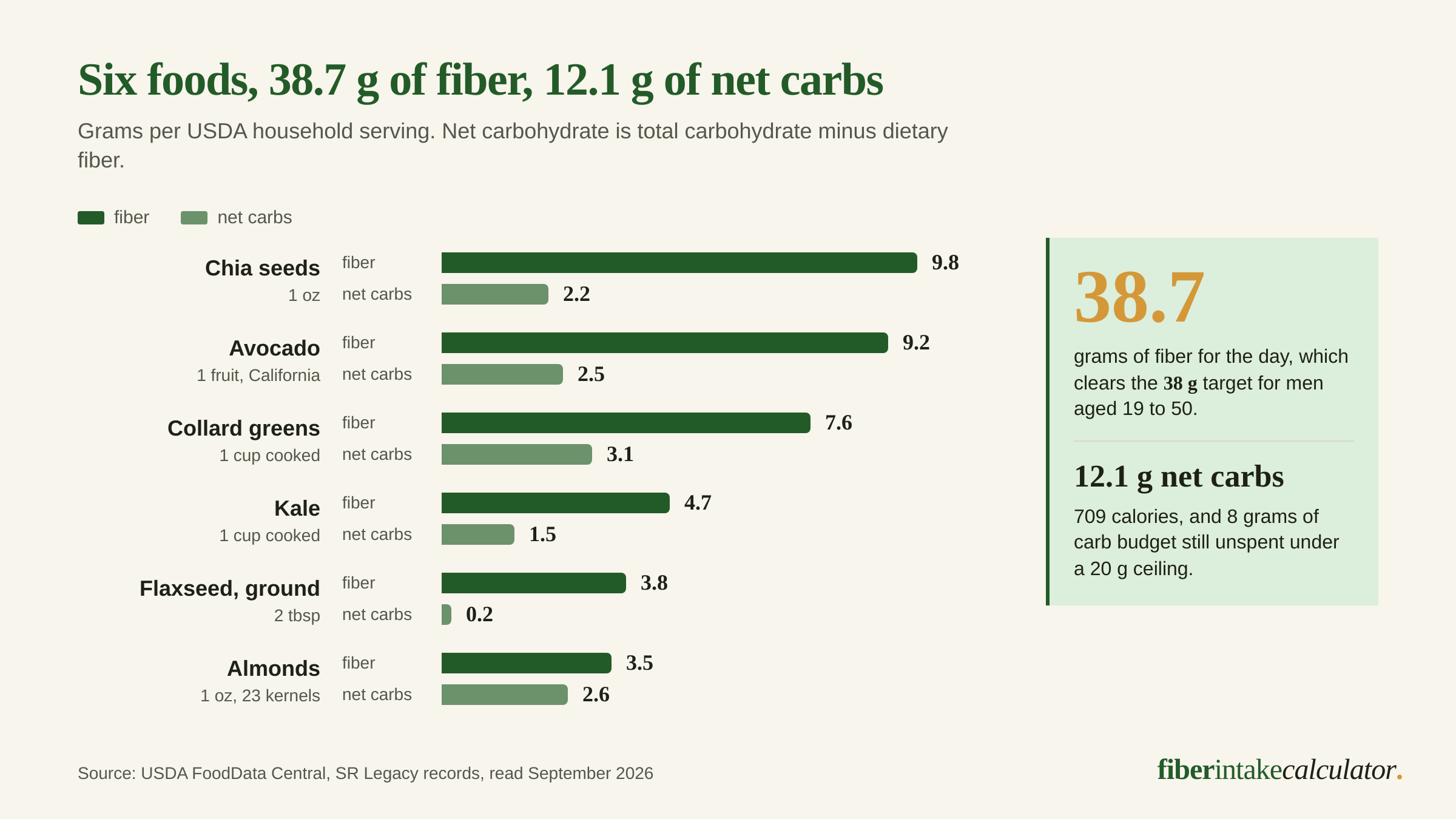
Six foods give you 38.7 grams of fiber for 12.1 grams of net carbohydrate: chia seeds, an avocado, cooked collard greens, cooked kale, ground flaxseed and almonds. That clears the highest adult fiber target while spending less carbohydrate than a single apple.
Every figure here is computed from USDA FoodData Central: fiber and total carbohydrate per 100 grams, multiplied by USDA’s own household serving weight. Net carbohydrate is total carbohydrate minus fiber.
The question is a budget, not a list
Published lists of high-fiber low-carb foods rank foods. Nobody counting carbohydrate needs a ranking. They need to know whether a fiber target fits inside a carbohydrate budget, and by how much.
Two numbers set the problem. The fiber target comes from the Institute of Medicine reference intakes: 25 grams a day for women and 38 grams for men aged 19 to 50, falling to 21 and 30 after 50. The fiber calculator gives you your own number from your weight and calories.
The carbohydrate budget is yours to set, and it is not a federal number. For scale, the same Institute of Medicine report puts carbohydrate at 45 to 65% of calories, which is 225 to 325 grams on a 2,000 calorie day. The budgets low-carb eaters work to sit far below that, commonly around 20 grams of net carbohydrate at the strict end and 50 grams at the moderate end.
Net carbohydrate is a convention, not a rule. Under 21 CFR 101.9(c)(6), total carbohydrate on a US label is calculated by subtracting protein, fat, moisture and ash from the weight of the food, which means fiber is already inside it. Subtracting fiber back out is a comparison method that no regulation defines. If you dose insulin against carbohydrate counts, the subtraction changes your dose, so agree it with your diabetes team rather than taking it from a food label.
A day that hits 38 grams of fiber on 12 grams of net carbs
Here is the full arithmetic for the graphic above.
| Food | Serving | Fiber | Net carbs | Calories |
|---|---|---|---|---|
| Chia seeds | 1 oz (28 g) | 9.8 g | 2.2 g | 138 |
| Avocado, California | 1 fruit (136 g) | 9.2 g | 2.5 g | 227 |
| Collard greens, cooked | 1 cup chopped | 7.6 g | 3.1 g | 63 |
| Kale, cooked | 1 cup | 4.7 g | 1.5 g | 42 |
| Flaxseed, ground | 2 tbsp (14 g) | 3.8 g | 0.2 g | 75 |
| Almonds | 1 oz, 23 kernels | 3.5 g | 2.6 g | 164 |
| Total | 38.7 g | 12.1 g | 709 |
If your target is 25 grams rather than 38, the first four rows do it: 27.5 grams of fiber for 6.4 grams of net carbohydrate and 482 calories. That leaves roughly 14 grams of carbohydrate for the rest of the day even on a 20 gram ceiling.
Nothing in that list is exotic and none of it is a supplement. It is also not a meal plan. The 709 calories are the fiber part of the day, and the protein and fat sit on top, which matters if calories are capped as well as carbohydrate. Our page on fiber while losing weight works through what happens to a fiber target when calories come down.
The standard high-fiber day costs 99 grams of net carbs
The reason this looks surprising is that the usual advice for hitting a fiber target is built from legumes and grains. Priced in carbohydrate, that route is eight times more expensive.
| The usual high-fiber day | Fiber | Net carbs | Calories |
|---|---|---|---|
| Lentils, 1 cup cooked | 15.6 g | 24.2 g | 230 |
| Oatmeal, 1 cup cooked | 4.0 g | 24.1 g | 166 |
| Whole-wheat spaghetti, 1 cup | 4.6 g | 30.6 g | 174 |
| Apple with skin, 1 medium | 4.4 g | 20.8 g | 95 |
| Total | 28.6 g | 99.7 g | 665 |
Ten grams less fiber, 88 grams more net carbohydrate, for about the same calories.
That is not an argument against lentils. A cup of them delivers 15.6 grams of fiber, more than any single row in the low-carb plan, which is exactly why our legume ranking and whole grains ranking exist. It is an argument that when carbohydrate is the binding constraint, those two groups are the wrong tool, and the seeds, the avocado and the cooked greens do the same job for an eighth of the carbohydrate.
Carb cost, the column every list is missing
Ranking foods by fiber per serving answers a different question from the one a carb counter is asking. A food can be high in fiber and still a bad buy, if the carbohydrate it brings along outweighs it.
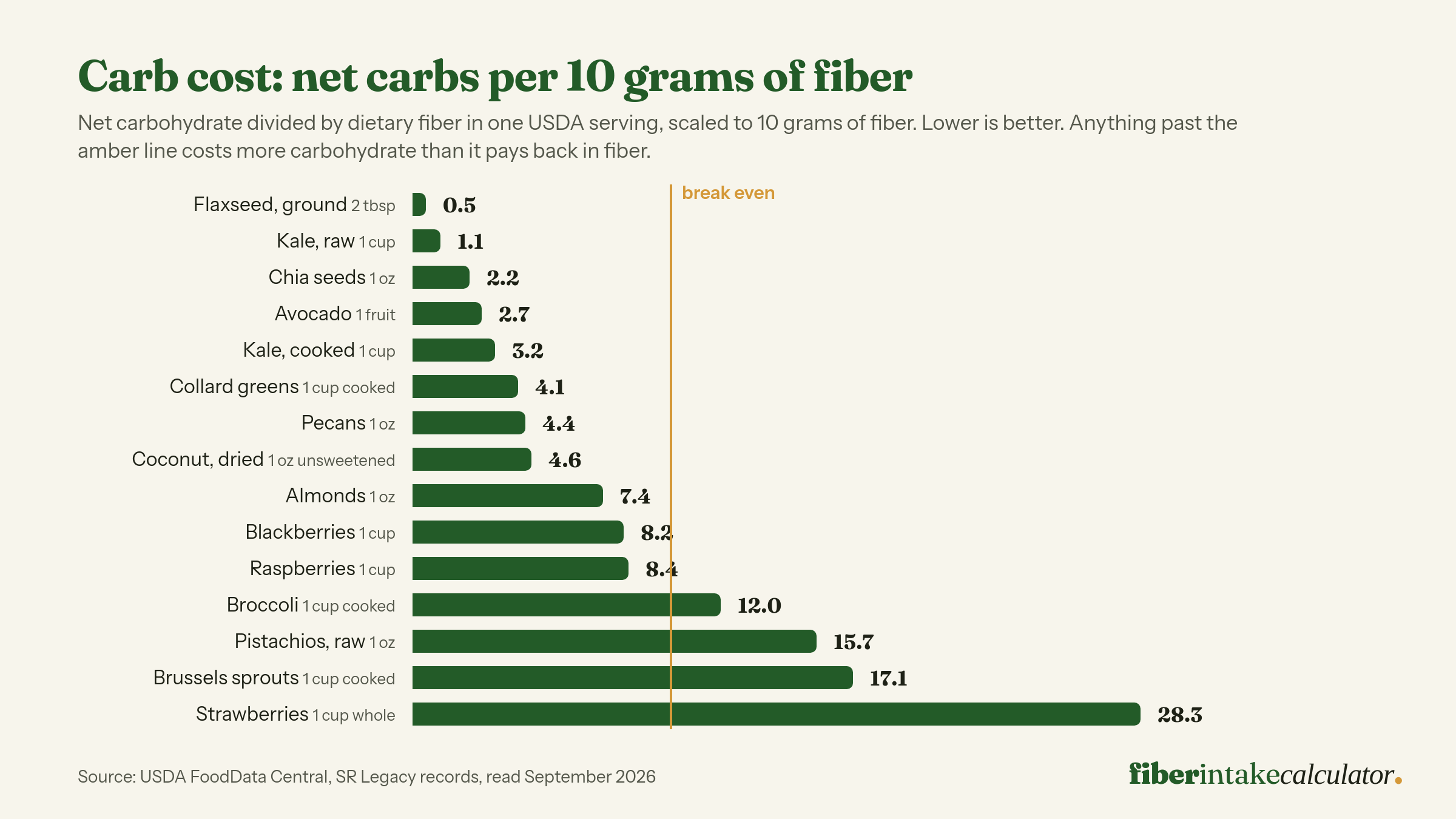
The measure is net carbohydrate divided by fiber, scaled to 10 grams of fiber so it reads as a price. Ground flaxseed costs 0.5 grams of net carbohydrate per 10 grams of fiber. Chia seeds cost 2.2 and an avocado 2.7. Broccoli costs 12.0, which means a cup of it brings more carbohydrate than fiber.
The break-even line is 10. Above it, a food adds more net carbohydrate to your day than fiber. Pistachios (15.7), Brussels sprouts (17.1) and strawberries (28.3) all sit above it, and all three appear on published high-fiber low-carb lists.
Two cautions on reading the low end. Ground flaxseed and hulled sesame seeds compute to almost zero net carbohydrate because total carbohydrate is measured by difference. In a food that is 42% fat, as flaxseed is, or 61% fat, as hulled sesame is, that subtraction absorbs every rounding error in the other measurements. Hulled sesame lands at 0.13 grams of net carbohydrate per 100 grams, which is not a real zero, and it is excluded from the table below for that reason. Read flax as nearly free rather than exactly free. How we treat figures like this is set out on our methodology page.
The same ratio ranked across legumes, grains and fruit, where the denominator is large enough to divide by comfortably, is on our page about fiber for diabetes, which is where this column matters for a different reason.
Leafy greens are named first and finish last per serving
Almost every high-fiber low-carb list opens with spinach, kale and chard, and almost none of them attaches a portion. The portion is the whole story.
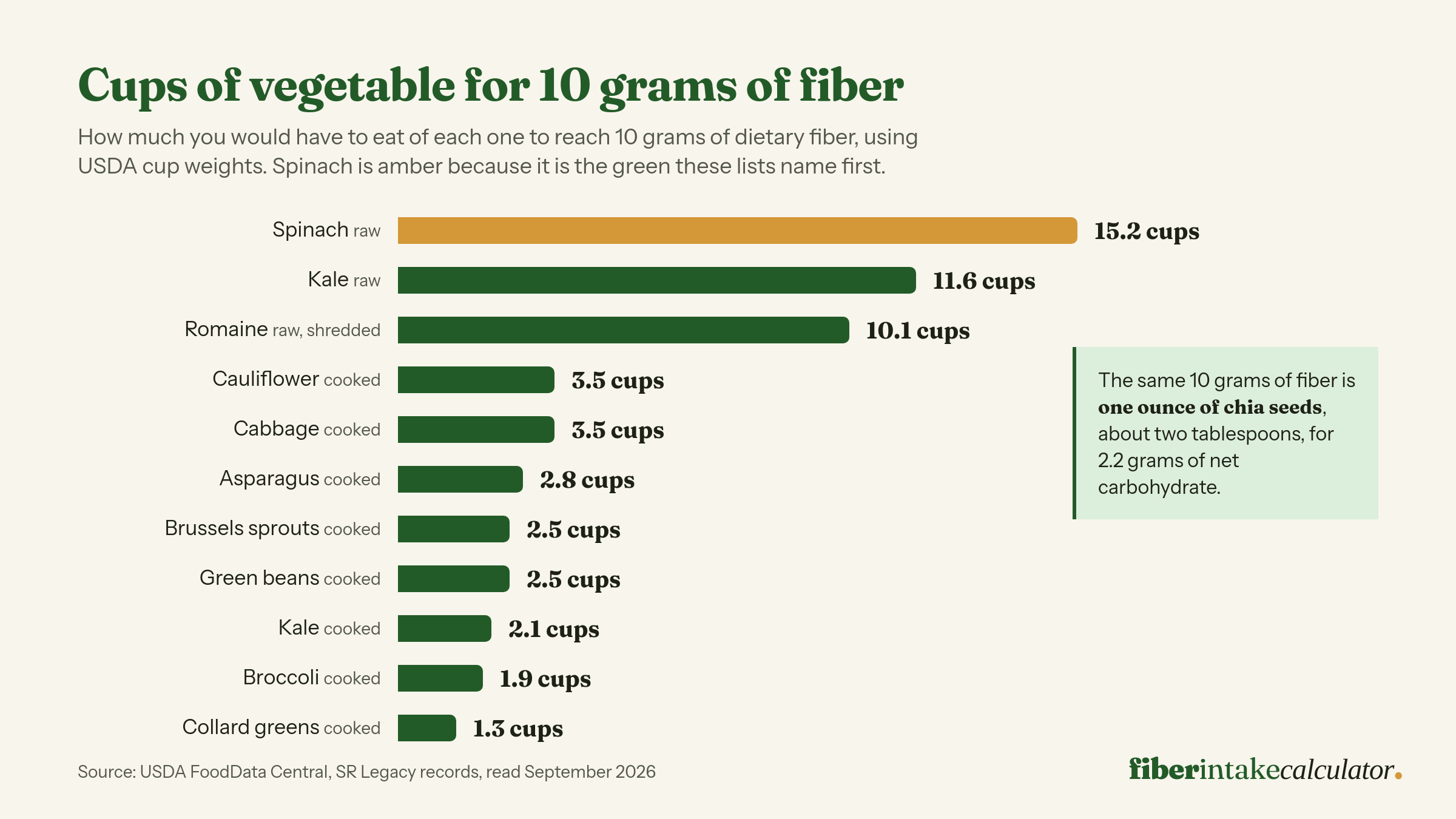
A cup of raw spinach weighs 30 grams and holds 0.7 grams of fiber. Reaching 10 grams takes 455 grams of leaves, which is 15.2 cups. Raw kale takes 11.6 cups and shredded romaine 10.1 cups. Nobody eats that.
Cooking changes the answer, because the water leaves and the cup weight rises. A cup of cooked kale weighs 118 grams and carries 4.7 grams of fiber, five times the raw cup. Cooked collard greens reach 10 grams of fiber in 1.3 cups.
| Green | Fiber per cup | Cups for 10 g of fiber | Net carbs for 10 g |
|---|---|---|---|
| Collard greens, cooked | 7.6 g | 1.3 | 4.1 g |
| Kale, cooked | 4.7 g | 2.1 | 3.2 g |
| Swiss chard, cooked | 3.7 g | 2.7 | 9.7 g |
| Romaine, raw shredded | 1.0 g | 10.1 | 5.7 g |
| Kale, raw | 0.9 g | 11.6 | 0.8 g |
| Spinach, raw | 0.7 g | 15.2 | 6.5 g |
Raw greens are still worth eating, and raw kale has the second cheapest carb cost in the table below at 1.1. It just cannot carry a fiber target on its own. The cooked and raw records for every vegetable are separate USDA analyses, which is why our high-fiber vegetables ranking lists both forms side by side instead of averaging them.
Three numbers on these lists that do not survive checking
Pistachios cost more carbohydrate than they pay. An ounce carries 3.0 grams of fiber and 4.7 grams of net carbohydrate. They appear on published low-carb fiber lists above cauliflower, which carries 2.9 grams of fiber for 2.2 grams of net carbs. Hulled sunflower seeds have the same problem: 3.0 grams of fiber against 4.0 grams of net carbs in a quarter cup.
Chia seeds give 9.8 grams of fiber, not 11. The figure in circulation is “2 tablespoons, 11 grams of fiber”. USDA’s own portion for chia is 1 ounce, 28 grams, which is slightly more than 2 tablespoons, and it gives 9.8 grams. Chia is still the best high-volume source on this page. The number quoted for it is about 12% generous on a larger serving.
Strawberries are not a low-carb berry. A cup of whole strawberries carries 2.9 grams of fiber and 8.2 grams of net carbohydrate, a carb cost of 28.3, the worst on this page. Raspberries give 8.0 grams of fiber for 6.7 grams of net carbs and blackberries 7.6 for 6.2, which is why those two are the berries worth the budget. The rest of the carton, form by form, is on our high-fiber berries page.
A general note on the published figures: most of these lists round every number to whole grams, which erases the differences you are scanning for. Rounded to the nearest gram, cauliflower and broccoli both read “2 grams of fiber” per cup, when the real figures are 2.9 and 5.1. The table below keeps one decimal place and names the serving on every row.
If the budget still will not close
Three things are worth trying before you conclude that fiber and low carbohydrate cannot coexist.
Cook the greens. That single change takes kale from 0.9 grams a cup to 4.7.
Move the seeds to the front of the day. Chia and flax carry a third of a fiber target between them for under 2.5 grams of net carbohydrate, and they go into yogurt, a smoothie or a bake without becoming a meal of their own. Read the group on its own terms before you load up on it, though: our ranking of high-fiber nuts and seeds shows nuts carrying the lowest fiber per calorie of any group we rank, 1.5 grams per 100 calories against 5.5 for legumes, so a carbohydrate budget and a calorie budget point in opposite directions here.
Consider an isolated fiber last, not first. A psyllium or methylcellulose dose adds fiber with almost no digestible carbohydrate, and the dose per serving is on the label rather than in a database; the per-dose grams for every major product are compared on our fiber supplements page. Whichever route you take, add the fiber gradually and drink water with it. If the reason you are chasing the number is a stuck gut, the trials that moved stool frequency used more than 10 grams a day sustained for at least four weeks, and the per-trial doses are on our fiber for constipation page.
Every low-carb food, ranked
Sort by any column. Fiber per serving answers the usual question. Net carbs per 10 g fiber answers the one a carb counter is asking, and lower is better. The serving column names the USDA household portion behind each row, because a cup of raw leaves and a cup of cooked greens are different weights and different records.
The rows are the low-carbohydrate aisle only. Legumes, grains and starchy vegetables are ranked on the master high-fiber foods chart. The % of your target column uses the result you saved in the calculator, or the FDA Daily Value of 28 g until you have one. Every figure traces to USDA FoodData Central or to the Institute of Medicine intakes, both listed on our sources page.
| Food | Fiber per serving (g) | Net carbs per serving (g) | Net carbs per 10 g fiber | Serving | Group | % of your target |
|---|---|---|---|---|---|---|
| Chia seeds | 9.8 | 2.2 | 2.2 | 1 oz (28 g) | Seeds | – |
| Avocado, California | 9.2 | 2.5 | 2.7 | 1 fruit (136 g) | Vegetables | – |
| Edamame, cooked | 8.1 | 5.8 | 7.2 | 1 cup (155 g) | Other | – |
| Raspberries | 8 | 6.7 | 8.4 | 1 cup (123 g) | Fruit | – |
| Collard greens, cooked | 7.6 | 3.1 | 4.1 | 1 cup chopped (190 g) | Vegetables | – |
| Blackberries | 7.6 | 6.2 | 8.2 | 1 cup (144 g) | Fruit | – |
| Coconut, fresh shredded | 7.2 | 5 | 6.9 | 1 cup (80 g) | Nuts | – |
| Artichoke, cooked | 6.8 | 7.5 | 11 | 1 medium (120 g) | Vegetables | – |
| Broccoli, cooked | 5.1 | 6.1 | 12 | 1 cup chopped (156 g) | Vegetables | – |
| Kale, cooked | 4.7 | 1.5 | 3.2 | 1 cup (118 g) | Vegetables | – |
| Coconut, dried unsweetened | 4.6 | 2.1 | 4.6 | 1 oz (28 g) | Nuts | – |
| Brussels sprouts, cooked | 4.1 | 7 | 17.1 | 1 cup (156 g) | Vegetables | – |
| Okra, cooked | 4 | 3.2 | 8 | 1 cup sliced (160 g) | Vegetables | – |
| Green beans, cooked | 4 | 5.8 | 14.5 | 1 cup (125 g) | Vegetables | – |
| Flaxseed, ground | 3.8 | 0.2 | 0.5 | 2 tbsp (14 g) | Seeds | – |
| Swiss chard, cooked | 3.7 | 3.6 | 9.7 | 1 cup chopped (175 g) | Vegetables | – |
| Asparagus, cooked | 3.6 | 3.8 | 10.6 | 1 cup (180 g) | Vegetables | – |
| Almonds | 3.5 | 2.6 | 7.4 | 1 oz, 23 kernels (28 g) | Nuts | – |
| Mushrooms, white, cooked | 3.4 | 4.8 | 14.1 | 1 cup pieces (156 g) | Vegetables | – |
| Turnip, cooked | 3.1 | 4.8 | 15.5 | 1 cup cubes (156 g) | Vegetables | – |
| Red bell pepper, raw | 3.1 | 5.9 | 19 | 1 cup chopped (149 g) | Vegetables | – |
| Sunflower seeds, hulled | 3 | 4 | 13.3 | quarter cup (35 g) | Seeds | – |
| Pistachios, raw | 3 | 4.7 | 15.7 | 1 oz, 49 kernels (28 g) | Nuts | – |
| Cauliflower, cooked | 2.9 | 2.2 | 7.6 | 1 cup (124 g) | Vegetables | – |
| Strawberries | 2.9 | 8.2 | 28.3 | 1 cup whole (144 g) | Fruit | – |
| Cabbage, cooked | 2.8 | 5.4 | 19.3 | 1 cup shredded (150 g) | Vegetables | – |
| Pecans | 2.7 | 1.2 | 4.4 | 1 oz, 19 halves (28 g) | Nuts | – |
| Hazelnuts | 2.7 | 2 | 7.4 | 1 oz, 21 kernels (28 g) | Nuts | – |
| Eggplant, cooked | 2.5 | 6.2 | 24.8 | 1 cup cubes (99 g) | Vegetables | – |
| Macadamia nuts | 2.4 | 1.5 | 6.3 | 1 oz, 10 to 12 kernels (28 g) | Nuts | – |
| Peanuts, raw | 2.4 | 2.2 | 9.2 | 1 oz (28 g) | Nuts | – |
| Cocoa powder, unsweetened | 2 | 1.1 | 5.5 | 1 tbsp (5 g) | Other | – |
| Walnuts, English | 1.9 | 2 | 10.5 | 1 oz, 14 halves (28 g) | Nuts | – |
| Zucchini, cooked | 1.8 | 3 | 16.7 | 1 cup sliced (180 g) | Vegetables | – |
| Pumpkin seeds, hulled | 1.7 | 1.3 | 7.6 | 1 oz (28 g) | Seeds | – |
| Celery, raw | 1.6 | 1.4 | 8.7 | 1 cup chopped (101 g) | Salad greens | – |
| Tomato, raw | 1.5 | 3.3 | 22 | 1 medium (123 g) | Salad greens | – |
| Hemp hearts | 1.2 | 1.4 | 11.7 | 3 tbsp (30 g) | Seeds | – |
| Sesame seeds, whole | 1.1 | 1 | 9.1 | 1 tbsp (9 g) | Seeds | – |
| Romaine lettuce, raw | 1 | 0.6 | 6 | 1 cup shredded (47 g) | Salad greens | – |
| Kale, raw | 0.9 | 0.1 | 1.1 | 1 cup (21 g) | Salad greens | – |
| Spinach, raw | 0.7 | 0.4 | 5.7 | 1 cup (30 g) | Salad greens | – |
| Olives, ripe canned | 0.5 | 1.4 | 28 | 10 small (32 g) | Other | – |
| Cucumber, raw | 0.3 | 1.6 | 53.3 | half cup sliced (52 g) | Salad greens | – |
Fiber and carbohydrate come from USDA FoodData Central, read September 2026: the per-100-gram value on each record multiplied by a household portion weight carried on the same record. Net carbohydrate is total carbohydrate minus dietary fiber, which is a convention rather than a defined term, since US labels already count fiber inside total carbohydrate. The carb cost column is net carbohydrate divided by fiber, scaled to 10 grams of fiber, so lower is better. See the methodology page for how figures are sourced and reviewed.
Frequently asked questions
How do you get enough fiber on a low-carb diet?
Spend the carbohydrate on the foods that pay the most fiber back. An ounce of chia seeds, one California avocado, a cup of cooked collard greens, a cup of cooked kale, two tablespoons of ground flaxseed and an ounce of almonds come to 38.7 grams of fiber for 12.1 grams of net carbohydrate and 709 calories, computed from USDA FoodData Central records. That clears the 38 gram target for men aged 19 to 50 and still leaves room under a 20 gram carbohydrate ceiling.
How do you get 30 grams of fiber a day on keto?
Four foods do it inside about 7 grams of net carbohydrate. An ounce of chia seeds gives 9.8 grams of fiber, a California avocado gives 9.2, a cup of cooked kale gives 4.7 and two tablespoons of ground flaxseed give 3.8, which is 27.5 grams of fiber for 6.4 grams of net carbs and 482 calories. Add an ounce of almonds or a cup of raspberries and you pass 30 grams.
What kind of fiber cancels out carbs?
None of it cancels anything. Fiber is already counted inside total carbohydrate on a US label, because 21 CFR 101.9(c)(6) calculates total carbohydrate by subtracting protein, fat, moisture and ash from the weight of the food. Subtracting fiber back out is the net carbohydrate convention, and no federal rule defines it. It is a useful way to compare foods rather than a nutritional fact about them. If you dose insulin against carbohydrate counts, agree the method with your diabetes team first.
Which food gives the most fiber for the fewest carbs?
Ground flaxseed on the ratio and chia seeds on the volume. Two tablespoons of ground flaxseed carry 3.8 grams of fiber for 0.2 grams of net carbohydrate, the lowest carb cost in USDA's records, but the serving is small. An ounce of chia seeds carries 9.8 grams of fiber for 2.2 grams of net carbs, which is enough fiber to matter in a day. A California avocado is the best whole food at 9.2 grams of fiber for 2.5 grams of net carbs.
Are leafy greens actually high in fiber?
Per 100 grams they are respectable. Per serving they are the weakest thing on any low-carb list, because a cup of raw leaves weighs almost nothing. A cup of raw spinach holds 0.7 grams of fiber and a cup of raw kale holds 0.9 grams, so reaching 10 grams takes 15.2 cups of spinach or 11.6 cups of kale. Cooking fixes it: a cup of cooked kale is 4.7 grams and a cup of cooked collards is 7.6 grams.
Built and maintained by the FiberIntake team, with data from USDA FoodData Central and peer-reviewed sources. Figures are checked against the cited source before publish. About this site →