Soluble vs Insoluble Fiber, in Actual Grams
Last updated: October 1, 2026
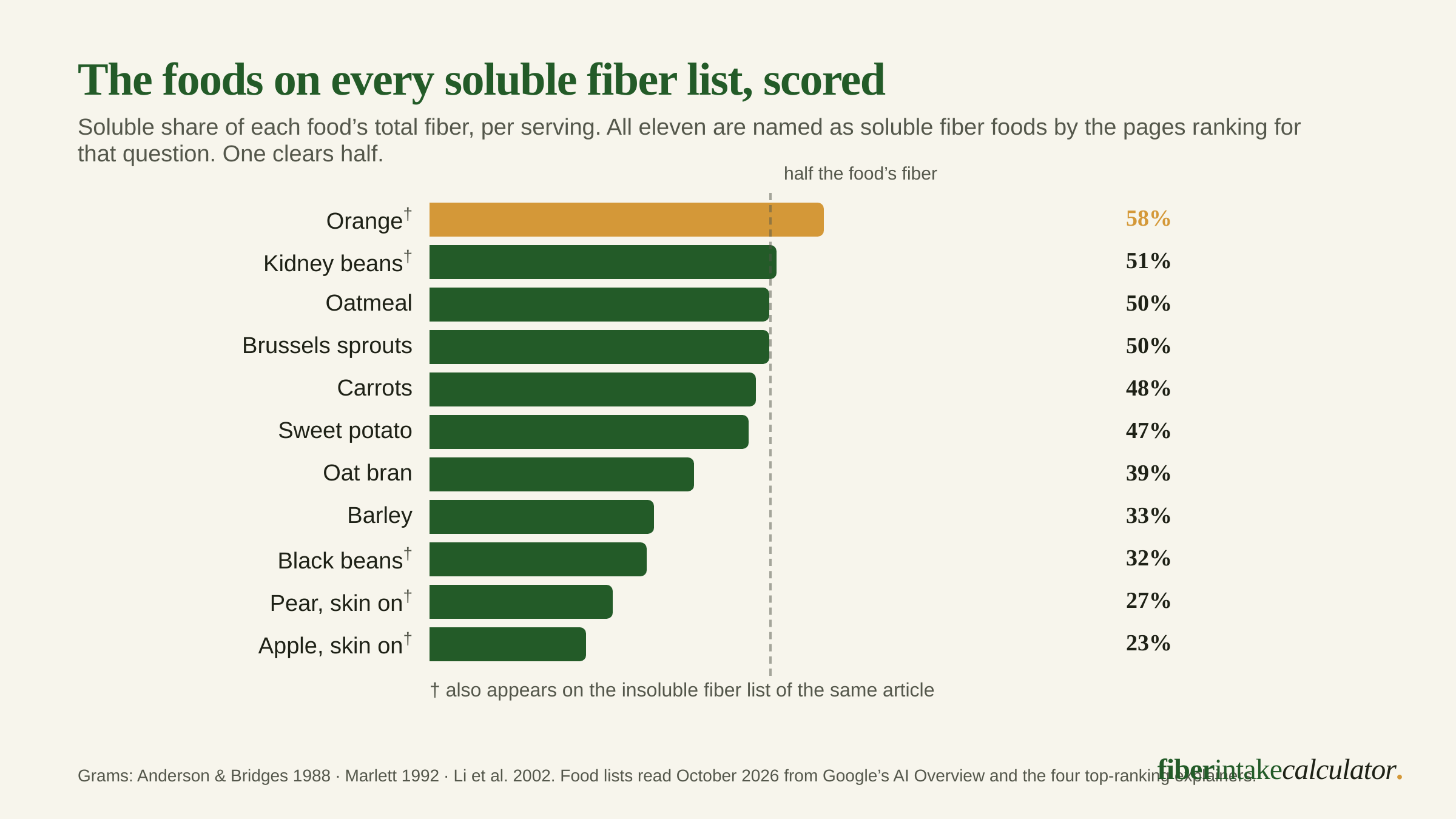
Eleven of the whole foods in the table below appear on the soluble side of the food lists that rank for this question. Exactly one of them is majority soluble by weight: an orange, at 58%. Apple with skin, named on nearly every soluble list including the one Google’s AI Overview shows, is 23% soluble and 77% insoluble.
The split is real. The lists are not. Every plant food carries both fibers, and across the 13 whole foods we hold laboratory splits for, the pooled ratio is 38.8% soluble to 61.2% insoluble.
The short answer. Soluble fiber forms a gel and does the measurable work on cholesterol, blood sugar and even constipation. Insoluble fiber adds bulk. You do not get to choose between them when you eat food, only when you buy a supplement, and nearly every supplement on the shelf is soluble.
The difference, in one table
One property separates them, and the name says it: soluble fiber dissolves in water, insoluble fiber does not. Everything else follows from that.
| Soluble fiber | Insoluble fiber | |
|---|---|---|
| In water | Dissolves, forming a viscous gel | Stays intact, holds water on its surface |
| Named types | Beta-glucan, psyllium mucilage, pectin, gums, inulin and fructooligosaccharide, wheat dextrin, resistant starch | Cellulose, most hemicellulose, lignin |
| Found in | Oats and barley, beans, citrus, the flesh of fruit, psyllium husk | Wheat bran and whole grains, nuts and seeds, the skins and stalks of produce |
| What the gel does | Slows gastric emptying, traps bile acids, holds water in the stool | No gel. Coarse particles mechanically stimulate secretion |
| Measured effects | LDL cholesterol, irritable bowel symptoms, stool frequency | Stool bulk, and only when the particles stay coarse |
The named-types row is the one worth keeping. “Soluble” is not one substance: psyllium mucilage and inulin are both soluble and they behave nothing alike, which is the crack that the whole soluble-versus-insoluble frame eventually falls through. Our explainer on what fiber actually does takes that apart mechanism by mechanism.
Every food has both, and the split is rarely what the lists imply
USDA FoodData Central publishes total dietary fiber only. There is no official soluble and insoluble breakdown to look up, which is why the food lists on this topic are category assertions rather than measurements. The grams in our table come from peer-reviewed laboratory analyses instead (Anderson and Bridges 1988; Marlett 1992; Li and colleagues 2002).
Put those grams against the lists and the lists come apart. Of the 11 whole foods that published lists place on the soluble side, 1 is majority soluble, 5 are an even split, and 5 are majority insoluble. One convention throughout: majority soluble above 55%, even split 45% to 55%, majority insoluble below 45%.
Worse than the mislabelling is the double-labelling. Five of those 11 foods are named on both the soluble and the insoluble list of the same article. Healthline, the highest-ranking non-institutional page on this query, puts apples, pears, citrus, broccoli, rye, chia seeds and legumes on both sides of one table, which leaves the table unable to answer the question it was built for. Google’s AI Overview does the same in fewer words: beans appear in its soluble list and in its insoluble list, four lines apart.
How to read a soluble fiber food list from now on. Treat it as a list of foods that contain some soluble fiber, which is nearly all of them. Oat bran, barley and black beans are genuinely useful sources of soluble grams. They are also 39%, 33% and 32% soluble, so most of what you get from them is the other fiber.
Two rows in the table validate the lists rather than breaking them, and they are the two nobody argues about. Psyllium husk is 88% soluble, which is why MedlinePlus files it under soluble fiber and why it dominates the supplement aisle. Whole flaxseed is 39% soluble, and the lists file it under insoluble. When a published list is right, it tends to be right about a seed or a husk rather than a fruit.
The honest caveat is that this literature is thin and does not always agree with itself. For one food the published analyses differ by nearly fivefold on the soluble fraction of a half cup, which is why there is no lentil row here at all. The full comparison of what each source claims is on our page about soluble fiber in lentils, and how we check every figure before it ships is on our methodology page.
So what is the actual ratio?
Across the 13 whole foods in the table, 21.9 g of soluble fiber against 34.6 g of insoluble, a total of 56.5 g. That is 38.8% soluble and 61.2% insoluble, or about one part soluble to every 1.6 parts insoluble.
No authority sets a target for either fraction, and the ratio above is why: eat ordinary plant food in ordinary amounts and you land near two parts insoluble to one part soluble without aiming at anything. Every published target is total fiber:
| Target | Amount | What it covers |
|---|---|---|
| Institute of Medicine, women 19 to 50 | 25 g a day | Total fiber |
| Institute of Medicine, men 19 to 50 | 38 g a day | Total fiber |
| Institute of Medicine, after 50 | 21 g and 30 g | Total fiber |
| FDA Daily Value on labels | 28 g a day | Total fiber |
| Soluble fiber, any authority | No target | Not set |
Two numbers come close to a soluble target without being one. Under 21 CFR 101.81 a product may tie itself to reduced coronary heart disease risk only alongside 7 g a day or more of soluble fiber from psyllium husk, or 3 g a day of beta-glucan from whole oats or barley. The Adult Treatment Panel III diet lists 10 to 25 g a day of viscous fiber as an option for lowering LDL. Those are claim thresholds and a therapeutic option, not intakes anyone is told to hit. Our soluble fiber calculator totals the soluble grams in a day’s food against them, and the fiber intake calculator gives you the total-fiber number that actually has an official basis.
Which one is better, goal by goal
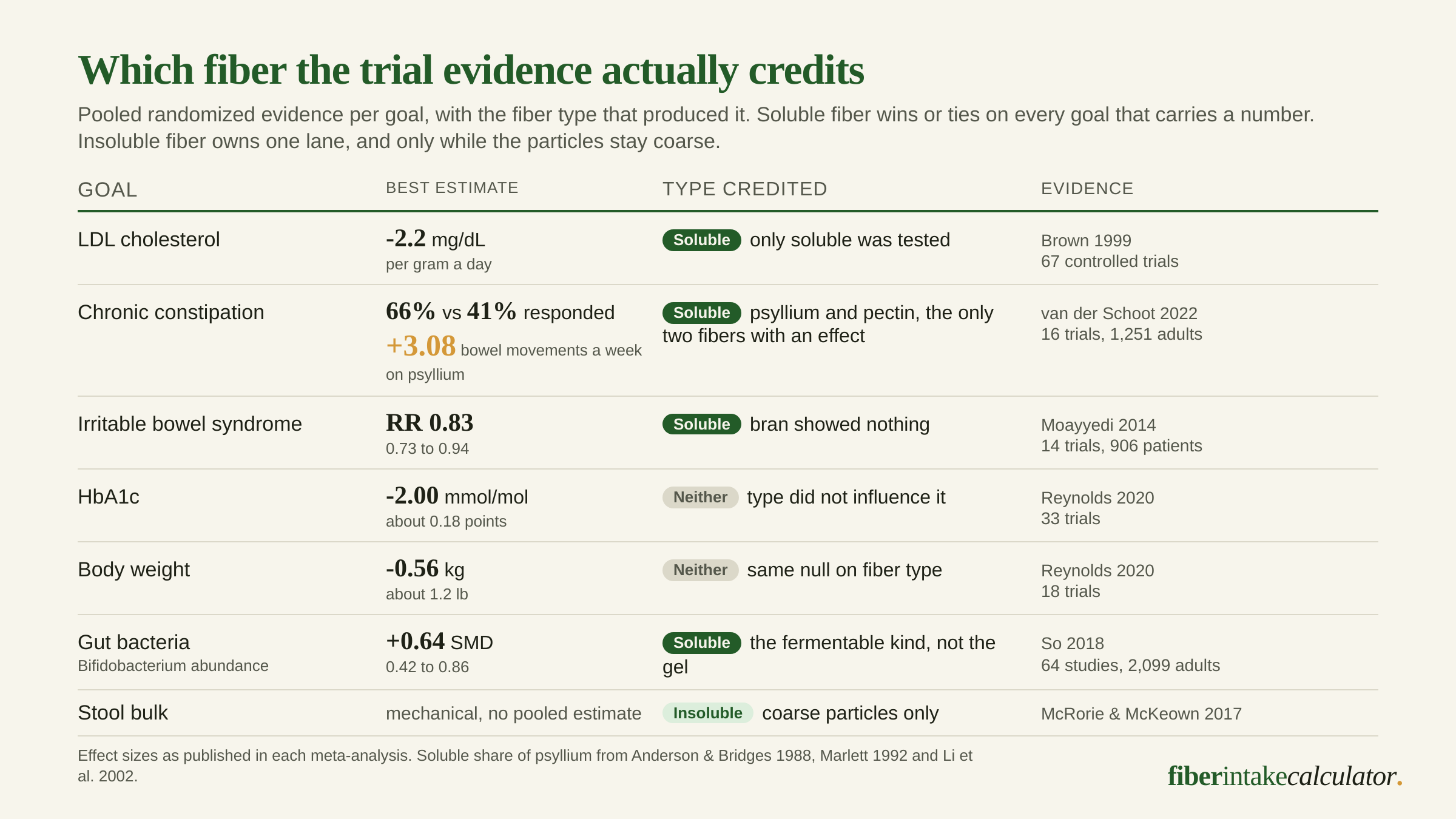
The comparison tables on this topic are qualitative. The best of them, on the page ranking sixth, is literally one checkmark against two checkmarks. Pooled randomized evidence exists for most of those rows, so here it is with the effect size and the fiber that produced it.
| Goal | Best estimate | Type credited | Evidence |
|---|---|---|---|
| LDL cholesterol | -2.2 mg/dL per gram a day | Soluble. Only soluble fiber was tested | Brown 1999, 67 controlled trials |
| Chronic constipation | 66% vs 41% responder rate | Psyllium and pectin, the only two fibers with significant effects | van der Schoot 2022, 16 trials, 1,251 adults |
| Stool frequency | +3.08 a week, psyllium | Soluble. Psyllium is 88% soluble | van der Schoot 2022 |
| Irritable bowel syndrome | RR 0.83 0.73 to 0.94 | Soluble. Bran showed nothing, RR 0.90 (0.79 to 1.03) | Moayyedi 2014, 14 trials, 906 patients |
| HbA1c | -2.00 mmol/mol about 0.18 points | Neither. Fiber type did not influence it | Reynolds 2020, 33 trials |
| Body weight | -0.56 kg about 1.2 lb | Neither. Same null on fiber type | Reynolds 2020, 18 trials |
| Gut bacteria | +0.64 SMD Bifidobacterium | Soluble, but the fermentable kind, not the gel kind | So 2018, 64 studies, 2,099 adults |
| Stool bulk | Mechanical stimulation of water and mucous secretion | Coarse insoluble particles only | McRorie and McKeown 2017 |
Read down the type column. On every goal with a pooled number, soluble fiber either wins or ties. The one lane insoluble fiber owns outright is mechanical bulking, and that lane is narrow: the same review notes that finely milled wheat bran, from the same grain as the coarse bran that works, can be constipating.
Two rows deserve the caveat. The constipation result is a supplement result, and the dose clause matters more than the headline: the benefit showed up above 10 g a day, held for four weeks or longer. Our page asking whether fiber makes you poop sets that against the trials where reducing fiber also helped. And the HbA1c row is the strongest evidence against the premise of the whole comparison: meta regression across 42 trials found fiber type did not influence the improvement in HbA1c, fasting glucose, total cholesterol, LDL or triglycerides, which our fiber for diabetes page works through marker by marker.
Where the solubility split stops predicting
Solubility is a laboratory property. It describes what a fiber does in a test tube, and it was adopted as a nutrition category because it was the thing analysts could measure.
The properties that predict outcomes are gel formation, particle size and fermentability. Those cut across solubility rather than along it. Psyllium and inulin are both soluble; psyllium gels and resists fermentation, inulin does neither, and only psyllium has a laxative effect. Coarse and finely milled wheat bran are both insoluble, from the same grain, and they behave in opposite directions. Our page on high-fiber foods for gut health sorts fibers by those axes instead, with the trial effect sizes attached.
This is why the two sides of our split table are useful for shopping and useless for prediction. Use the grams to see what is actually in your food. Use the mechanism to decide what to change.
How to get both without counting either
The practical answer is a shape of day, not a ratio.
- For the gel side, eat something from the top of the soluble column most days. Oat bran at 2.2 g of soluble fiber per three-quarter cup, cooked kidney beans at 2.9 g per half cup, or a tablespoon of psyllium at 7.0 g. Our soluble fiber table ranks them all.
- For the bulk side, keep skins on and choose whole grains. Apple with skin delivers 3.4 g of insoluble fiber and a pear 4.0 g, and the whole grains ranking puts every grain on one serving basis. The insoluble fiber ranking sorts the same table the other way.
- For the total, which is the only number with an official target, use the calculator and the beans and legumes ranking, because legumes are the shortest route to a 25 g or 38 g day from food.
- If you are buying a supplement, know that you are buying soluble fiber almost whatever you pick. Our comparison of the best fiber supplements works out how many spoonfuls or capsules each product takes to reach the 7 g psyllium threshold.
Every figure on this page traces to a named analysis or a federal rule, all listed on our sources page.
The table, scored
Each row shows the soluble share of that food’s total fiber, which side of the published food lists it sits on, and the verdict under the convention above. Sort by any column.
| Food | Soluble share (%) | Listed as | Verdict | Soluble (g) | Insoluble (g) | Serving |
|---|---|---|---|---|---|---|
| Psyllium husk | 88 | Soluble list | Majority soluble | 7 | 1 | 1 tbsp |
| Orange | 58 | Both lists | Majority soluble | 1.8 | 1.3 | 1 medium |
| Kidney beans, cooked | 51 | Both lists | Even split | 2.9 | 2.8 | 1/2 cup |
| Oatmeal, cooked | 50 | Soluble list | Even split | 2 | 2 | 1 cup |
| Brussels sprouts, cooked | 50 | Soluble list | Even split | 1 | 1 | 1/2 cup |
| Carrots, cooked | 48 | Soluble list | Even split | 1.1 | 1.2 | 1/2 cup |
| Sweet potato, cooked | 47 | Soluble list | Even split | 1.8 | 2 | 1 medium |
| Oat bran, cooked | 39 | Soluble list | Majority insoluble | 2.2 | 3.5 | 3/4 cup |
| Flaxseed, whole | 39 | Insoluble list | Majority insoluble | 1.1 | 1.7 | 1 tbsp (10 g) |
| Barley, cooked | 33 | Soluble list | Majority insoluble | 1 | 2 | 1/2 cup |
| Black beans, cooked | 32 | Both lists | Majority insoluble | 2.4 | 5.1 | 1/2 cup |
| Avocado | 31 | Neither list | Majority insoluble | 2.1 | 4.6 | half (100 g) |
| Pear, with skin | 27 | Both lists | Majority insoluble | 1.5 | 4 | 1 medium |
| Apple, with skin | 23 | Both lists | Majority insoluble | 1 | 3.4 | 1 medium |
Soluble and insoluble grams are compiled from peer-reviewed analyses (Anderson & Bridges 1988; Marlett 1992; Li et al. 2002), because USDA FoodData Central publishes total fiber only. The share column is soluble divided by the row total. "Listed as" records which side of the published soluble and insoluble food lists the food sits on, read in October 2026 from Google's AI Overview and the four highest-ranking explainers (Mayo Clinic, MedlinePlus, Healthline, WebMD). Verdict uses one convention throughout: majority soluble above 55%, even split 45% to 55%, majority insoluble below 45%. See methodology.
Frequently asked questions
Is it better to take soluble fiber or insoluble fiber?
Soluble, if you are choosing a supplement, because that is where the trial evidence sits. Psyllium raised stool frequency by 3.08 bowel movements a week and was one of only two fibers with a significant effect on chronic constipation (van der Schoot et al., 2022). Soluble fiber lowered LDL cholesterol by about 2.2 mg/dL for every gram taken daily (Brown et al., 1999) and reduced persisting irritable bowel symptoms at a risk ratio of 0.83, where bran showed nothing (Moayyedi et al., 2014). If you are choosing food rather than a supplement, the question dissolves: every plant food carries both, and the ratio is not yours to pick.
What helps you poop better, soluble or insoluble fiber?
Soluble, which is the opposite of what the standard advice says. The best-measured laxative in the pooled trials is psyllium, a soluble fiber that is 88% soluble in our table, at 3.08 extra bowel movements a week. Insoluble fiber does have a real mechanism, mechanical stimulation by coarse particles, but it depends on particle size: finely milled wheat bran from the same grain can be constipating (McRorie and McKeown, 2017).
Is Metamucil soluble fiber or insoluble fiber?
Soluble. Its active ingredient is psyllium husk, which our split table records at 7.0 g soluble against 1.0 g insoluble per tablespoon, so it is 88% soluble. Nearly every fiber supplement on the shelf is soluble, which is worth knowing if you went looking for one because an article told you insoluble fiber is the one for regularity.
Are chia seeds soluble or insoluble fiber?
Both, and the published lists cannot agree which side to file them on: Healthline's own food table lists chia seeds under soluble and under insoluble. The measured neighbour we hold data for is whole flaxseed, at 1.1 g soluble and 1.7 g insoluble per tablespoon, so 39% soluble. We do not publish a chia row because we have not found a laboratory split for it we can stand behind.
What is the right ratio of soluble to insoluble fiber?
No authority publishes one, and the foods decide it for you. Across the 13 whole foods in our split table the pooled ratio is 38.8% soluble to 61.2% insoluble, roughly one part soluble to every 1.6 parts insoluble. The Institute of Medicine sets 25 g a day for women and 38 g for men aged 19 to 50, and the FDA Daily Value on labels is 28 g. All of those are total fiber.
Built and maintained by the FiberIntake team, with data from USDA FoodData Central and peer-reviewed sources. Figures are checked against the cited source before publish. About this site →