High-Fiber Foods for Gut Health, and the Fibers Your Bacteria Actually Eat
Last updated: September 27, 2026
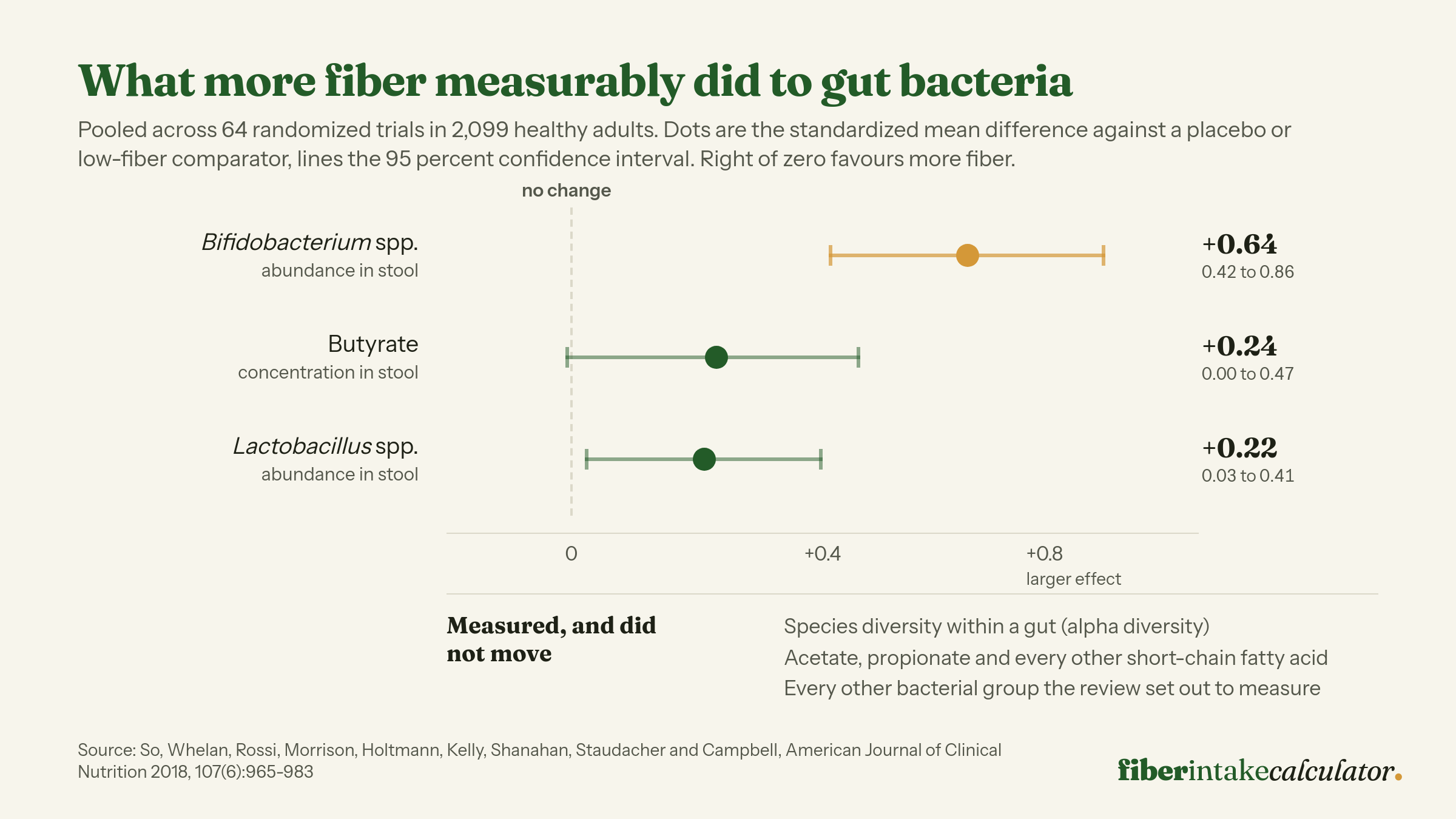
Across 64 randomized trials in 2,099 healthy adults, adding fiber raised Bifidobacterium abundance by a standardized mean difference of 0.64 (95% CI 0.42 to 0.86) and fecal butyrate by 0.24 (0.00 to 0.47). Bacterial diversity within the gut did not change at all (So et al., American Journal of Clinical Nutrition 2018).
Every page on this keyword tells you fiber feeds your gut bacteria, then hands you a list of foods sorted by total grams. Total grams is not the variable that moved those bacteria. The fiber family was.
This page carries the effect size for each measured outcome, the null results alongside them, the daily dose at which each fiber type changed something in a dose-ranging trial, and the reason the fibers with the strongest bacterial evidence are partly invisible in the food tables everyone ranks by. Clinical figures name their study and are listed in full on our sources page. Food figures are computed from USDA FoodData Central records read in September 2026.
What more fiber actually did to gut bacteria
The review below is the one that put numbers on this question: a systematic search of randomized controlled trials of fiber against a placebo or low-fiber comparator in healthy adults, pooled as standardized mean differences.
| What was measured | Effect of more fiber | 95% confidence interval | P value |
|---|---|---|---|
| Bifidobacterium abundance | +0.64 | 0.42 to 0.86 | < 0.00001 |
| Fecal butyrate concentration | +0.24 | 0.00 to 0.47 | 0.05 |
| Lactobacillus abundance | +0.22 | 0.03 to 0.41 | 0.02 |
| Alpha diversity (species variety within one gut) | no difference | - | - |
| Acetate, propionate and other short-chain fatty acids | no difference | - | - |
| Every other bacterial group the review specified | no difference | - | - |
Read the units before the size. A standardized mean difference of 0.64 means the average treated participant sat about two thirds of a standard deviation above the average control participant. It is a moderate effect, measured reliably, on one genus.
Then read what is not on the list. Alpha diversity, the number most gut-health marketing points at, did not move. Butyrate scraped past significance with a confidence interval whose lower bound sits on zero. Acetate and propionate did not move.
The subgroup carried the whole result. Splitting the trials by fiber type, it was fructans and galacto-oligosaccharides that produced significantly greater abundance of both genera, at P < 0.00001 and P = 0.002. The review's own conclusion names those two families. "Eat more fiber" is a rounding of a finding that was specific about which fiber.
The fibers with the best bacterial evidence are missing from the fiber numbers
This is the fact that reorganizes the whole topic, and no page in the top twenty results for this query mentions it.
Fructans are inulin and oligofructose. Inulin is a chain of fructose units, counted as oligofructose when the chain is short. They are the family that carried the bifidobacteria result above. They are also, per van Loo and colleagues in Critical Reviews in Food Science and Nutrition (1995), not measured by classic methods of dietary fiber analysis, and consequently often not mentioned in food tables. That review put western intake at 1 to 10 grams per person per day, sitting outside the numbers used in nutritional recommendations.
USDA put a figure on the American version of that. Using two 24-hour recalls from more than 15,000 people in the 1994 to 1996 Continuing Survey of Food Intakes by Individuals, average intake was 2.6 grams of inulin and 2.5 grams of oligofructose a day, ranging from 1.3 grams in young children to 3.5 grams in teenage boys and adult men. Two foods supplied nearly all of it: wheat at about 70 percent and onions at about 25 percent (Moshfegh et al., Journal of Nutrition 1999).
Now look at what a fiber ranking says about onions. A full cup of chopped raw onion carries 2.7 grams of total fiber in USDA records. Three cloves of garlic carry 0.2 grams. Those numbers get onions cut from every high-fiber food list in the search results, including the ones with “gut health” in the title, while USDA’s own survey has onions supplying a quarter of the country’s intake of the fiber family with the strongest bacterial evidence behind it.
What to do with this. Keep eating the legumes and the berries for the grams. Stop treating the onion, the leek and the head of garlic as fiber-free seasoning. The gram count on a food table is not measuring the part of them that matters here.
The same gap explains a smaller puzzle. Wheat is the largest American source of these fibers, per that survey, and wheat products are also the standard example of insoluble bulking fiber. One food, two different fiber jobs, and only one of them shows up in the total.
Fermented, or bulky: the two jobs pull in opposite directions
Fiber does not have one mechanism in the gut. It has several, and the conditions that make a fiber good at one make it bad at another.
McRorie and McKeown set this out in the Journal of the Academy of Nutrition and Dietetics in 2017, and the single most useful sentence in it is about laxation. There are only two mechanisms that drive a laxative effect in the large bowel: coarse insoluble particles such as wheat bran that mechanically stimulate water and mucous secretion, and the water-holding capacity of gel-forming soluble fiber such as psyllium. Both require the fiber to resist fermentation and remain relatively intact, which is to say still present in the stool.
A fiber that gets fermented has, by definition, been consumed before it reaches the end. That is the point when you are feeding bacteria. It is the problem when you want a bowel movement.
| Fiber group | Examples | Viscous | Fermented | What it is good at |
|---|---|---|---|---|
| Gel-forming soluble | Beta-glucan, psyllium, raw guar gum | Yes | Resists it | Lowering cholesterol, improving glycemic control, holding stool water |
| Non-viscous soluble | Inulin, fructooligosaccharide, wheat dextrin | No | Readily | Feeding bacteria. No viscosity-dependent benefit, and no laxative effect |
| Coarse insoluble | Wheat bran, large particles | No | Resists it | Mechanical laxation. No cholesterol or glucose effect |
| Fine insoluble | Finely milled wheat bran | No | Resists it | Little. The same review notes it can be constipating |
The physical reason viscous fiber resists fermentation is worth a line. A soluble fiber that holds a lot of water and forms a gel keeps itself relatively shielded from microbial enzymes, which is why viscosity and fermentability tend to trade off (Fu et al., Microorganisms 2022). Short chains and small particles do the opposite, which is why the oligosaccharides ferment fastest.
None of this makes the soluble and insoluble split wrong. It makes it incomplete, which is the argument our soluble fiber page, the insoluble fiber table and the comparison of the two all run into: soluble covers a gel-forming psyllium and a freely fermented inulin, and those two behave nothing alike. Solubility is one axis. Viscosity and fermentability are the other two, and they are the ones this topic turns on.
The practical version. If your goal is bacteria, you want the fibers that get eaten in the colon. If your goal is regularity, you want the fibers that survive it. Most people want both, which means two different foods rather than more of one. Our fiber for constipation page covers the second job, dose by dose.
The dose at which each fiber actually changed something
Guidance on this subject almost never gives a gram figure for the microbiota specifically. There is one, or rather eleven, because a set of dose-ranging trials gave healthy adults several amounts of a single fiber and looked at what changed and where.
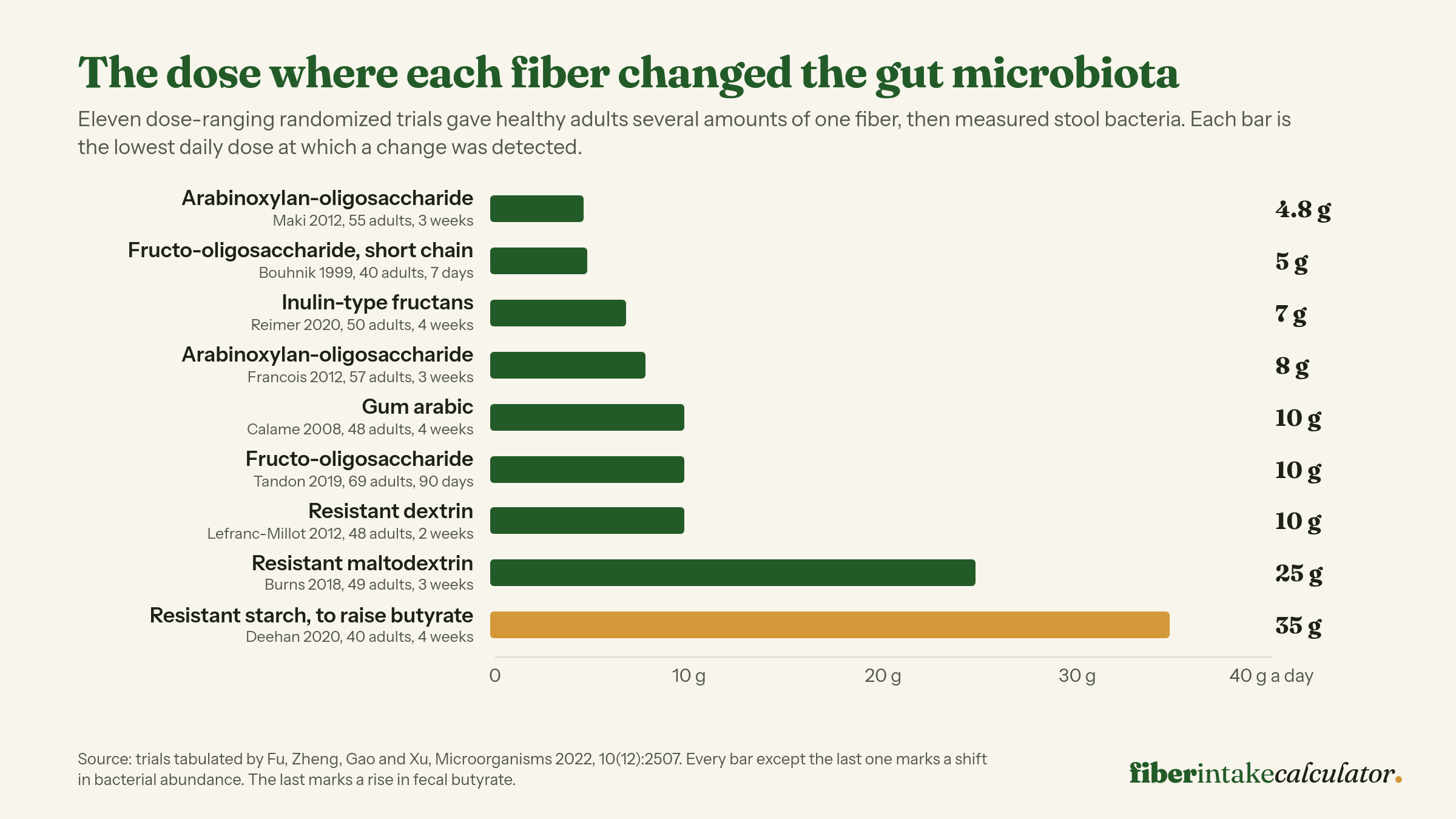
| Fiber | Doses tested | Duration | Lowest dose that changed something | What changed |
|---|---|---|---|---|
| Arabinoxylan-oligosaccharide Maki 2012, 55 adults | 2.2 or 4.8 g | 3 weeks | 4.8 g | Bifidobacterium |
| Fructo-oligosaccharide, short chain Bouhnik 1999, 40 adults | 2.5 to 20 g | 7 days | 5 g | Bifidobacteria |
| Inulin-type fructans Reimer 2020, 50 adults | 3 or 7 g | 4 weeks | 7 g | Bifidobacterium. Diversity and fecal short-chain fatty acids did not move |
| Arabinoxylan-oligosaccharide Francois 2012, 57 adults | 2.4 or 8 g | 3 weeks | 8 g | Bifidobacteria, plus fecal acetate and propionate |
| Gum arabic Calame 2008, 48 adults | 5 to 40 g | 4 weeks | 10 g | Bifidobacteria, lactobacilli, bacteroides |
| Fructo-oligosaccharide Tandon 2019, 69 adults | 2.5 to 10 g | 90 days | 10 g | Alpha diversity and six genera. Reversed after stopping |
| Resistant dextrin Lefranc-Millot 2012, 48 adults | 10 to 20 g | 2 weeks | 10 g | Bacteroides at 10 g, less Clostridium perfringens at 15 g, lower colonic pH at 20 g |
| Inulin Kolida 2007, 30 adults | 5 or 8 g | 2 weeks | none identified | Bifidobacteria rose, depending on starting abundance |
| Resistant maltodextrin Fastinger 2008, 38 adults | 7.5 or 15 g | 3 weeks | none identified | Propionate share rose linearly |
| Resistant maltodextrin Burns 2018, 49 adults | 15 or 25 g | 3 weeks | 25 g | Bifidobacteria |
| Resistant starch type 4 Deehan 2020, 40 adults | 10 to 50 g, stepped | 4 weeks | 20 g | Maize: community shifts at 20 g, fecal butyrate at 35 g. Tapioca: propionate at 35 g. Potato: no effect at any dose |
Those eleven trials are tabulated together by Fu and colleagues in Microorganisms (2022), and each is listed individually on our sources page.
Three patterns come out of that table, and all three are useful.
The short-chain fibers work at small doses. Arabinoxylan-oligosaccharide at 4.8 grams and short-chain fructo-oligosaccharide at 5 grams are the two lowest thresholds on the list, and both are a fraction of a daily fiber target. Short chains ferment fast.
Raising a short-chain fatty acid costs far more than shifting a genus. In the resistant starch trial, community structure shifted at 20 grams and fecal butyrate only rose at 35. The bacteria change before their output does.
The same fiber, from a different plant, did nothing. That trial gave three preparations of the same fiber type. Maize and tapioca resistant starch each changed something. Potato resistant starch produced no detectable effect at any dose up to 50 grams. Fiber type is not a fine enough description to predict a result.
One caution about all of it. Every trial here used an isolated fiber, most ran two to four weeks, and the outcome is stool composition, not a symptom or a disease. A shift in Bifidobacterium is a biological signal. It is not evidence that you feel better, and no page should sell it as one.
Diversity is the wrong thing to chase
A more diverse gut being a healthier gut is the premise of a whole product category. The trial evidence does not support using fiber to buy it.
The 64-trial review found no difference in alpha diversity between fiber and comparator. The larger narrative review of this literature goes further: across the randomized trials of specific fibers in healthy people, alpha diversity was observed to decrease in several and to stay stable in others, with no consistent direction (Fu et al., 2022). One of the trials in the dose table above, the 90-day fructo-oligosaccharide trial, did raise a diversity index at 10 grams, and the same paper notes the effect reversed once people stopped.
What is consistent is beta diversity, the difference between one population’s gut community and another’s. Populations eating high-fiber diets reliably carry a different community structure from populations eating western ones. That is a real and repeatable finding, and it is not the same claim as a diversity score you can raise in a month.
The honest summary. Fiber changes which bacteria are there. It does not reliably change how many kinds are there. Any product promising to raise your microbiome diversity score is promising the outcome that did not move.
High-fiber foods for gut health, with what is known about each one
Here is the food ranking the query asks for, computed from USDA FoodData Central records, with a column almost nobody prints: what the evidence actually resolves about the fiber in that food. The blanks are the point. For most of the food supply, the fiber is a single total with no family attached to it.
| Food | Serving | Fiber (g) | What is known about its fiber |
|---|---|---|---|
| Lentils, cooked | 1 cup (198 g) | 15.6 | Legume fiber is high in the insoluble fraction and highly fermentable in the colon, per UF IFAS Extension |
| Black beans, cooked | 1 cup (172 g) | 15.0 | Same legume pattern |
| Chickpeas, cooked | 1 cup (164 g) | 12.5 | Same legume pattern |
| Green peas, cooked | 1 cup (160 g) | 8.8 | Same legume pattern |
| Edamame, cooked | 1 cup (155 g) | 8.1 | Same legume pattern |
| Raspberries | 1 cup (123 g) | 8.0 | Fruit fiber carried the diverticulitis signal in cohort data. Family not resolved in food tables |
| Artichoke, cooked | 1 medium (120 g) | 6.8 | Not resolved into families in food composition data |
| Wheat bran, crude | 1/4 cup (14.5 g) | 6.2 | The reference coarse insoluble fiber. Laxative by mechanical stimulation, resists fermentation |
| Barley, pearled, cooked | 1 cup (157 g) | 6.0 | Carries beta-glucan, the gel-forming fiber behind the FDA heart claim |
| Apple, with skin | 1 medium (169 g) | 4.1 | Not resolved into families in food composition data |
| Oatmeal, cooked | 1 cup (234 g) | 4.0 | Carries beta-glucan, gel-forming and viscous |
| Potato, russet, baked in skin | 1 medium (173 g) | 4.0 | Not resolved. Note that potato resistant starch was the one preparation that changed nothing in the dose trial |
| Oat bran, raw | 1/4 cup (23.5 g) | 3.6 | Carries beta-glucan at higher concentration than rolled oats |
| Carrots, raw | 1 cup chopped (128 g) | 3.6 | Not resolved into families in food composition data |
| Prunes, dried | 5 prunes (47.5 g) | 3.4 | Not resolved. Tested directly against psyllium in constipation trials |
| Banana | 1 medium (118 g) | 3.1 | Not resolved into families in food composition data |
| Onion, raw | 1 cup chopped (160 g) | 2.7 | About 25 percent of American inulin and oligofructose intake, per USDA survey data, and almost none of it is inside this gram figure |
| Kiwifruit, green | 1 fruit (69 g) | 2.1 | Not resolved. Tested directly in constipation trials |
| Asparagus, cooked | 1/2 cup (90 g) | 1.8 | Not resolved into families in food composition data |
| Leeks, raw | 1 cup (89 g) | 1.6 | Not resolved into families in food composition data |
| Garlic, raw | 3 cloves (9 g) | 0.2 | Not resolved into families in food composition data |
The top of that table is the standard advice and it is correct. Legumes are the densest thing on the list by a wide margin, which is why our legume ranking computes the whole category from USDA records and why the general food chart puts them first.
The bottom of the table is where this page differs from the other nineteen results. Onion at 2.7 grams and garlic at 0.2 grams would be cut from any list sorted by the number in the third column, and the fourth column is the reason not to cut them.
Barley and oats deserve their own note. Beta-glucan is the gel-forming fiber that resists fermentation, which makes them a poor choice by the logic of this page and an excellent one by the logic of cholesterol and blood sugar. Our whole grains ranking separates the dry and cooked figures, which is where most published grain numbers go wrong. How we handle food figures generally is on our methodology page.
Adding it: the ramp, and who should be careful
Rapid fermentation is the mechanism and also the side effect. Gas is what fermentation produces.
The American Diabetes Association’s nutrition consensus report puts the practical ceiling plainly: intakes above 50 grams a day bring A1C down 0.2 to 0.3 points and frequently bring flatulence, bloating and diarrhea with them. Below that, the standard advice to add a few grams a week rather than a few grams a day exists because the bloating from a sudden jump is what makes people quit. The same ramp logic runs through our piece on fibermaxxing, where the calorie cost of very high intakes is the part usually left out.
Two groups should treat the fermentable fibers with more caution than a general audience.
Irritable bowel syndrome. In 14 randomized trials in 906 patients, soluble fiber reduced persisting symptoms at RR 0.83 (95% CI 0.73 to 0.94) while wheat bran did not, at RR 0.90 (0.79 to 1.03), per Moayyedi and colleagues in the American Journal of Gastroenterology (2014). That review did not test rapidly fermentable fibers as a separate arm, and rapidly fermentable carbohydrate is the basis of the restriction diets used in that condition, so more fermentation is not automatically the goal.
Anyone on a prescribed fiber restriction. Recovery from bowel surgery, an active flare, or a colonoscopy preparation all cut fiber deliberately. Our low-fiber diet page covers what those diets allow.
If a supplement is how you would rather close a gap, our fiber supplement comparison lists the labeled dose of each product, and the dose table above is the right thing to read it against, because most of the trials in that table used exactly these kinds of isolated fibers.
How much, in the end
The dose thresholds above are per fiber, in a trial, for a stool measurement. Your daily target is a different number answering a different question.
| Number | What it is | Source |
|---|---|---|
| 14 g per 1,000 kcal | The Adequate Intake, expressed per calorie | Institute of Medicine, 2005 |
| 25 g and 38 g | Adequate Intake for women and men aged 19 to 50 | Institute of Medicine, 2005 |
| 25 to 29 g | Where the population risk curve falls fastest across 185 prospective studies | Reynolds et al., Lancet 2019 |
| 4.8 to 35 g | The span of doses that changed something measurable in gut bacteria, by fiber type | Eleven dose-ranging trials, above |
The overlap is the useful part. A general target in the high twenties covers most of the bacterial thresholds in the table, provided the fiber is not all coming from one source. That is the real argument for variety, and it is a better one than the version usually given, because it names what variety is for: different fiber families ferment differently, and a diet built on one of them only ever tests one.
Work out your own number with the fiber calculator, then read the conditions overview for how this dose compares with the ones tested in specific conditions, including diabetes, where the analysis found fiber type predicted nothing at all. Two topics, two opposite answers about whether type matters, and both are correctly reported.
Frequently asked questions
What fiber is best for gut health?
On the evidence, the fructans and the galacto-oligosaccharides. Pooled across 64 randomized trials in 2,099 healthy adults, fiber raised Bifidobacterium abundance by a standardized mean difference of 0.64 (95% CI 0.42 to 0.86) and Lactobacillus by 0.22 (0.03 to 0.41), and subgroup analysis found those two fiber families were the ones producing significantly greater abundance of both (So et al., American Journal of Clinical Nutrition 2018). Fructans are inulin and oligofructose, which USDA's own intake survey traces mostly to wheat and onions. That is a narrower answer than the usual list, and it is the one the trials support.
What fiber makes it easier to poop?
A different one, and that is the part most gut-health advice skips. There are only two mechanisms that produce a laxative effect in the large bowel: coarse insoluble particles such as wheat bran that mechanically stimulate secretion, and gel-forming soluble fiber such as psyllium that holds water. Both require the fiber to resist fermentation and still be present in the stool (McRorie and McKeown, Journal of the Academy of Nutrition and Dietetics 2017). Soluble fermentable fibers such as inulin, fructooligosaccharide and wheat dextrin do not provide a laxative effect, and that review notes wheat dextrin and fine wheat bran particles can be constipating. So the fiber that feeds bacteria best is close to the opposite of the fiber that moves stool.
How do I get 30 g of fiber a day?
From USDA records, one cup of cooked lentils is 15.6 grams, one cup of cooked black beans is 15.0 grams and one cup of raspberries is 8.0 grams, so a cup of lentils and a cup of raspberries together come to 23.6 grams before anything else on the plate. Average intake in the cohorts behind this literature runs about 19 grams a day, so the practical move is one legume serving added to a day you already eat, then a second one a week or two later. Work out your own target on the calculator first, because 30 grams is above the Adequate Intake for most women and below it for most men.
Is 1 banana a day enough fiber?
No. A medium banana carries 3.1 grams of fiber per USDA records, against an Adequate Intake of 25 grams a day for women and 38 grams for men aged 19 to 50. One banana is roughly a tenth of an adult male target. It is a reasonable thing to eat and it is not a fiber strategy, which is a distinction most single-food advice blurs.
Do fiber supplements feed gut bacteria as well as food does?
For this particular outcome, isolated fibers are where the evidence is. Every one of the eleven dose-ranging trials that established a gram threshold for a microbiota change used an isolated fiber: inulin, fructo-oligosaccharide, gum arabic, arabinoxylan-oligosaccharide, resistant dextrin, resistant maltodextrin or resistant starch. That is close to the reverse of the usual advice to prefer whole foods over supplements. Where food does win is the long-term outcome evidence, which comes from cohorts whose fiber came principally from food rather than from manufactured products with fiber added, and no trial has yet shown supplements deliver comparable long-term clinical benefit.
Built and maintained by the FiberIntake team, with data from USDA FoodData Central and peer-reviewed sources. Figures are checked against the cited source before publish. About this site →