Fiber for IBS, Measured Against the Trials That Tested It
Last updated: October 3, 2026
Every page on this subject reaches the same conclusion: choose soluble fiber, avoid bran. The conclusion is right. What is missing is every number underneath it.
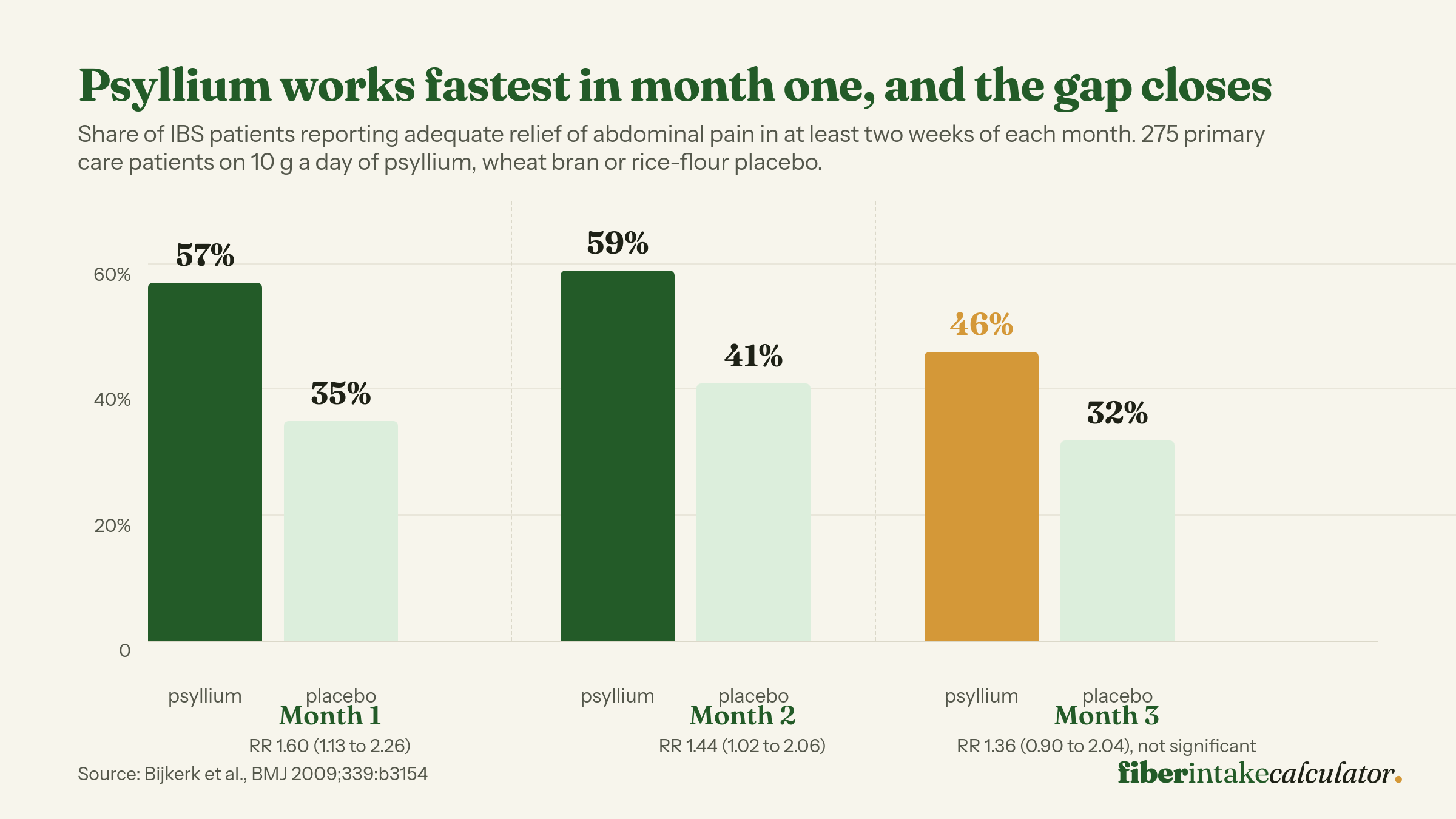
Here is the central one. In 275 primary care patients randomized to 10 grams a day of psyllium, wheat bran or placebo, 57 percent of the psyllium group reported adequate relief of abdominal pain in month one against 35 percent on placebo (relative risk 1.60, 95% CI 1.13 to 2.26), a number needed to treat of four (Bijkerk et al., BMJ 2009).
Three things in that trial decide how you should actually use fiber, and none of them appear in the standard advice: the benefit was largest in month one and gone by month three, bran drove twice as many people to quit as placebo did, and the patients were already eating 26.9 grams of fiber a day before anyone gave them more.
This page carries the tested doses, the month-by-month results, how soluble fiber grades against every other first-line option, and where official guidance says to eat less rather than more. Clinical figures name their study and are listed in full on our sources page. Fiber values in food come from the soluble split dataset described on our methodology page.
What the trial behind the advice actually did
The advice to pick soluble over insoluble fiber rests mostly on one trial, run in Dutch general practice because almost every earlier fiber trial had been done in hospital clinics. Patients took their assigned powder in two daily doses, mixed into food.
| Arm | Patients | Product, daily | Fiber actually added | Total intake reached | Stopped for intolerance |
|---|---|---|---|---|---|
| Psyllium (soluble) | 85 | 10 g psyllium husk | 7.1 g | 35.1 g | 7 |
| Bran (insoluble) | 97 | 10 g wheat bran | 6.5 g | 34.1 g | 18 |
| Placebo | 93 | 10 g rice flour | not applicable | not applicable | 9 |
Two columns in that table do work that the usual food lists cannot. The fourth says patients assigned 10 grams took about 7, which is what adherence looks like in practice. The sixth is the intolerance count, and it is the hard evidence behind the claim that insoluble fiber makes IBS worse.
The tested dose was 10 grams of product a day, taken in two doses with food. Not a food list, and not an instruction to eat more plants. The patients were eating 26.9 grams of fiber a day already.
That baseline figure is worth sitting with. The population who benefited from psyllium was not fiber deficient by any published standard. Mean intake before randomization was 26.9 grams a day (SD 11.8), above the midpoint of the 22 to 34 gram range the Dietary Guidelines for Americans set for adults. The fiber worked as a treatment, in other words, not as the correction of a shortfall. Patient organisation pages that frame IBS as a consequence of eating too little fiber are describing the general population, where average intake really is low, and not the patients in the trial.
The group was 78 percent female, mean age 34.4 years, and 56 percent had constipation predominant IBS. Only 39 percent met the stricter Rome II criteria, which matters for a reason that comes up later.
The benefit is front-loaded, which changes how long you test it
This is the part no competing page prints, and it is the part that tells you when to stop.
| Month | Psyllium | Placebo | Relative risk | 95% confidence interval | Reading |
|---|---|---|---|---|---|
| Month 1 | 45/79 (57%) | 27/78 (35%) | 1.60 | 1.13 to 2.26 | Significant |
| Month 2 | 39/66 (59%) | 27/66 (41%) | 1.44 | 1.02 to 2.06 | Significant |
| Month 3 | 25/54 (46%) | 18/56 (32%) | 1.36 | 0.90 to 2.04 | Interval crosses 1 |
Responders were patients reporting adequate relief in at least two of the previous four weeks, a validated single-question endpoint for this condition. The absolute gap was 22 percentage points in month one (95% CI 7 to 38), which is the number needed to treat of four.
By month three the gap has narrowed to 14 points and the interval includes no effect. Note what is happening on both sides: the psyllium response rate falls from 57 to 46 percent while the placebo rate falls from 35 to 32 percent. Two readings are available and the trial cannot separate them. Either the drug effect genuinely fades, or the groups shrank enough that the same effect stopped reaching significance, since only 54 and 56 patients were still being assessed.
Adjusting for the one baseline imbalance pushes the early effect up rather than down. Patients randomized to psyllium happened to start with slightly milder abdominal pain, and correcting for that in logistic regression raised the month-one relative risk to 2.70 (1.33 to 5.46).
Symptom severity, the secondary endpoint, behaved in the opposite direction over time. Scores fell by 90 points on psyllium against 49 on placebo after three months (P=0.03), while bran’s 58-point fall was indistinguishable from placebo (P=0.61). No arm improved quality of life measurably.
Give it a month, judge it at three. The British Society of Gastroenterology treatment algorithm says to review efficacy after three months of treatment and discontinue if there is no response. The trial data says the same thing from the other direction: if it was going to work, month one is where you saw it.
Two subgroups did better than the whole trial. Restricting the analysis to the 39 percent who met Rome II criteria raised the month-one relative risk to 1.81 (1.12 to 2.94). The constipation predominant subgroup came in at 1.65 (1.05 to 2.62). Both point the same way: the more clearly someone has IBS, the better psyllium looked.
What nobody has is a diarrhea-predominant result from this trial. Every page on this search gives subtype-specific fiber advice, and the trial evidence for splitting by subtype is one constipation subgroup analysis. That gap is worth knowing about before you follow a confident recommendation for IBS with diarrhea.
Why bran gets singled out
Bran has one statistically significant result in this trial, and it is a trap. Bran beat placebo in month three, 57 against 32 percent (relative risk 1.70, 1.12 to 2.57). It did nothing in months one and two.
Then the authors ran the worst case analysis, counting everyone lost to follow-up as a non-responder. Psyllium survived it in months one and two. Bran’s month-three result did not: 1.45 (0.97 to 2.16).
The explanation the authors give is survivorship, and the numbers support it. Eighteen of 97 bran patients stopped because they could not tolerate the supplement, twice the rate in either other arm, and most of those exits happened in the first month. Whoever was still taking bran in month three was a self-selected subset who got on with it.
| What happened | Psyllium | Bran | Placebo |
|---|---|---|---|
| Randomized | 85 | 97 | 93 |
| Completed three months | 54 (64%) | 54 (56%) | 56 (60%) |
| Lost to follow-up, any reason | 31 | 43 | 37 |
| Stopped for intolerance of the supplement | 7 | 18 | 9 |
| Any moderate adverse event | 63 (74%) | 62 (64%) | 61 (66%) |
The adverse event row looks strange next to the intolerance row, and the authors flag why: moderate adverse events were reported at similar rates in all three arms precisely because the people bran bothered most had already left. Diarrhea and constipation were the commonest complaints across all arms. No serious adverse events occurred, and one bran patient reported severe constipation.
Pooled evidence agrees with the single trial. Across 14 randomized trials in 906 patients, fiber of any type reduced the risk of IBS symptoms persisting to 0.86 (95% CI 0.80 to 0.94, number needed to treat 10), soluble fiber to 0.83 (0.73 to 0.94, number needed to treat 7), and wheat bran to 0.90 (0.79 to 1.03), which includes no effect (Moayyedi et al., 2014). The updated pool behind the 2021 British guideline adds a trial for 946 patients and gives 0.87 (0.80 to 0.94).
Our page on soluble and insoluble fiber sets this result beside the six other goals where the two types have been compared head to head, and IBS is the cleanest split of the set.
Soluble is the wrong single axis
Solubility is one property of a fiber. It is not the one that predicts whether a fiber causes gas, and the standard food lists for this condition mix the two up.
The review that both AI Overviews cite most for this topic classifies fiber on four axes: soluble or insoluble, viscous or not, short chain or long chain, fermentable or not. Its central claim is about fermentation speed, not solubility. Short chain, soluble, highly fermentable fibers such as oligosaccharides produce gas faster than the gut can absorb and clear it, which is what causes pain, bloating and flatulence. Long chain, intermediately viscous, moderately fermentable fiber such as psyllium produces little gas (El-Salhy et al., 2017).
Read that carefully and the practical rule changes. Inulin and fructo-oligosaccharides, the fibers added to manufactured foods to make them “high fiber”, are soluble. They are also the fermentable carbohydrates a low FODMAP diet removes. The patient guide written by the Monash group for the International Foundation for Gastrointestinal Disorders names inulin, fructo-oligosaccharides and pectin as readily fermentable fibers for exactly this reason.
| Fiber | Soluble? | Ferments | Viscous gel? | Where it lands in IBS |
|---|---|---|---|---|
| Psyllium husk | Yes | Slowly | Yes | The tested one. Little gas, trial evidence, guideline recommendation |
| Methylcellulose | Yes | Not fermented | Yes | Commonly suggested, no comparable IBS trial base |
| Partially hydrolysed guar gum | Yes | Slowly | Low viscosity | Commonly suggested for sensitive guts |
| Wheat dextrin | Yes | Readily | No | Soluble but non-viscous, no IBS trial base |
| Inulin and fructo-oligosaccharides | Yes | Rapidly | No | Soluble and still a gas problem. Removed on a low FODMAP diet |
| Pectin | Yes | Readily | Yes | The main soluble fiber in apples and pears, and readily fermentable |
| Wheat bran | No | Slowly | No | No measured benefit, highest intolerance rate in the trial |
Five of those seven fibers are soluble, and they behave completely differently. “Choose soluble” cannot tell you apart from one another, which is why a soluble fiber food list that includes pears, apples and inulin-fortified cereal bars can leave someone worse off while they believe they are following the advice. The mechanism behind all of it, gel formation and what the gel does on the way through, is on our soluble fiber page.
Our fiber supplement comparison reads the labels and converts each product to fiber grams per dose, which is the other place these products separate: a dose of powder and a dose of fiber are rarely the same weight.
How much soluble fiber is in actual food
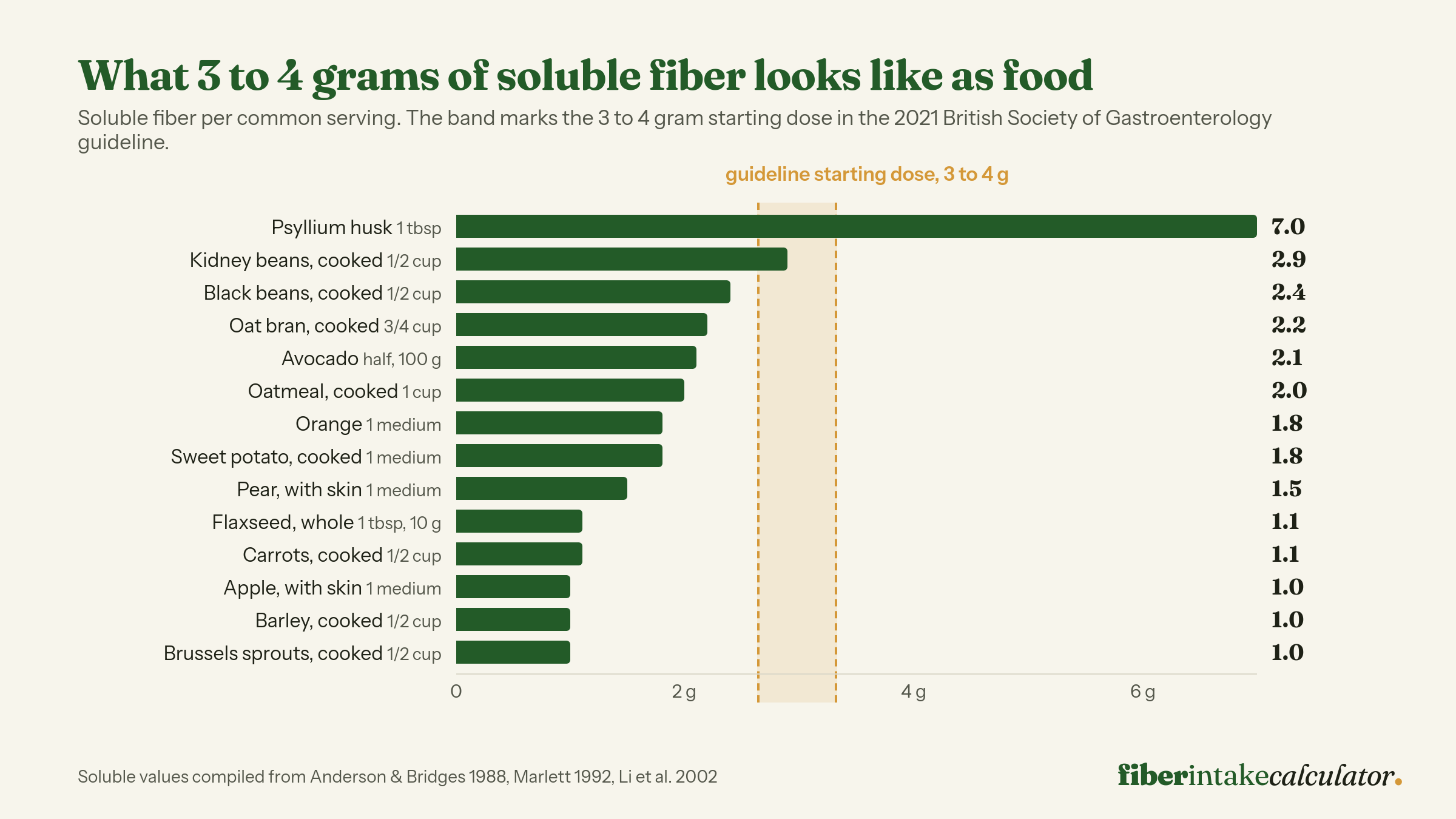
The British guideline’s starting dose is 3 to 4 grams of soluble fiber a day. That is a small number, and it is small on purpose. Here is what it looks like as food.
| Food | Serving | Soluble fiber | Insoluble fiber | Total |
|---|---|---|---|---|
| Psyllium husk | 1 tbsp | 7.0 g | 1.0 g | 8.0 g |
| Kidney beans, cooked | 1/2 cup | 2.9 g | 2.8 g | 5.7 g |
| Black beans, cooked | 1/2 cup | 2.4 g | 5.1 g | 7.5 g |
| Oat bran, cooked | 3/4 cup | 2.2 g | 3.5 g | 5.7 g |
| Avocado | half (100 g) | 2.1 g | 4.6 g | 6.7 g |
| Oatmeal, cooked | 1 cup | 2.0 g | 2.0 g | 4.0 g |
| Orange | 1 medium | 1.8 g | 1.3 g | 3.1 g |
| Sweet potato, cooked | 1 medium | 1.8 g | 2.0 g | 3.8 g |
| Pear, with skin | 1 medium | 1.5 g | 4.0 g | 5.5 g |
| Flaxseed, whole | 1 tbsp (10 g) | 1.1 g | 1.7 g | 2.8 g |
| Carrots, cooked | 1/2 cup | 1.1 g | 1.2 g | 2.3 g |
| Apple, with skin | 1 medium | 1.0 g | 3.4 g | 4.4 g |
| Barley, cooked | 1/2 cup | 1.0 g | 2.0 g | 3.0 g |
| Brussels sprouts, cooked | 1/2 cup | 1.0 g | 1.0 g | 2.0 g |
A single tablespoon of psyllium husk clears the starting dose on its own, which is the practical reason the trials used a supplement rather than a menu. Two portions of beans would also do it, and would bring 8 grams of insoluble fiber along for the ride plus the fermentable oligosaccharides that legumes carry.
The pattern in the last three columns is the thing to take away. Only psyllium delivers soluble fiber without a large insoluble load attached. In food, the ratio is not yours to choose, and anyone telling an IBS patient to get soluble fiber from apples and pears is also handing them 3.4 and 4.0 grams of insoluble fiber and a readily fermentable pectin load.
Soluble and insoluble values here are compiled from published analytical work (Anderson and Bridges 1988, Marlett 1992, Li and colleagues 2002) rather than from USDA FoodData Central, which carries total fiber only. Our methodology page explains the compilation and its limits. For total fiber across a much wider set of foods, the high-fiber foods chart ranks 42 of them from USDA portions.
Where fiber ranks against everything else offered first
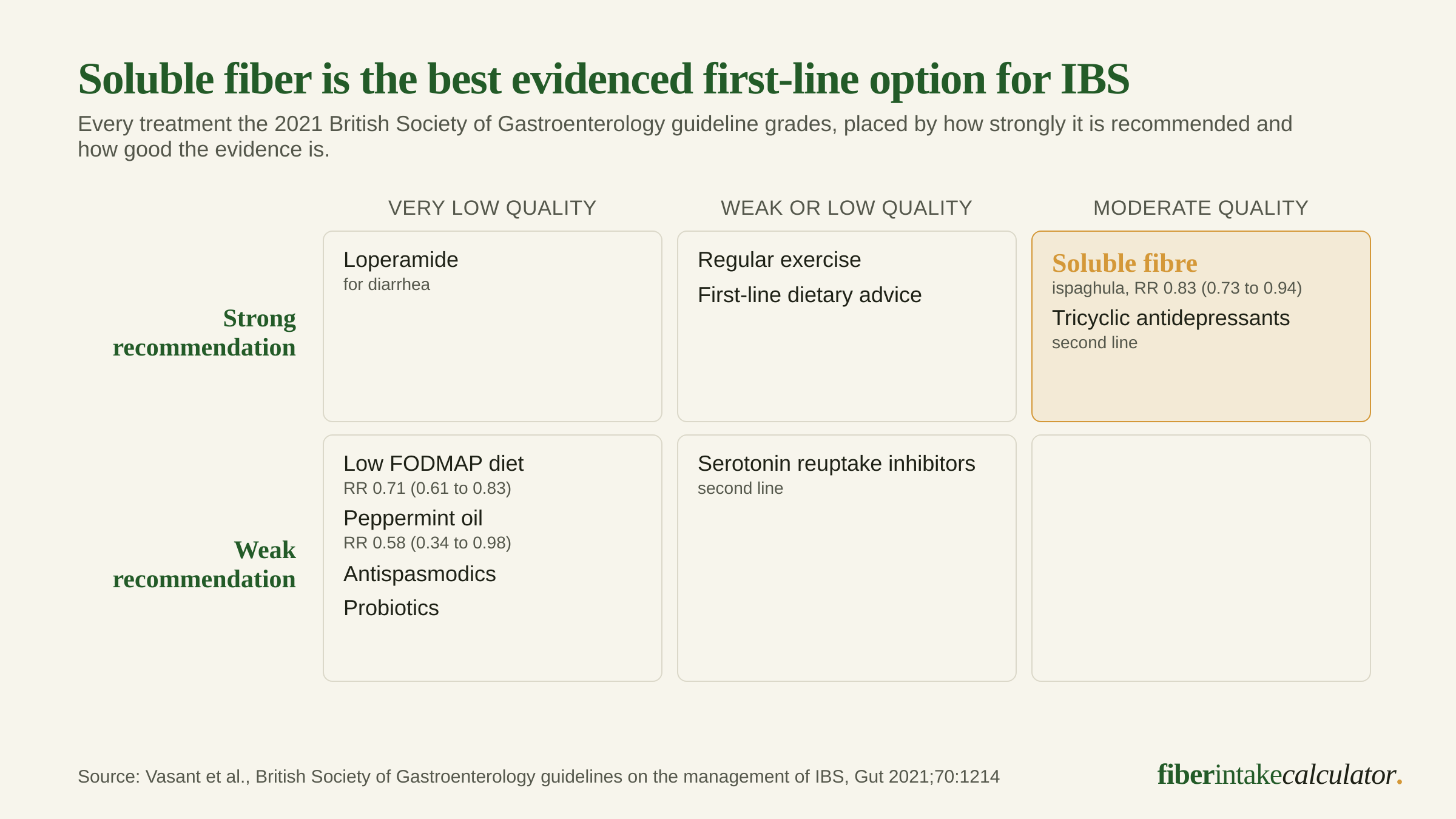
This is the comparison that reframes the whole question, and it is on none of the ranking pages. The 2021 British Society of Gastroenterology guideline grades every treatment it recommends on two scales: how strong the recommendation is, and how good the underlying evidence is. Lining the first-line options up side by side produces an order that is close to the reverse of their popularity online.
| Treatment | Recommendation | Quality of evidence | Pooled effect where given |
|---|---|---|---|
| Soluble fibre, such as ispaghula | Strong | Moderate | RR 0.83 0.73 to 0.94 |
| Loperamide, for diarrhea | Strong | Very low | Not pooled |
| Regular exercise | Strong | Weak | Not pooled |
| First-line dietary advice | Strong | Weak | Not pooled |
| Low FODMAP diet | Weak | Very low | RR 0.71 0.61 to 0.83 |
| Peppermint oil | Weak | Very low | RR 0.58 0.34 to 0.98 |
| Antispasmodics | Weak | Very low | Not pooled |
| Probiotics, as a group | Weak | Very low | Not pooled |
| Gluten-free diet | Not recommended | Very low | RR 0.42 0.11 to 1.55 |
Soluble fibre is the only first-line treatment in that guideline carrying both a strong recommendation and moderate-quality evidence. Everything else is either strongly recommended on very low or weak evidence, or weakly recommended on very low evidence. Among second-line options only tricyclic antidepressants match it, at strong and moderate.
The low FODMAP diet comparison deserves its own paragraph, because it is the thing most people try instead. Its pooled estimate looks better than fiber’s, 0.71 against 0.83, but the guideline rates the evidence very low for reasons it spells out: small trials, near-impossible blinding, and wide heterogeneity driven by what each study used as a control. When the comparison was against standard dietary advice rather than a habitual or high-FODMAP diet, the effect shrank to 0.82 (0.67 to 1.01), crossing no effect. Every trial also tested only the four to six week elimination phase, never the reintroduction and personalisation that is supposed to follow. It also needs a trained dietitian to run safely.
Fiber is better evidenced than the diet people usually try instead of it. Soluble fibre: strong recommendation, moderate evidence. Low FODMAP diet: weak recommendation, very low evidence, and a specialist to supervise it.
The guideline’s wording on fiber is specific in both directions: soluble fibre such as ispaghula is an effective treatment for global symptoms and abdominal pain, insoluble fibre such as wheat bran should be avoided as it may exacerbate symptoms, and soluble fibre should be started at a low dose and built up gradually to avoid bloating.
Our overview of fiber across conditions puts the IBS effect size next to constipation, hemorrhoids, diverticulitis and diabetes in one table, and IBS has the smallest number needed to treat of the set.
When the guidance says eat less, not more
One national guideline on this condition points the opposite way from everything else on this search, and quoting it properly matters.
Healthcare professionals should review the fibre intake of people with IBS, adjusting (usually reducing) it while monitoring the effect on symptoms. People with IBS should be discouraged from eating insoluble fibre (for example, bran). If an increase in dietary fibre is advised, it should be soluble fibre such as ispaghula powder or foods high in soluble fibre (for example, oats).
That is NICE clinical guideline 61, recommendation 1.2.1.5. The parenthesis is theirs. Not one page ranking for this search uses the word reducing, and the omission changes the starting assumption for anyone whose intake is already high. The trial baseline of 26.9 grams a day says plenty of IBS patients are in exactly that position.
The same guideline’s dietary advice is unusually concrete, and most of it is about limits:
- Limit high-fiber foods such as wholemeal or high-fiber flour and bread, bran cereals, and whole grains such as brown rice.
- Limit fresh fruit to three portions a day, where a portion is about 80 grams.
- Restrict tea and coffee to three cups a day, and reduce alcohol and fizzy drinks.
- Reduce resistant starch, which is common in processed and reheated foods.
- Avoid sorbitol if diarrhea is the main symptom, including in sugar-free gum and sweets.
- For wind and bloating, oats and up to one tablespoon of linseed a day may help.
The two approaches are less contradictory than they look. Both say avoid bran. Both say if you add fiber, add the soluble kind. They differ on whether the first move is to add or to subtract, and that depends on what you are eating now, which is a question your own intake answers rather than a guideline. The fiber calculator gives you the total target to measure against.
Three official ramp rates, and what they agree on
Everyone says add fiber slowly. The published numbers for “slowly” disagree by a factor of two, and it is more useful to see all three than to pick one.
| Source | Stated ramp | Stated destination |
|---|---|---|
| NIDDK | Add 2 to 3 g a day | 22 to 34 g a day total, per the Dietary Guidelines |
| British Society of Gastroenterology, 2021 | Start soluble fibre at 3 to 4 g a day, build up gradually | 20 to 30 g a day |
| El-Salhy et al., 2017 review | Increase by no more than 5 g a day each week | 20 to 35 g a day, as typically advised in primary care |
What they agree on is the shape: start at a few grams, add a few grams at a time, and expect a transient period of bloating and changed bowel habit while the gut adjusts. The destination is also consistent at roughly 20 to 35 grams a day, which is the ordinary adult target rather than anything specific to IBS.
The reason the ramp matters more here than elsewhere is mechanical. Soluble fiber increases colonic water content and volume, and in a gut with visceral hypersensitivity that increase is itself capable of producing pain and bloating. The British guideline gives this as its explicit reason for the low starting dose. Our page on pushing fiber intake high covers what going too fast costs, and our page on fiber and constipation covers the case where more fiber is the problem rather than the fix.
If constipation is the dominant symptom, the dose evidence is better developed in that literature than in this one, and our page on fiber for constipation has the thresholds those trials used. For the fermentation side of the picture, including what different fibers do to gut bacteria and at what dose, see our page on fiber and gut health.
What this adds up to
Fiber is a real treatment for IBS with a real effect size, and it is narrower and more specific than the advice built on it.
The fiber is psyllium. The dose that was tested is 10 grams of product a day, which is about 7 grams of fiber in practice, started at 3 to 4 grams and built up. The effect shows up inside a month, at a number needed to treat of four, and by three months it is no longer separable from placebo, which is also when the guideline tells you to decide whether to continue. Wheat bran has no measured benefit and the highest quit rate in the trial. Solubility alone will not sort the options, because rapidly fermentable soluble fibers such as inulin cause the same gas problem the advice is trying to avoid. And if your intake is already high, the national guidance starts by reviewing it downward rather than adding more.
IBS is diagnosed by ruling other things out, so symptoms that are new, changing, or accompanied by bleeding or weight loss are a reason to see a clinician before changing a diet.
Frequently asked questions
What is the best fiber for IBS?
Psyllium, because it is the only fiber with a dose, a responder rate and a guideline grade behind it. In the largest trial, 275 primary care patients took 10 grams a day of psyllium, bran or placebo for 12 weeks. In the first month, 57 percent of the psyllium group reported adequate relief of abdominal pain or discomfort against 35 percent on placebo, a relative risk of 1.60 (95% CI 1.13 to 2.26) and a number needed to treat of four (Bijkerk et al., BMJ 2009). Pooling 14 trials in 906 patients, soluble fiber reduced the risk of symptoms persisting to 0.83 (0.73 to 0.94) while wheat bran showed nothing at 0.90 (0.79 to 1.03) (Moayyedi et al., 2014).
Can fiber make IBS worse?
Wheat bran can, and the trial data puts a count on it. In the Bijkerk trial, 18 of 97 patients on bran stopped because they could not tolerate it, against 7 of 85 on psyllium and 9 of 93 on placebo. The authors note the dropouts happened mostly in the first month and were attributed to IBS symptoms getting worse. NICE guidance goes further than avoiding bran: its recommendation is that clinicians review a patient's fiber intake, usually reducing it, while watching what happens to symptoms. Rapidly fermentable fibers such as inulin and fructo-oligosaccharides are a separate problem, because they produce gas faster than the gut can clear it.
How much fiber should you eat a day with IBS?
Two different numbers get mixed up here. A soluble fiber supplement starts at 3 to 4 grams a day and builds gradually toward 20 to 30 grams a day, per the British Society of Gastroenterology 2021 guideline. Total fiber from the whole diet has its own target, 22 to 34 grams a day for adults in the Dietary Guidelines for Americans 2020 to 2025 as cited by NIDDK. Worth knowing: patients in the main trial were already eating 26.9 grams a day before they were randomized, so the benefit was not from fixing a shortfall. Our calculator works out your own total from body size and calories.
Which is better for IBS, Metamucil or Benefiber?
That is an ingredient question rather than a brand question. Metamucil's fiber is psyllium husk, which is the fiber in the trials, the pooled soluble-fiber estimate and both guideline recommendations. Benefiber's fiber is wheat dextrin, a soluble but non-viscous fiber with no comparable trial base in IBS. Partially hydrolysed guar gum and methylcellulose are the other two commonly suggested options. Our supplement comparison reads 15 labels and converts each to fiber grams per dose, which is where these products differ most.
How long does fiber take to work for IBS, and when do you stop?
Fast, then it levels off. Psyllium beat placebo in month one (57 against 35 percent) and month two (59 against 41 percent) but not in month three (46 against 32 percent, relative risk 1.36, 95% CI 0.90 to 2.04). Symptom severity scores told a slightly different story, falling 90 points on psyllium against 49 on placebo by three months. The British Society of Gastroenterology treatment algorithm sets the practical rule: review after three months and discontinue if there has been no response.
Built and maintained by the FiberIntake team, with data from USDA FoodData Central and peer-reviewed sources. Figures are checked against the cited source before publish. About this site →