Can Too Much Fiber Cause Constipation?
Last updated: October 2, 2026
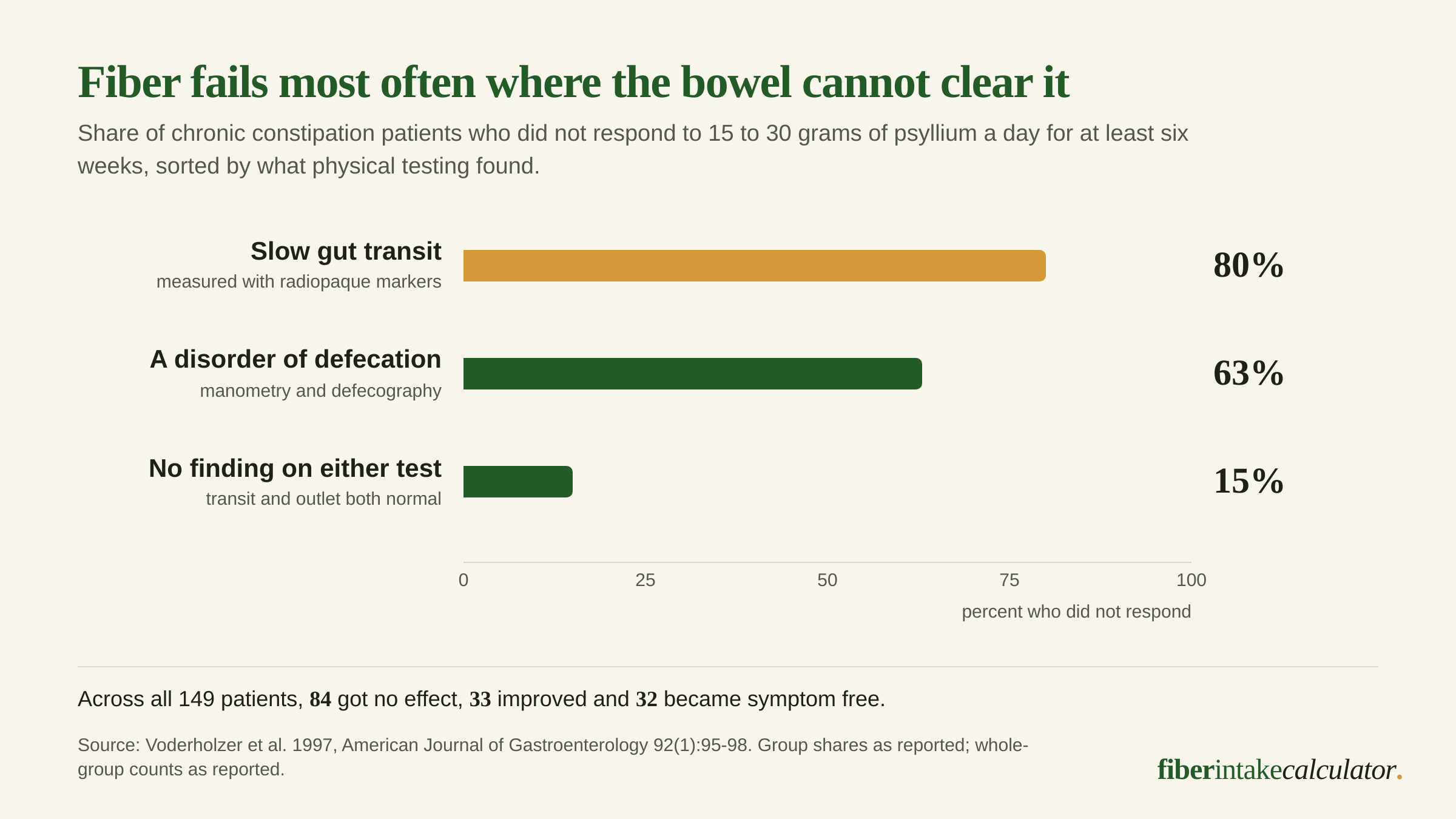
Yes, for a defined group, and the group has a number attached. In 149 patients with chronic constipation given 15 to 30 grams of psyllium a day for at least six weeks, 80% of those with slow gut transit and 63% of those with a disorder of defecation did not respond, against 15% of those whose transit and outlet both tested normal.
That is the honest shape of the answer. The variable is almost never how many grams. It is which of three bowels the grams arrive in.
The pages ranking for this question give three reasons instead: dehydration, excess bulk and increasing too fast. One of those survives the evidence, one is half right, and one has two trials against it. This page works through all three, then covers what to do if adding fiber made things worse. Your own daily target, if you want to know what you are measuring against, comes from the fiber calculator.
Which constipation you have decides the answer
About 20% of adults have chronic constipation, per University Hospitals. It is not one condition. Physical testing splits it into slow transit through the colon, a disorder of defecation at the outlet, and constipation where both tests come back normal.
Voderholzer and colleagues ran that split against fiber treatment in 1997, at two gastroenterology departments in Munich. Every patient got the same thing: psyllium seed, 15 to 30 grams a day, for at least six weeks. Then the results were sorted by what the transit studies, proctoscopy, manometry and defecography had found.
| What testing found | Did not respond | What fiber is being asked to do |
|---|---|---|
| Slow transit through the colon | 80% | Push more volume through a colon already moving too slowly to clear what is in it |
| A disorder of defecation | 63% | Pass bigger, bulkier stool through an outlet that is not coordinating properly |
| No finding on either test | 15% | Add bulk and water to a system that works, which is the job fiber is good at |
Across the whole group of 149, 84 patients got no effect, 33 improved and 32 became symptom free. More than half of everyone treated got nothing from six weeks of a fiber with the best trial record in constipation.
The rule the whole page rests on: fiber adds bulk and water to stool. That only helps a bowel that can move what it already holds. Where the problem is the moving rather than the making, more material is the wrong direction.
The study had no placebo arm, so the 15% figure includes anyone who would have improved anyway. What it does measure cleanly is the gap between the groups, which is the thing no page ranking for this question mentions. Our guide to fiber for constipation has the randomized evidence on the other side of the same question.
The three reasons the search results give, scored
Every top-ranking page on this question, and Google’s own summary of them, gives the same three mechanisms. Here is each one against the trial evidence.
| The claim | What the evidence shows | Verdict |
|---|---|---|
| "Fiber pulls water from your body, leaving stools hard and dry" | Extra fluid alone changed stool output not at all in 15 healthy volunteers. Extra fluid alongside 25 g of fiber did improve things. A review of constipation beliefs found no evidence fluid treats constipation unless the person is dehydrated. | Backwards. Water is a co-factor, not a drain |
| "Too much bulk overwhelms a sluggish bowel" | 80% of slow-transit patients and 63% of patients with a defecation disorder did not respond to six weeks of psyllium. In 63 patients already failing on a high-fiber diet, those who stopped it went from one bowel movement every 3.75 days to one a day. | Holds up, and it is the main mechanism |
| "Increasing too fast shocks your system" | Flatulence was significantly higher on fiber than control across 16 randomized trials, at a standardised mean difference of 0.80. No trial in that analysis tested the speed of the increase. | Half right. The gas is real, the gas is not constipation |
The third row is worth sitting with. Gas and bloating are what people actually feel when they add fiber quickly, and they are the symptoms every “too much fiber” list leads with. They are also a different thing from constipation. Fermentation produces gas by design, which is covered with the dose data on our page on pushing fiber intake high.
Water helps with the fiber, not instead of it
The dehydration explanation is the first reason Google’s summary gives and the one nearly every page repeats. Two trials bear on it directly, and no page ranking for this question cites either.
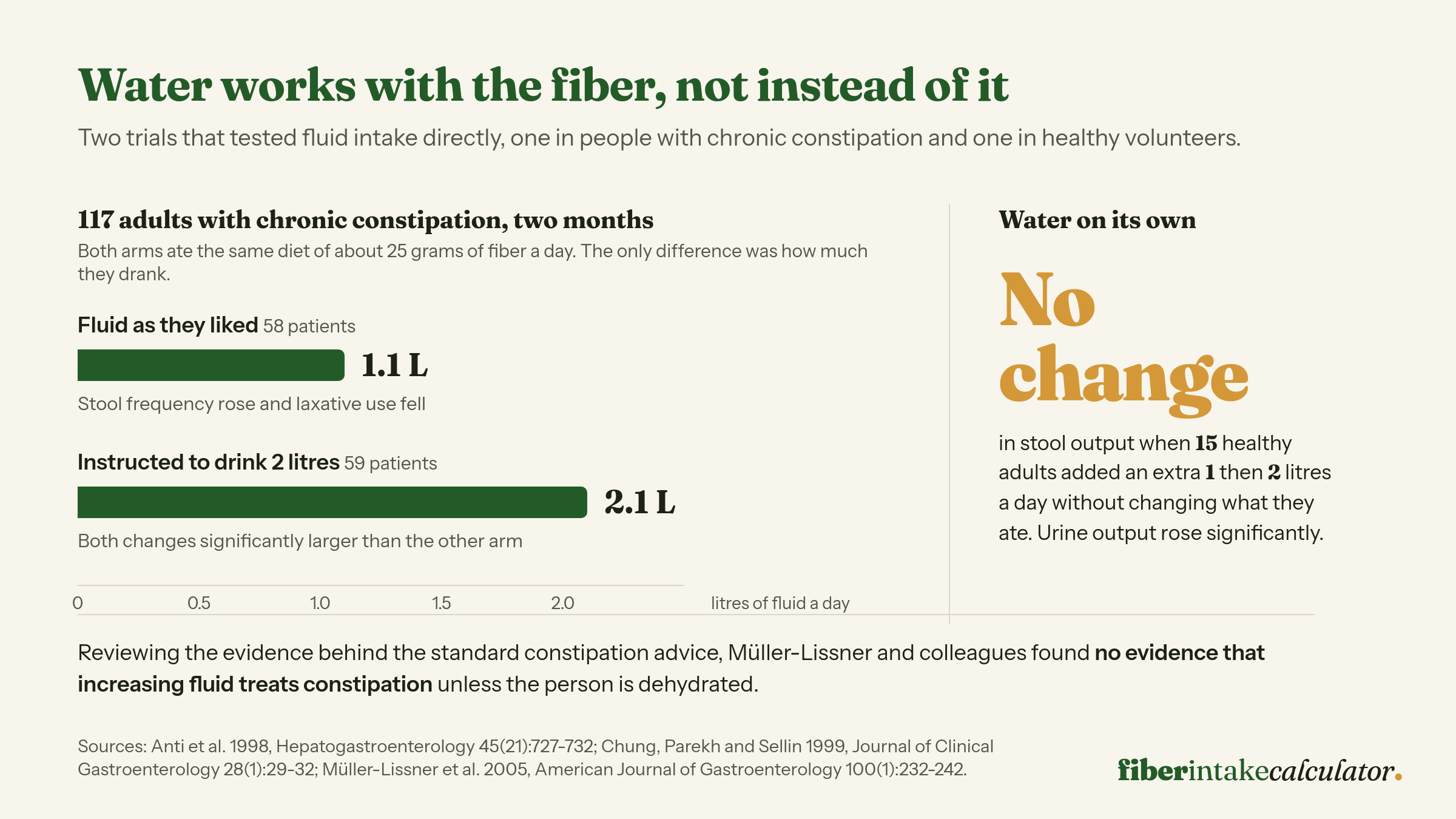
Water on its own did nothing. Chung, Parekh and Sellin gave 15 healthy volunteers an extra litre a day, then an extra two litres, without changing what they ate. Stool output did not change significantly. Urine output did.
Water alongside fiber did something measurable. Anti and colleagues randomised 117 adults with chronic functional constipation to the same diet of roughly 25 grams of fiber a day for two months. One arm drank what it liked and averaged 1.1 litres a day. The other was told to drink two litres and averaged 2.1. Both arms improved on stool frequency and laxative use. The two-litre arm improved significantly more on both.
Reviewing the beliefs that drive standard constipation advice, Müller-Lissner and colleagues put it plainly: there is no evidence that increasing fluid treats constipation unless the person is dehydrated.
What that means in practice. Drinking more water is not a remedy for fiber you have already eaten. It is a condition of the fiber working at all, and the only number any trial attaches to it is about two litres a day alongside the fiber. Drinking more while eating the same is the version with no evidence behind it.
No symptom list can tell you which group you are in
Every page on this question runs a “signs you are eating too much fiber” list. Bloating, cramping, early fullness, hard stools. The lists share a problem that has been tested directly.
Mertz, Naliboff and Mayer put 108 constipated patients through colon transit studies, anorectal manometry and rectal sensory testing, then checked whether their reported symptoms predicted what the testing found. Symptoms of slow transit did track colon transit, and symptoms matching irritable bowel syndrome did track rectal hypersensitivity. But pelvic floor symptom scores and straining correlated with no electromyographic or manometric measure of defecatory function at all. And patients with pelvic floor dysfunction, along with patients where nothing abnormal was found, had no specific symptoms distinguishing them.
Read those two findings together with the responder table above. The group fiber fails hardest is the group symptoms identify worst. A list of sensations cannot sort you into the box that decides whether more fiber is the right move, which is why a clinician orders a transit study instead of asking how bloated you feel.
Even where fiber works, a third of people do not respond
The strongest evidence on fiber for constipation is 16 randomized controlled trials pooled across 1,251 adults. It is a genuinely positive result, and it is worth reading precisely.
| Measure | Result | Condition attached |
|---|---|---|
| Responded on fiber | 311 of 473 66% | Significant effects came from psyllium and pectin only |
| Responded on control | 134 of 329 41% | Risk ratio 1.48, 95% CI 1.17 to 1.88 |
| Did not respond on fiber | 162 of 473 34% | Computed from the same counts |
| Number needed to treat | 4 | Computed from the 25 point gap between arms |
| Stool frequency | SMD 0.72 | Only at doses above 10 g a day, only at four weeks or longer |
| Stool consistency | SMD 0.32 | Only at higher doses |
| Flatulence | SMD 0.80 | Higher on fiber than control, a larger effect than any benefit |
Four people treated, one extra responder. That is a good result for a cheap, safe intervention, and it is also an honest answer to someone whose fiber is not working: a third of people in the trials were in the same position.
The two threshold rows matter more than they look. Nothing moved below 10 grams a day of supplemental fiber, and nothing moved on frequency inside four weeks. A fortnight of extra bran at six grams a day has not tested anything. Our fiber supplement comparison does the label arithmetic on what 10 grams means per product, which for most powders is several labelled doses.
What people add is mostly the bulking kind
There is one more reason adding fiber can go wrong, and it sits in what gets added. Told to eat more fiber, people reach for the standard list. Here is that list by what each serving actually delivers, from the published analyses behind our split table.
| Food | Serving | Insoluble (g) | Soluble (g) | Insoluble share |
|---|---|---|---|---|
| Apple, with skin | 1 medium | 3.4 | 1.0 | 77% |
| Pear, with skin | 1 medium | 4.0 | 1.5 | 73% |
| Avocado | half, 100 g | 4.6 | 2.1 | 69% |
| Black beans, cooked | 1/2 cup | 5.1 | 2.4 | 68% |
| Barley, cooked | 1/2 cup | 2.0 | 1.0 | 67% |
| Oat bran, cooked | 3/4 cup | 3.5 | 2.2 | 61% |
| Sweet potato, cooked | 1 medium | 2.0 | 1.8 | 53% |
| Oatmeal, cooked | 1 cup | 2.0 | 2.0 | 50% |
| Orange | 1 medium | 1.3 | 1.8 | 42% |
| Psyllium husk | 1 tbsp | 1.0 | 7.0 | 13% |
Nine of the 14 foods in our split table carry more insoluble than soluble fiber per serving and two are even. Psyllium sits at the far end at 13% insoluble, and psyllium is one of only two fibers with a significant effect in the pooled trials.
That is not an argument against eating apples. It is an observation about what the standard advice loads onto a bowel that is failing to clear what it has: mostly the bulking kind of fiber, which is the kind the Munich data says fails in two groups out of three. The full gram-level split is on our soluble and insoluble comparison, and the ranking by bulk alone is on our insoluble fiber page.
What to do if more fiber made it worse
Four things, in the order the evidence supports them.
Check the two variables with numbers attached first. Above 10 grams a day of supplemental fiber, four weeks or longer, about two litres of fluid a day alongside it. Most self-run fiber trials fail at least one of those and conclude the fiber does not work.
Change the kind before changing the amount. Psyllium and pectin were the two fibers with significant effects in the pooled trials. Coarse bran, wheat and whole grains are the ones that did not help irritable bowel with constipation. Highly fermentable fiber in rye, wheat, legumes, brassicas, apple and peach is what gastroenterologist Vu Nguyen names as the group most likely to produce cramping, bloating and gas, and the group to drop if those are your symptoms.
Consider that less may be the answer. Sixty-three patients with idiopathic constipation, all already on a high-fiber diet or supplements, were asked to stop fiber for two weeks and then eat as little as they found tolerable. Of the 41 still off it at six months, bowel frequency went from one motion every 3.75 days to one a day, and none reported bloating or straining. The study had no control group, no blinding, and everyone in it had already failed on fiber. We put those numbers beside the randomized evidence on our page asking whether fiber makes you poop, and our low-fiber diet guide covers what a deliberate reduction looks like in grams.
Stop self-managing at the right point. Constipation that has not improved after a proper trial of fiber and laxatives needs a clinician, not another diet change. So does constipation with rectal bleeding, abdominal pain or unexplained weight loss. The testing that sorts the three groups in the first table is not something you can approximate at home, and it is the only thing that answers this question for you specifically.
Where the numbers come from
The responder split is from Voderholzer and colleagues, 1997, in the American Journal of Gastroenterology, treating 149 chronic constipation patients with 15 to 30 grams of psyllium seed a day for at least six weeks. The randomized trial figures are from van der Schoot and colleagues, 2022, in the American Journal of Clinical Nutrition, pooling 16 trials in 1,251 adults; the non-response share and the number needed to treat are ours, computed from the responder counts that paper reports. The fluid trials are Chung, Parekh and Sellin, 1999, in the Journal of Clinical Gastroenterology, and Anti and colleagues, 1998, in Hepatogastroenterology. The verdict on fluid is from Müller-Lissner and colleagues, 2005, in the American Journal of Gastroenterology. The symptom and physiology comparison is Mertz, Naliboff and Mayer, 1999, in the same journal. The reducing-fiber cohort is Ho and colleagues, 2012, in the World Journal of Gastroenterology. The clinical cautions and the 20% prevalence figure are from University Hospitals, 2024, quoting gastroenterologist Vu Nguyen. Per-food soluble and insoluble grams are compiled from Anderson and Bridges 1988, Marlett 1992 and Li and colleagues 2002, because USDA FoodData Central publishes total fiber only. Full references sit on our sources page, and how every number is computed and checked is on our methodology page.
Frequently asked questions
Can too much fiber cause constipation?
For some people, yes, and the evidence puts numbers on who. Voderholzer and colleagues treated 149 patients who had chronic constipation with 15 to 30 grams of psyllium a day for at least six weeks, then sorted the results by what physical testing showed. Among patients with slow gut transit, 80 percent did not respond. Among patients with a disorder of defecation, 63 percent did not respond. Among patients whose transit and outlet both tested normal, 85 percent improved or became symptom free. The amount of fiber is rarely the variable. What the fiber lands on is.
Why am I constipated even though I am eating a lot of fiber?
Three explanations fit, and they are testable rather than guessable. The first is that the fiber cannot help your type of constipation: in the study above, more than half of all 149 patients got no effect from six weeks of psyllium. The second is dose and time. Across 16 randomized trials in 1,251 adults, response only separated from control at doses above 10 grams a day, and stool frequency only improved in trials running four weeks or longer. The third is that the fiber you added is the bulking kind, which needs a bowel that can already clear what is in it. A clinician can distinguish the first from the other two, and that distinction is what transit testing exists for.
How do you fix constipation caused by too much fiber?
Start by checking the two variables that have trial numbers attached. Fluid is one: in 117 constipated adults eating about 25 grams of fiber a day, the arm that drank 2.1 litres a day improved significantly more than the arm that drank 1.1 litres. Time is the other: nothing in the pooled trial data moved stool frequency in under four weeks. If those are both already covered, reducing fiber is the step with published evidence behind it. In 63 patients with idiopathic constipation who were already on a high-fiber diet, the 41 who stopped fiber entirely went from one bowel movement every 3.75 days to one a day at six months. That study had no control group, so treat it as a reason to talk to a clinician rather than a plan to run alone.
How can you tell if constipation is from too much fiber?
From symptoms alone you cannot, and that is a finding rather than an opinion. Mertz and colleagues put 108 constipated patients through colon transit studies, anorectal manometry and rectal sensory testing, then checked whether their symptoms matched the physiology. Straining and pelvic floor symptom scores correlated with no manometric or electromyographic measure of defecatory function, and the two groups that respond worst to fiber had no distinguishing symptoms at all. Every 'signs of too much fiber' list runs on symptoms that the testing says do not separate these groups. Counting grams for a week and testing, if a clinician thinks it is warranted, answers the question. Bloating does not.
Can too much fiber cause a bowel blockage?
It is rare, and the conditions under which it is a real risk are specific. Dry bulk-forming fibers swell: under federal rule 21 CFR 201.319, any dry-form product with psyllium, methylcellulose, guar gum, glucomannan or polycarbophil as its active ingredient has to carry a direction to take each dose with at least 8 ounces of liquid and a choking warning. Separately, in active Crohn's disease, insoluble fiber is not recommended where a blockage or stricture is suspected, as University Hospitals gastroenterologist Vu Nguyen puts it. If you have a known stricture, previous bowel surgery, or severe abdominal pain with vomiting, this is a question for a clinician before it is a question about diet.
Built and maintained by the FiberIntake team, with data from USDA FoodData Central and peer-reviewed sources. Figures are checked against the cited source before publish. About this site →