Does Fiber Make You Poop?
Last updated: September 28, 2026
Yes. Across 12 randomized controlled trials in 966 adults, adding fiber produced 1.19 more bowel movements a week than control. Two conditions sit under that number, and both get left out of the short answer: the effect only appeared above 10 grams a day, and only in trials that ran four weeks or longer.
Below that dose, or before that fourth week, the trials measured nothing.
This page covers what the measured answer looks like: how much more, how fast, and which fibers actually do it. If you want your own daily number first, the fiber calculator computes it from your height, weight, age and activity.
How much more, exactly
The current meta-analysis pooled 16 randomized trials in 1,251 adults with chronic constipation. Here is everything it measured, in the units the trials used.
| What was measured | Effect against control | Is it real? |
|---|---|---|
| Bowel movements a week, all fiber | +1.19 | Yes, 95% CI 0.59 to 1.78 |
| Bowel movements a week, psyllium | +3.08 | Yes, 95% CI 0.61 to 5.54 |
| Bowel movements a week, above 10 g a day | +1.60 | Yes, 95% CI 0.71 to 2.48 |
| Bowel movements a week, 10 g a day or less | 0 | No significant change |
| People who responded | 66% vs 41% | Yes, RR 1.48 (95% CI 1.17 to 1.88) |
| Stool consistency | SMD 0.32 | Yes, 95% CI 0.18 to 0.46 |
| Whole gut transit time | -7.5 hours | No, 95% CI -18.1 to 3.1 |
| Flatulence | SMD 0.80 | Yes, and higher on fiber |
Two of those rows deserve reading twice. Two thirds of people on fiber responded against four in ten on control, which is a real and useful difference. And fiber did not significantly change how long food takes to travel through the gut, which is the thing most people assume fiber is doing.
The dose that worked was more than 10 grams a day of added fiber. That is roughly half a cup of cooked navy beans, or a third of a cup of crude wheat bran, on top of whatever you already eat. Our page on fiber for constipation converts every trial dose into single servings.
How fast: nothing in the first four weeks
“How quickly does fiber make you poop” is the most searched follow-up to this question, and none of the pages ranking for it prints a number. The trial data does, and it is slower than the question expects.
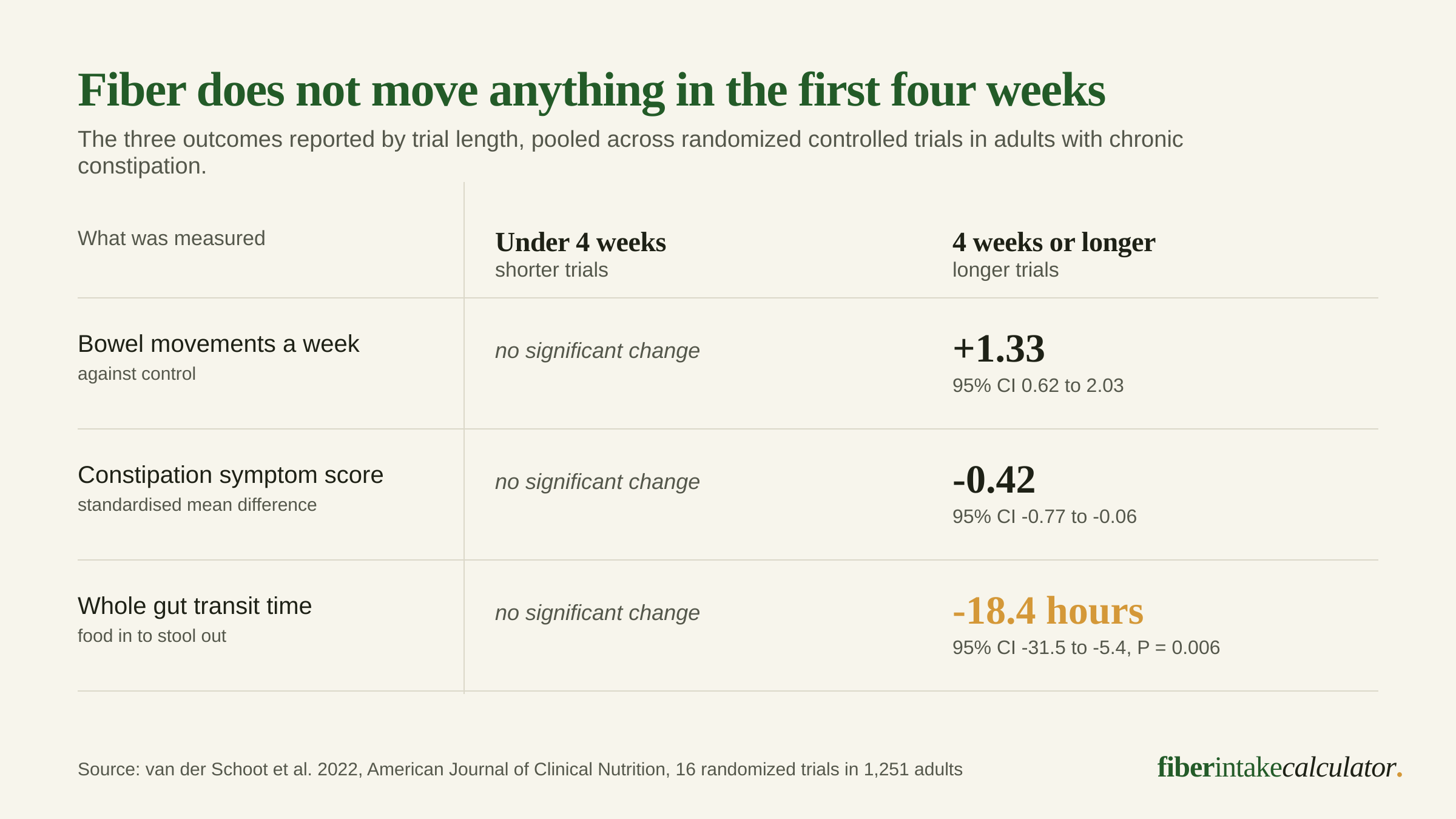
| Outcome | Trials under 4 weeks | Trials 4 weeks or longer |
|---|---|---|
| Bowel movements a week | No significant change | +1.33 |
| Constipation symptom score | No significant change | SMD -0.42 |
| Whole gut transit time | No significant change | -18.4 hours |
The transit time row is the clearest version of the point. Pooled across all trial lengths, fiber did not significantly move transit time at all. Restrict the analysis to trials that ran at least four weeks and it fell by 18.4 hours, most of a day, at P = 0.006.
So the change is real, and it is large, and it is not visible in week one. Anyone judging a fiber change after three days is reading noise. Give it the four weeks the trials gave it before deciding it failed.
That also reframes the gas most people quit over. The bloating usually arrives in the first week, which is exactly the window in which the benefit has not arrived yet. The order of events, not the size of either one, is what makes people give up.
Not every fiber does this
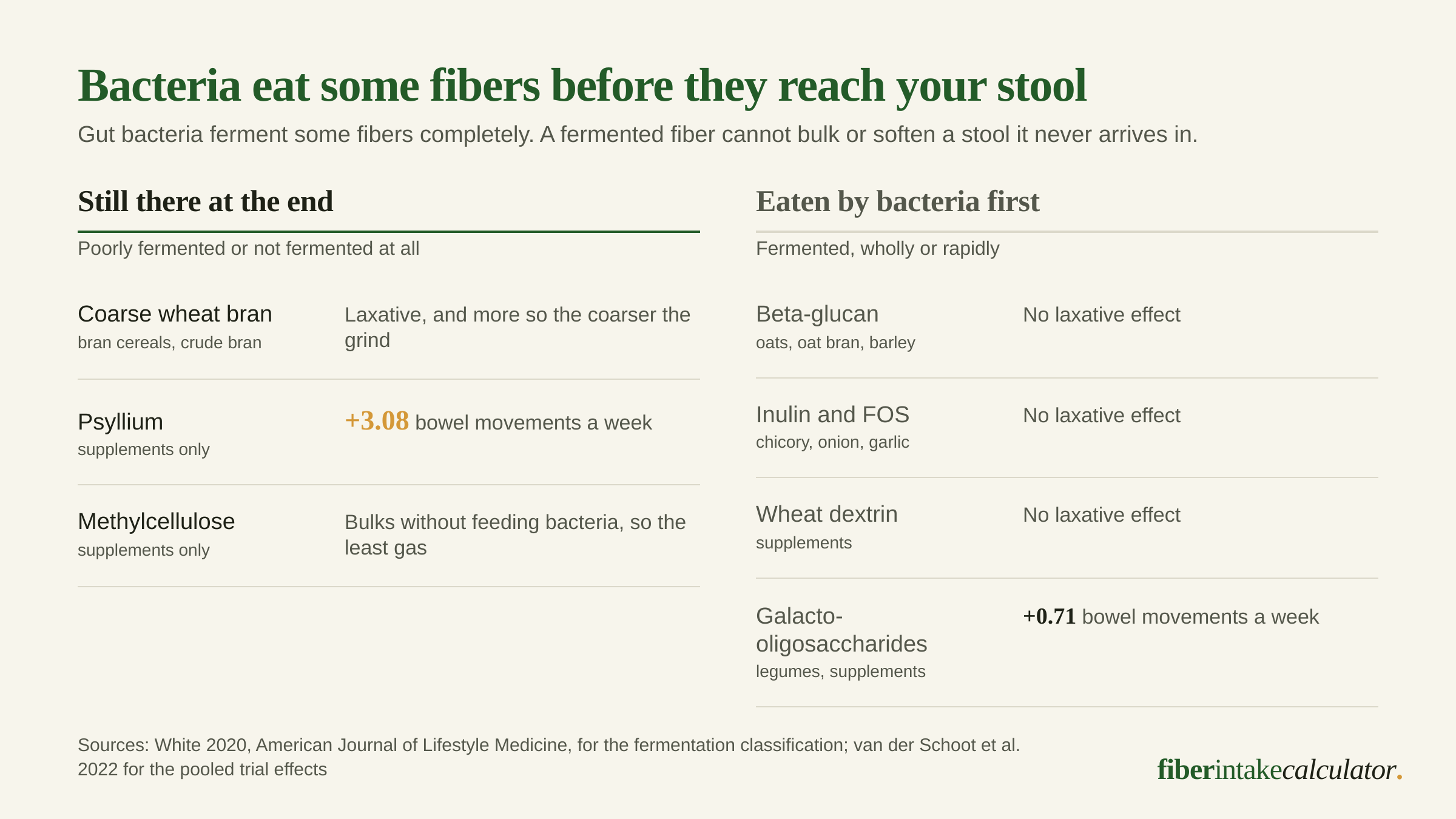
Here is the part the short answers skip. A fiber can only bulk or soften a stool if it is still in the stool. Gut bacteria ferment some fibers completely, and once a fiber is fermented it is gone: what remains is short-chain fatty acids and gas, not bulk.
A 2020 review in the American Journal of Lifestyle Medicine is direct about which is which. Coarse wheat bran is poorly fermented, so it survives the whole length of the bowel; its large rough particles irritate the gut lining, which increases water and mucus secretion, which raises stool water and shortens transit. The effect scales with particle size, so a coarse grind works better than a fine one. Psyllium gets there by a different route: it is soluble and forms a gel, but it is not fermented, so it also arrives intact.
The fibers on the other side of that line are the ones the same review says do not produce this benefit at all: wheat dextrin, inulin, guar gum, and the beta-glucan in oats.
The randomized trials agree, from a completely different direction. Psyllium moved stool frequency by 3.08 bowel movements a week. Galacto-oligosaccharides, a rapidly fermented prebiotic fiber, moved it by 0.71. Polydextrose and galacto-oligosaccharides together had no significant effect on stool consistency at all. Two independent lines of evidence, mechanism and trial, rank the fibers the same way.
The split is a gradient, not a switch. That +0.71 from a fermented fiber is a real result, and it is about a quarter of psyllium's. Fermented fibers are not useless; they are simply not the ones to reach for when the goal is regularity. What they are good for is the subject of our page on fiber and gut health, where being eaten by bacteria is the entire point.
Note where this leaves oats and beans. Both appear on nearly every page answering this question, including Google’s own summary, as the soluble fiber that softens stool. Oat beta-glucan is on the fermented list. Beans are on most gastroenterologists’ list of foods that worsen bloating. They are genuinely good foods and they raise your daily total, which is why they sit near the top of our high-fiber whole grains ranking and our bean and legume tables. They are just not the strongest pick for this particular job.
The pages ranking for this question disagree with each other
Read the top ten results and you get two incompatible mechanisms, stated with equal confidence and no citations on either side.
| Source | What it says soluble fiber does | What it says insoluble fiber does |
|---|---|---|
| Google AI Overview | Dissolves into a gel, softens stool | Adds weight and bulk, speeds transit |
| Johns Hopkins Medicine | Forms a gel, softens stool, raises frequency | Passes undigested, adds bulk, stimulates movement |
| University Hospitals | Forms a gel, softens stool, raises frequency | Adds stool bulk, stimulates movement |
| Healthline | Absorbs water, softens stool | Bulks stool, sweeps the bowel |
| Nebraska Medicine | Adds bulk, prevents diarrhea | Holds water, softens stool, for constipation |
The last row is the highest-ranking page for this exact query, and it assigns both roles the other way round from everyone above it. A reader who lands there and follows the advice is told to eat insoluble fiber for constipation and soluble fiber for diarrhea, which is the reverse of what the other four say.
The resolution is that the argument is about the wrong axis. Solubility predicts whether a fiber dissolves; it does not predict whether the fiber survives to the colon, and survival is what decides laxation. A non-fermented insoluble bran and a non-fermented soluble gel both raise stool water. A fermented soluble fiber does neither. That is why our separate pages on soluble fiber and insoluble fiber lead with what each one is measured to do rather than with the definition. The same survival test decides the other fiber claims too, and our explainer on what fiber actually does runs it across all of them with the effect size attached to each.
Can fiber make you poop less?
Ranking ninth for this exact question is a 2012 paper whose title is the opposite of the AI Overview’s answer: “Stopping or reducing dietary fiber intake reduces constipation and its associated symptoms.” No page above it mentions that it exists.
Sixty-three adults with idiopathic constipation, organic causes excluded by colonoscopy, all already on a high-fiber diet or fiber supplements. They stopped fiber for two weeks, then reduced to whatever level they could tolerate. At six months:
| Group | Before | After | In bowel movements a week | Bloating | Straining |
|---|---|---|---|---|---|
| Stopped fiber (41 patients) | Every 3.75 days | Every day | 1.87 to 7.00 | 0% | 0% |
| Reduced fiber (16 patients) | Every 4.19 days | Every 1.9 days | 1.67 to 3.68 | 31.3% | 43.8% |
| Stayed high fiber (6 patients) | Every 6.83 days | Every 6.83 days | 1.02, unchanged | 100% | 100% |
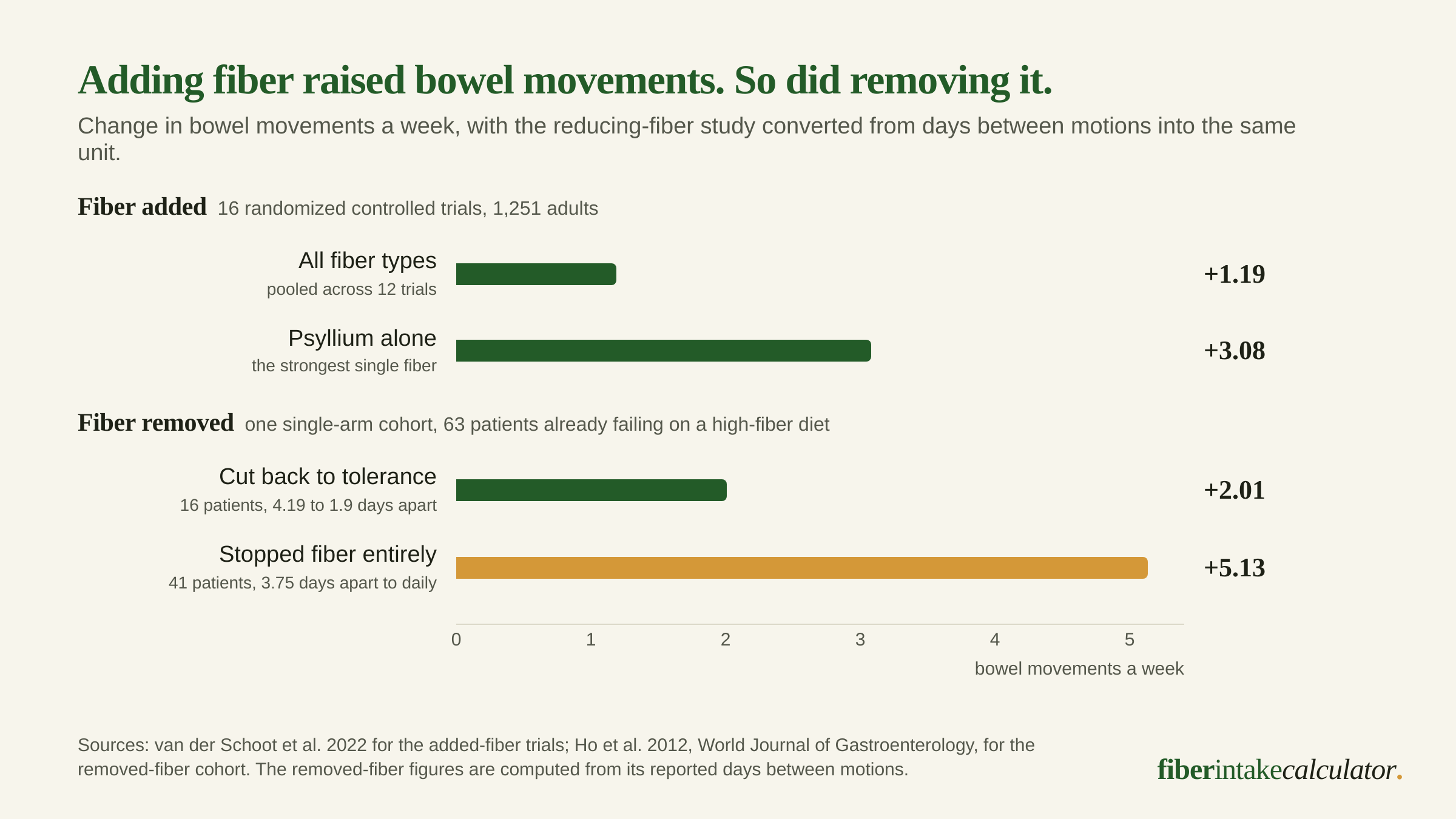
Converted into the same unit as the meta-analysis, stopping fiber gained 5.13 bowel movements a week. Adding fiber, across 12 randomized trials, gained 1.19. Nobody has put those two numbers side by side before, so it is worth saying clearly what the comparison does and does not mean.
It does not mean stopping fiber beats adding it. The 2012 study had no control group, no blinding, and no randomization, and every patient in it had already tried a high-fiber diet and was still constipated. That is a selected group by definition: people for whom fiber had demonstrably not worked. Put 63 such patients against 1,251 adults in 16 randomized trials and the trials carry the weight.
What it does mean is that the subgroup is real and worth recognising. If you are already eating a lot of fiber, already bloated, already straining, and have been for months, more fiber is a poor next move, and there is published evidence that less can help. A separate study put a size on that subgroup by testing people rather than asking them: of 149 chronic constipation patients given psyllium for six weeks, 80% of those with slow gut transit did not respond. Our page on whether too much fiber can cause constipation works through that split and the fluid trials behind the usual water advice. The same conclusion arrives from the clinical side: gastroenterologists note that highly fermentable fiber in rye, wheat, legumes, brassicas, apples and peaches can worsen cramping and gas in exactly these patients. Our low-fiber diet guide covers what a deliberate reduction looks like, and it is a conversation to have with a clinician rather than an experiment to run alone.
What the gas is telling you
Flatulence was significantly higher on fiber than on control, at a standardised mean difference of 0.80. That is a large effect, larger than any of fiber’s benefits in the same analysis.
It is also not a sign of doing it wrong. Gas is the by-product of fermentation, so a fermentable fiber producing gas is the mechanism working as designed. What makes it unpleasant is speed: a jump from a typical 17 grams a day to 35 gives the gut bacteria far more substrate than they are used to processing, all at once.
Two things make it manageable. Ramp slowly, adding a few grams a week rather than a day, which is the approach our page on pushing fiber intake high sets out week by week. And take dry fiber with water: any supplement sold in dry form with psyllium, methylcellulose, guar gum, glucomannan or polycarbophil as its active ingredient is required under federal rule to carry the direction to take each dose with at least 8 ounces of liquid, alongside a choking warning. That rule exists because these fibers swell.
If a supplement is how you are adding the grams, which fiber is on the label decides whether any of this applies. Our fiber supplement comparison reads the Supplement Facts panel on twelve products and sorts them by the same fermented and non-fermented split used above.
Where the numbers come from
The trial figures are from van der Schoot and colleagues, 2022, in the American Journal of Clinical Nutrition, pooling 16 randomized controlled trials in 1,251 adults with chronic constipation. The reducing-fiber figures are from Ho and colleagues, 2012, in the World Journal of Gastroenterology; the conversions into bowel movements a week are ours, computed by dividing seven by the days between motions the paper reports. The fermentation classification is from White, 2020, in the American Journal of Lifestyle Medicine, which declares no funding and no conflicts of interest. Food figures are from USDA FoodData Central, read in September 2026. Full references sit on our sources page, and the way we compute and check every number is on our methodology page.
Frequently asked questions
How quickly does fiber make you poop?
Slower than almost anyone expects. In the pooled trial data, trials shorter than four weeks found no significant change in stool frequency, no significant change in symptom scores, and no significant change in whole gut transit time. At four weeks or longer all three moved, with transit time falling by 18.4 hours. The honest answer to whether fiber will make you poop today is that the trials were not able to detect it that fast.
Does fiber act as a laxative?
Some fibers do and some do not, and the dividing line is not the one most articles use. Coarse wheat bran and psyllium reach the colon largely intact and both raise stool water content, so both act as laxatives. Fibers that gut bacteria ferment completely, including the beta-glucan in oats, inulin, wheat dextrin and guar gum, are no longer present in the stool by the time it forms, and a 2020 review in the American Journal of Lifestyle Medicine states plainly that they do not provide that benefit.
Can fiber make you poop less?
In one group of patients it did the opposite of what you would expect. Ho and colleagues followed 63 adults with idiopathic constipation who were already on a high-fiber diet or fiber supplements. The 41 who stopped fiber completely went from one bowel movement every 3.75 days to one every day, and none of them reported bloating or straining at six months. That study had no control group and no blinding, and everyone in it had already failed on fiber, so it identifies a subgroup rather than overturning the 16 randomized trials that point the other way.
What are the symptoms of too much fiber?
Gas first. Flatulence was significantly higher on fiber than on control in the pooled trials, with a standardised mean difference of 0.80, which is a large effect. Bloating and cramping follow the same mechanism, since fermentable fiber feeds the bacteria that make the gas. Constipation itself is the one people find surprising: a gel-forming fiber needs water to move, so a large dose taken dry can slow things down rather than speed them up.
Does mushy poop mean not enough fiber?
Not on its own. Fiber shifts stool consistency toward the middle of the range rather than in one direction, which is why the pooled consistency effect in constipated patients is a modest standardised mean difference of 0.32. A persistent change in how your stool looks is worth raising with a clinician rather than treating as a fiber problem, especially if it arrived suddenly or comes with bleeding, weight loss or pain.
Built and maintained by the FiberIntake team, with data from USDA FoodData Central and peer-reviewed sources. Figures are checked against the cited source before publish. About this site →