Soluble Fiber Calculator
Last updated: September 23, 2026
Pick what you ate today
Add a serving to start.
Seven grams a day is the number worth aiming at, and one tablespoon of psyllium husk carries all seven. That threshold comes from 21 CFR 101.81, the regulation that lets a food claim reduced heart-disease risk on the strength of its soluble fiber. From food alone it takes a day built around oats, beans and citrus: a cup of cooked oatmeal, half a cup of kidney beans and one orange come to 6.7 grams of soluble fiber, out of 12.8 grams of total fiber.
The calculator above counts that for you. Every food shows its soluble grams before you pick it, so the arithmetic is yours to check, and the result names the single food that closes whatever gap is left.
The short version. Aim for 7 g a day of soluble fiber. Psyllium is the fastest gram-for-gram, oats and beans the easiest to eat daily. Your food label will not tell you the number, because panels declare total fiber only.
Every figure here is cited to the regulation or paper it comes from, listed in full on our sources page. The food values are the same peer-reviewed split analyses behind our soluble fiber table.
How much soluble fiber per day?
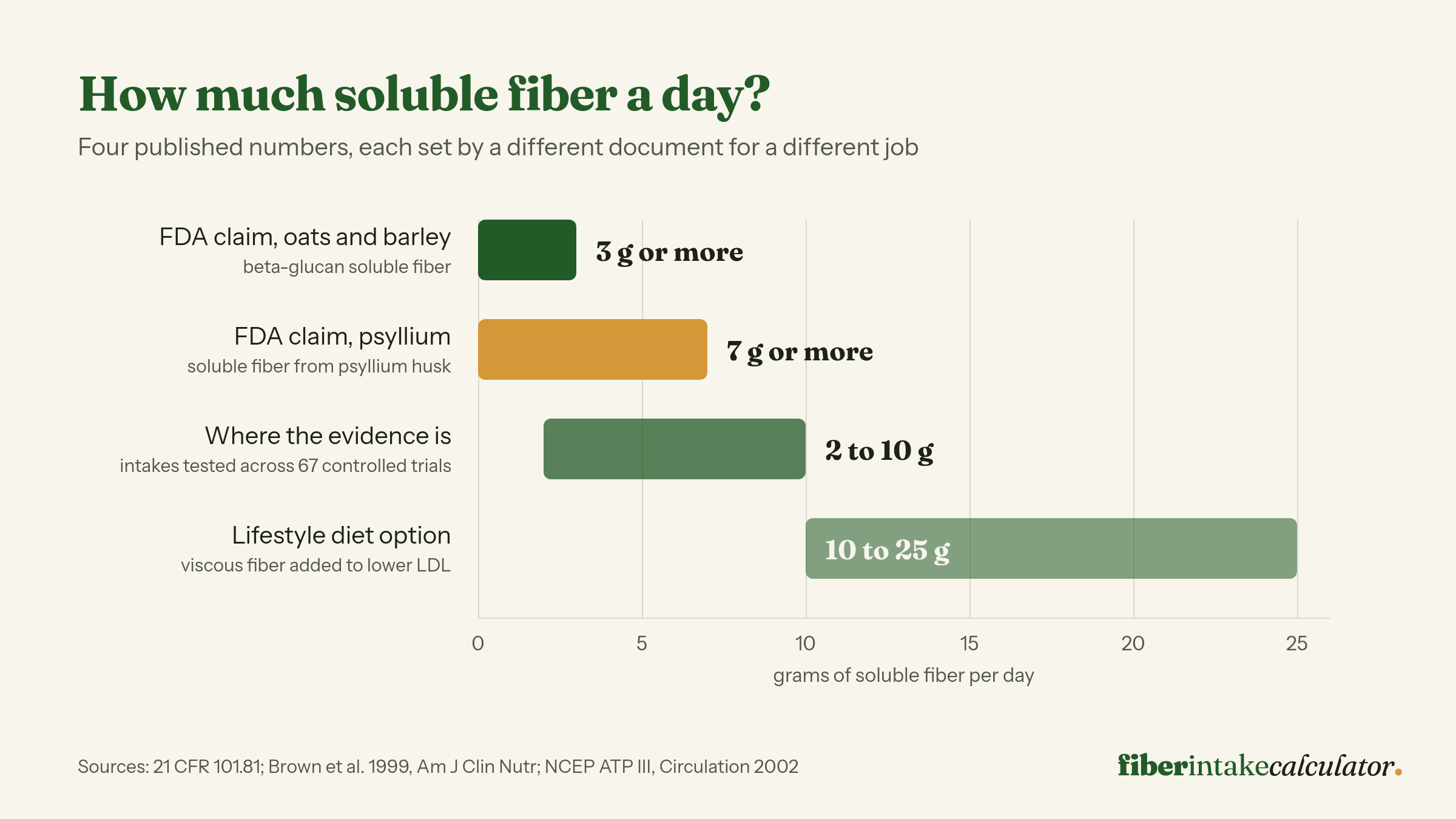
Four numbers circulate, and they disagree because they answer different questions.
| Daily amount | What it actually is | Set by |
|---|---|---|
| 3 g | Beta-glucan soluble fiber from whole oats or barley, the level a food must supply before it may carry the heart-disease claim | 21 CFR 101.81 |
| 7 g | Soluble fiber from psyllium seed husk, the same claim on a different fiber | 21 CFR 101.81 |
| 2 to 10 g | The range of intakes tested across 67 controlled trials, so the range over which the cholesterol effect is measured rather than assumed | Brown et al. 1999 |
| 10 to 25 g | Viscous soluble fiber listed as a therapeutic option in the lifestyle diet for lowering LDL cholesterol | NCEP ATP III, 2002 |
Two of those are label rules. A regulation has to name a level a manufacturer can be held to, which is why 7 grams is a sharp number rather than a range. One is a research finding. One is clinical advice written for people already being treated for high cholesterol.
None of them is a recommended intake in the way 25 or 38 grams of total fiber is. The Institute of Medicine sets Adequate Intakes for total dietary fiber only, and there is no official target for the soluble fraction on its own. Get your total number from the daily fiber calculator first; soluble fiber is a goal you layer on top of it, not a replacement.
What each gram is worth
The cholesterol effect has a size. Pooling 67 controlled trials, Brown and colleagues found LDL cholesterol falls 0.057 mmol/L for every gram of soluble fiber a day (95% confidence interval 0.044 to 0.070), which is about 2.2 mg/dL per gram.
| Soluble fiber per day | Estimated LDL change | In mg/dL |
|---|---|---|
| 3 g | 0.17 mmol/L | 6.6 |
| 5 g | 0.29 mmol/L | 11.0 |
| 7 g | 0.40 mmol/L | 15.4 |
| 10 g | 0.57 mmol/L | 22.0 |
The table stops at 10 grams on purpose. Those trials tested 2 to 10 grams a day, so beyond 10 the per-gram figure is an extrapolation nobody has measured. The calculator above stops counting at the same point.
These are averages across trial populations, not a forecast for one person. Fiber is also one lever among several: the same lifestyle diet that lists viscous fiber pairs it with saturated fat under 7% of calories and plant stanols. Cholesterol treatment is a conversation with a clinician, and a bowl of oatmeal is not a substitute for one.
How to reach 7 grams from food
Only psyllium gets there in a single serving. Everything else is addition.
| Food | Serving | Soluble fiber | Servings to reach 7 g |
|---|---|---|---|
| Psyllium husk | 1 tbsp | 7.0 g | 1 |
| Kidney beans, cooked | 1/2 cup | 2.9 g | 2.4 |
| Black beans, cooked | 1/2 cup | 2.4 g | 2.9 |
| Oat bran, cooked | 3/4 cup | 2.2 g | 3.2 |
| Avocado | half | 2.1 g | 3.3 |
| Oatmeal, cooked | 1 cup | 2.0 g | 3.5 |
| Orange | 1 medium | 1.8 g | 3.9 |
| Sweet potato, cooked | 1 medium | 1.8 g | 3.9 |
| Pear, with skin | 1 medium | 1.5 g | 4.7 |
| Flaxseed, whole | 1 tbsp | 1.1 g | 6.4 |
| Carrots, cooked | 1/2 cup | 1.1 g | 6.4 |
| Barley, cooked | 1/2 cup | 1.0 g | 7 |
| Brussels sprouts, cooked | 1/2 cup | 1.0 g | 7 |
| Apple, with skin | 1 medium | 1.0 g | 7 |
Mixing beats repeating. Oatmeal, half a cup of kidney beans and an orange reach 6.7 grams; add half a cup of cooked carrots and the day closes at 7.8 grams of soluble fiber and 15.1 grams of total fiber. Swap the kidney beans for black beans and the soluble total drops to 5.9 while the total fiber climbs to 17.0, which is the whole point of counting the two separately.
Beans do the heaviest lifting per serving, and the spread inside the group is wide enough to matter: our ranking of legumes by fiber sorts them on total grams, where navy and white beans lead. Lentils are the legume that is missing from the picker above, because the published soluble values for them range from 0.6 to 2.8 grams a half cup; soluble fiber in lentils sets each source against USDA’s total and explains which end to trust. Among grains, oats and barley are the two carrying beta-glucan, and a cooked cup of pearled barley brings 6.0 grams of total fiber in our whole grains ranking.
Why the label will not tell you
Nutrition Facts panels must declare total dietary fiber. The soluble and insoluble lines are voluntary, so almost no packaged food carries them. That is also why USDA FoodData Central has no soluble column to look up: the split values on this page come from laboratory analyses published between 1988 and 2002, described in full in our methodology.
Supplement panels are the exception, and they introduce their own trap. A psyllium powder that lists 2 grams of soluble fiber per rounded teaspoon is not contradicting the 7 grams a tablespoon in the table above. Three teaspoons make a tablespoon, and label values are rounded to the nearest gram, so the tub understates what the powder carries. Our comparison of the best fiber supplements works through what each panel means in doses per day.
The one-third rule does not hold
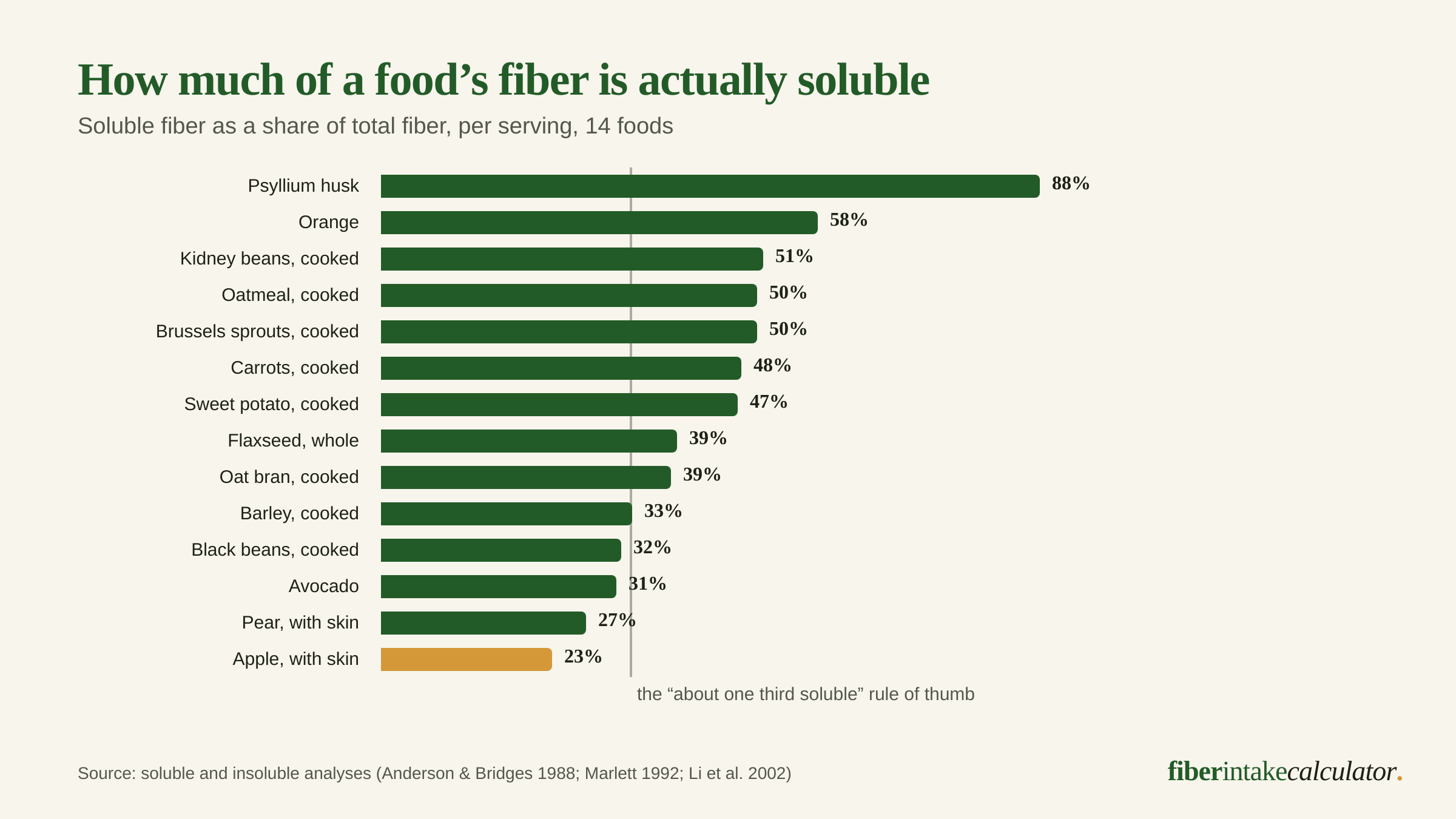
The standard shortcut says plant foods run about one third soluble to two thirds insoluble, so you can estimate the soluble grams from the total. Set psyllium aside and the 13 whole foods above come to 38.8% soluble (21.9 grams of soluble fiber out of 56.5 total), with the middle food at 39%. The shortcut understates, and not by a fixed amount.
It also fails in the wrong places. An orange is 58% soluble, the highest of any whole food here. An apple with the skin, the food named on almost every soluble fiber list, is 23%, the lowest. Scale an apple’s 4.4 grams of total fiber by one third and you credit yourself 1.5 grams of soluble fiber when the apple carries 1.0.
That is the case for counting the soluble column rather than scaling the total, and for reading the insoluble side of the same table when the goal is bulk rather than cholesterol. The two fibers do different jobs, which is why psyllium’s gel survives all the way through the colon and leads the pooled trial results on fiber for constipation while wheat bran does not.
Frequently asked questions
How much soluble fiber should I eat per day?
There is no Adequate Intake for soluble fiber on its own; the Institute of Medicine sets 25 to 38 grams for total fiber. The usable number is 7 grams a day, the level FDA ties to its psyllium heart-disease claim in 21 CFR 101.81. The lifestyle diet in the NCEP adult cholesterol report lists 10 to 25 grams of viscous fiber a day as a therapeutic option, and the trials that measured the cholesterol effect tested 2 to 10 grams a day.
How do I get 10 grams of soluble fiber a day?
Two tablespoons of psyllium husk get there alone, at about 7 grams each. From food it takes four or five servings: a cup of cooked oatmeal (2.0 g), half a cup of kidney beans (2.9 g), an orange (1.8 g), half an avocado (2.1 g) and half a cup of cooked carrots (1.1 g) come to 9.9 grams. Build the day in the calculator above and it names the food that closes whatever is left.
What is the best soluble fiber for lowering cholesterol?
Psyllium husk. It carries an FDA heart-disease claim at 7 grams a day of soluble fiber, and one tablespoon of the husk holds about that much, which no whole food comes close to. Beta-glucan from whole oats and barley has its own claim at 3 grams a day. Both are viscous fibers, which is the property that binds bile acids.
Do nutrition labels show soluble fiber?
Rarely. Nutrition Facts panels must declare total dietary fiber; the soluble and insoluble lines are voluntary, so most packages leave them off. Supplement panels often do split them, which is why a psyllium tub is easier to count than a loaf of bread.
Is a soluble fiber calculator accurate?
Within the limits of the underlying analyses. USDA FoodData Central measures total fiber only, so every soluble figure anywhere, ours included, traces back to laboratory analyses of a few dozen foods published between 1988 and 2002. Treat the total as an estimate good to about a gram, not a lab value.
Built and maintained by the FiberIntake team, with data from USDA FoodData Central and peer-reviewed sources. Figures are checked against the cited source before publish. About this site →